Category Archives: Photography, Reflections

Siren Song : an Exhibition

Beyond, in space, desert brush is green.
before, in time, brush and green
were wind, the sun, the earth

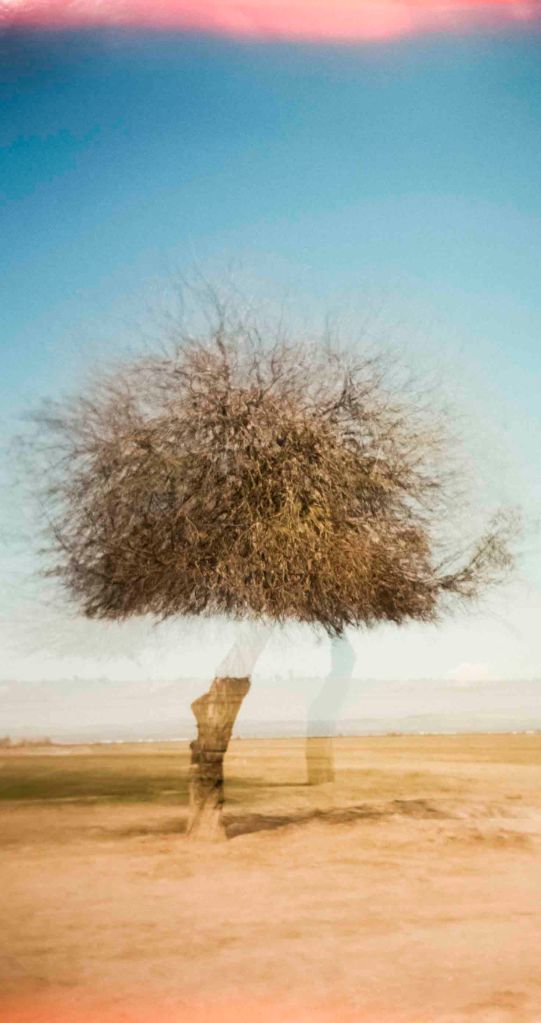
I was introduced to the Salton Sea, California, through the film, “Plagues & Pleasures on the Salton Sea,” and first visited there a few years later, in 2015. I returned another seven times over four years, for a total of seventeen weeks. Time allowed me to become more intimately acquainted with this place and, through photography, I was able to reveal the region through layers so as to give an intimate, emotive impression of what I was seeing.

Because of the pandemic in 2020 my photography project came to an end. As I thought about the work I began to envision the photographs as a book that would also include poems that I had written at night in my motel room, irrespective of the photos I had taken during the day. I researched small photobook publishers and was lucky to find Emily Macaulay of Stanley James Press. Emily designed the book with me and she managed the photo printing. She created the letterpress printed text pages and hand stitched / bound this oversized book in an edition of 75 copies. I did not imagine, when the book was completed in October 2023, that I would turn this project into an exhibition.
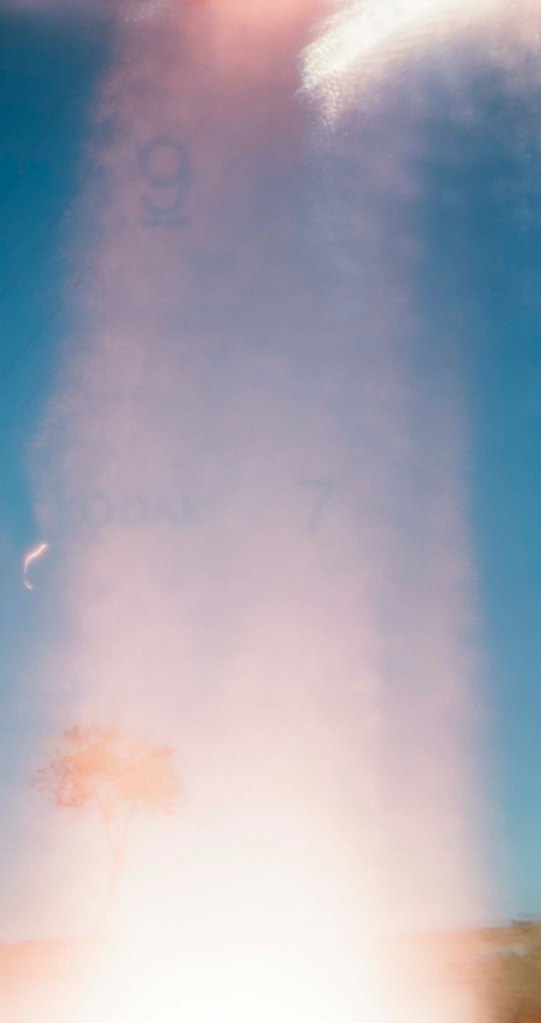
Last year, however, I had the opportunity to submit a proposal to the Victoria Hall Gallery, in Westmount, Quebec, and this exhibition was the product: a photo installation with words and sound. It ran from April 11 until May 12.

The photographs in the main gallery space were printed on large sheets of paper (32.5″ x 43.5″ and 41.5″ x 78.5″), and tacked to the wall, unframed, in order to create a more bodily experience. Photographs in an auxiliary space were smaller, more documentary in nature and, framed. I recorded the sound environment around the Salton Sea because, to me, sound is an integral part of the landscape. Gisela Fulla Silvestre, a sound editor and re-recording mixer, let the natural sounds lift the emotional narrative for this exhibition. The poems and sound track in the main area were critical as different ways to enter, feel, and understand the installation. They added another dimension and layer to the work. Sound, words and photographs came together to help visitors become more immersed or absorbed in the work and world of the Salton Sea.

The town is in the middle of the desert. 
The house is in the middle of town.
Its call is always the same,

"Come home. Come home."
It’s hot. It’s sunny. 
Few clouds.
Bone and stone become one,
here.
A fragment of memory. 
Familiar in this unexpected setting.
There is solace.

And now to toot my horn – here is a review in the Westmount Independent :

And here is (a poor) video of the exhibition but nonetheless a documentation of it :

The Fence 8th Edition, New England Regional Showcase in Boston, 2020

Siren Song

I am pleased to say that work from my ongoing project, Siren Song (photos taken at the Salton Sea in California), has been chosen for the The Fence: New England Regional Showcase, in Boston in 2020. Here is a link to the site where you can see the work of all eight whose work shall be displayed : https://fence.photoville.com/city/boston/

Unabashedly (almost), I ask you to vote for my work for the People’s Choice Award and thank you in advance. I have to admit, though, that I do not really know how this process works. Is it a matter of who asks the most people to vote or do people simply stumble across this page and then vote? I have no idea. No matter, I’m so very excited that my work will be exposed in such a public venue, next year. It’s quite an honour and I thank jurors Meg Birnbaum, Erin Carey, Karen Davis, Iaritza Menjivar, Elin Spring, and Paula Tognarelli. Thank you SO very much!


LensCulture’s 2018 Emerging Talent Awards

Cachoeira_ Brasil_-2

Santos Antônio de Pádua. Misiones Jesuitas Sao Francisco Rio de Igreja. Bahia, Brasil. 2015.

I’m very delighted and honoured to have been included in this year’s LensCulture Emerging Talents Award. Thank you to the Jurors for picking me as one of the top 50. The work is part of my on going project “This Miracle.”

True story: From time to time I go through my spam email in case something was thrown into it by mistake. The letter from Jim Casper informing me that I was selected was in that pile from a few days prior. Even though I doubted it was spam, I had to find out. So I wrote to him in a separate email (I had to be safe, after all). Amazingly, it was not spam. As you already know…

Salvador, Bahia, Brazil

Light Bulb. Salvador, Bahia, Brasil. 2017.

Chapada Diamantina

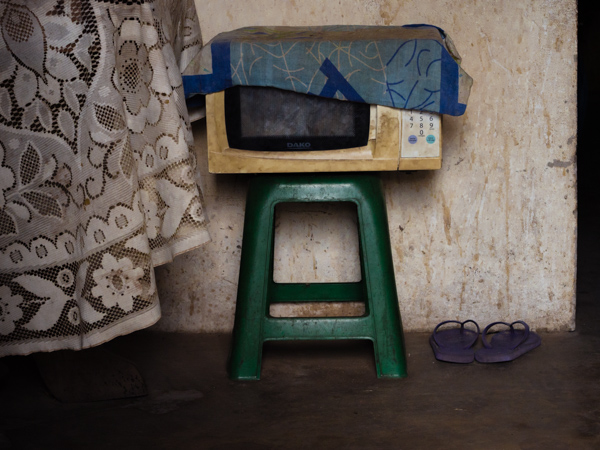
Living Room. Arandai, Chapada Diamantina, Bahia, Brasil. 2017.

Quilombo near Cachoeira, Bahia, Brasil-2

Curtain in quilombo home. Outside Cachoeira, Bahia, Brasil. 2015.


11th Julia Margaret Cameron Award for Women Photographers

Bed. Arandai, Chapada Diamentina, Bahia, Brasil. 2017.

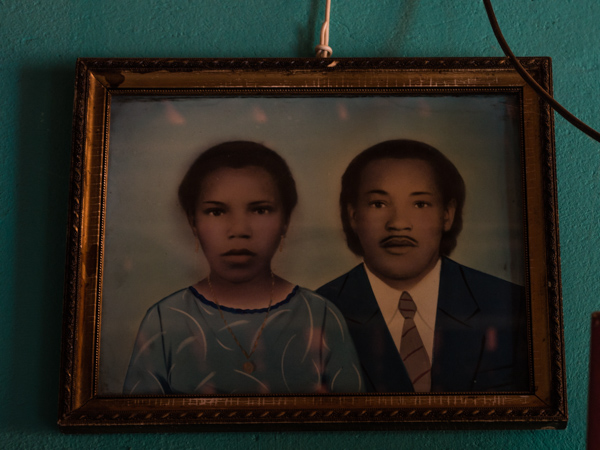
I’m very honoured to have won Runner Up in the 11th Julia Cameron Award for the Abstract & Still Life category. Thank you to the Jurors. The work is part of my on going project “This Miracle” which is a personal exploration into the human landscape in Bahia, Brasil.

Family Photograph. Beira Rio, Chapada Diamentina, Bahia, Brazil. 2017.

Living Room. Santiago de Iguape, Bahia, Brasil. 2017.

Floor. Arandai, Chapada Diamentina, Bahia, Brasil. 2017

Is Bigger Better? Perhaps.

Yours Truly in front of Siren Song (exhibition view at the Griffin Museum of Photography, Winchester, MA). 2018. Photo Credit: Natalie Schaefer

I am of the belief that a photograph isn’t truly a photograph until it is a print. Perhaps I am “stuck in the past.” Nonetheless, to me, making a print is the final step in the photography workflow without which the image cannot becomes the object it is meant to be. When trying to produce the best rendering of the picture – a true surrogate of the world I photographed – I find that looking at the print, rather than viewing it on a screen, best shows me what needs tweaking. I can then re-process and re-print.

If you’ve read my blog you know that I have been taking photos at the Salton Sea, in California, for nearly three years now. After the first two trips, I began making 4″x6″ prints so that I could easily pin them on my wall and move them around – to live with them, if you will. Over time, I experimented with various printing paper to get the right “feel of place” that worked with the image, colour palette, and light. Paper choice was critical and I ended up producing 5″x7″ proofs on bright, matte paper. Through this process I also realised that intimacy was key to viewing the work and decided that I would make most of my prints no larger than this.

The point of a small picture is the sense of privacy it affords the viewer. Only one person at a time can move in close to see it. The picture becomes a metaphor for an interior space. Small photos feel more personal; they remind us of old family albums, where we can touch and hold the pictures so that our senses are filled with memory.

However, for numerous reasons, I recently experimented with printing this body of work larger. Though it should have come as no surprise I was struck by how much more detail I could see with the bigger print. This inevitably led me to experiment with larger and still larger prints, until the photos felt as though I could almost walk into them. Despite their intimacy, small prints simply could not create that feeling.

Scale clearly affects  how the image is viewed, the degree of depth that can be seen, and the emotional impact it elicits. The physicality of larger prints seems to place the images into the physical world and allow them breathing room – encouraging the viewer to both move further back and closer in. Yet, much as too-small pictures may actually become lost, too-large prints run the risk of being dominant.

Thus, a next step for me is to print bigger again and play with various sizes of sequenced photos – to see how the body and mind react to and perceive their placement together.

It has been a gradual learning process for me. Finding the appropriate scale for the pictures , along with the tools I use as a photographer (from camera to computer to printing paper), helps create the photograph as an artifact and contributes to the tangible experience of viewing the final print.

Siren Song (exhibition view at the Griffin Museum of Photography, Winchester, MA). The smaller photos are 5″x7″ and the largest are 17″x 22.”  2018.

Look at Me: Fragments of a Body

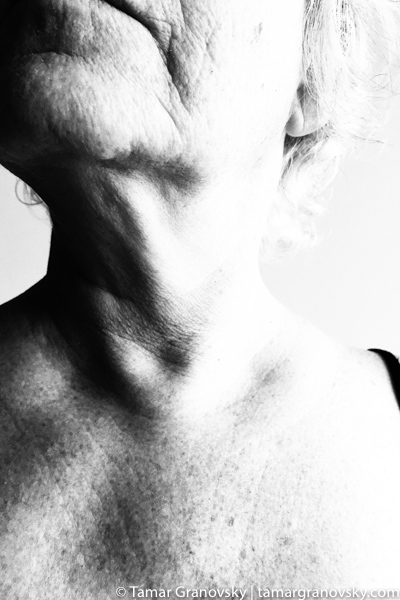
Self Portrait (Neck).

Since I bought a smart phone, three years ago, I have taken photos of my self (many of which are posted on Instagram). This “self-portraiture” has been a necessity of sorts – a way of seeing myself in the world as I pass through or (more precisely) live in it as a physical being. It is a way of viewing my ordinary body without a mirror. Skin, hair, creases, and folds are so utterly commonplace and things that we all share, as human beings. Despite this sameness I feel out of place and flawed. In some photographs I am dressed. However, it is nakedness that is of greatest interest to me since it is literally skin that separates my inner landscape from the outer world.

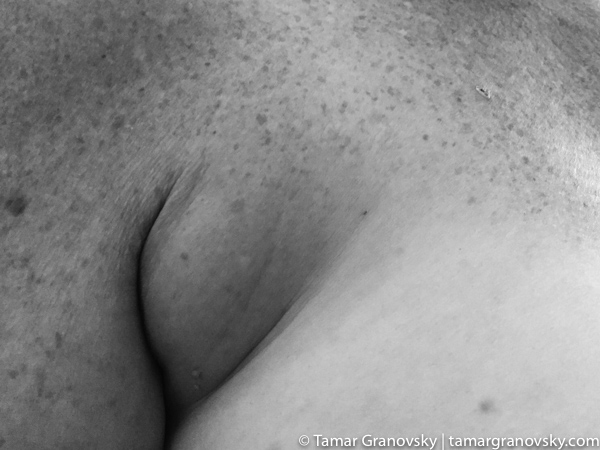
Each photograph is of a fragment of myself. It is a distorted and incomplete view – a detail. Since I hold the mobile phone in my hand there is no other way to see myself except through these closeups.

Self Portrait (Belly).

The photographs of me are not always flattering but, the only body I truly understand and need to embrace is the one I occupy. Yet, I often want to reject it since it is now a heavier and baggier form than it was in its youth. Wrinkles are now laid bare. I am not quite old but old age is a taboo in North American society. I am past the age of fifty and women, in particular, are led to believe that their shapes are imperfect and regard them with disdain (and all too often I believe this is true for myself). In fact, reshaping one’s body with plastic surgery (in an attempt to recapture youth) is widely accepted.

Some pictures are meant to give a sense of mood. Many are simply the camera (and an app, perhaps) drawing my figure. The person (me) is not the subject; it is the body (mine). I am not dealing with older age, per se.

Self Portrait (Armpit).

There is something freeing about turning the camera toward me. I feel alive and empowered. My body is all mine no matter the imperfections. I intend to continue these photographs. This act of imaging my self as an evolving being is a path to self acceptance.

Self Portrait (Knees).

Self Portrait (Mouth).

Self Portrait (Thighs).

Self Portrait (At Rest With Headache).