
I still feel China in me. I smell it and taste it.
The stench of cigarette smoke was all enveloping; it seemed that every man held a cigarette between his pursed lips or fingers; Ba was almost always with one. But there were other odours. My throat closed as I inhaled the remarkable potency of chili oil as lunch dishes were being prepared. More importantly, though, were the marvelous fragrances of those meals themselves. I recall the scent of fried eggplant or slivered potatoes, hung shao rou (braised pork belly) or, delicious stir fried amaranth with garlic.
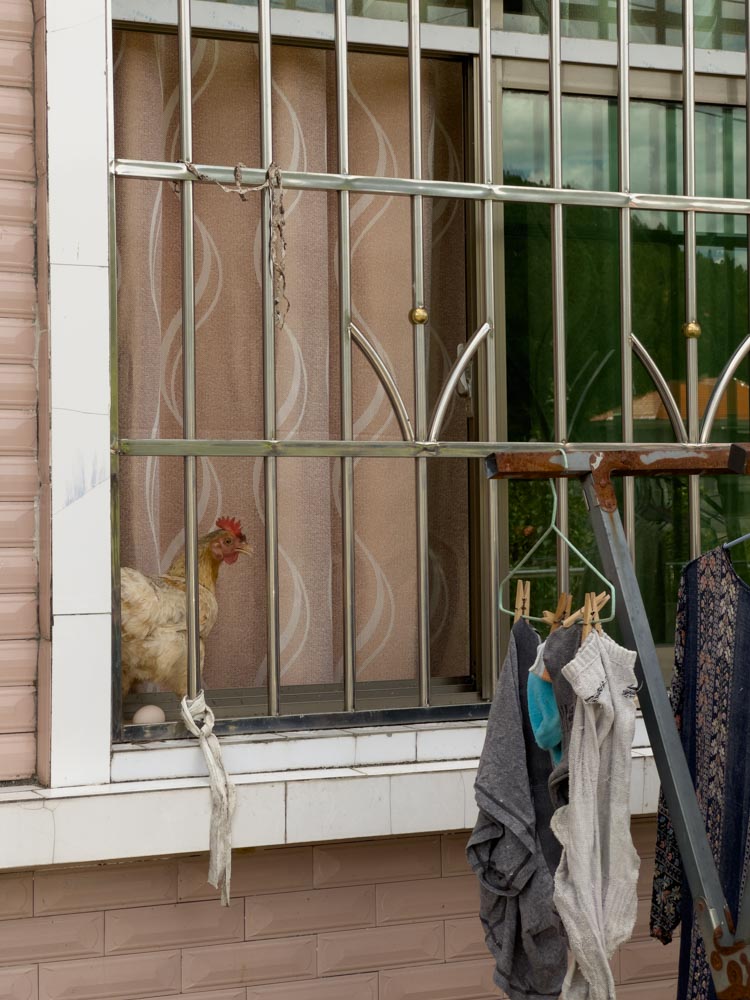
I can also hear China. The sound of roosters in the distance and the content murmurs of “auk, auk auk auk, auk” or “rrrrRR!!” of the hens in the yard. At night, in the dark, there was an orchestra of frogs. The background vocals of the cicadas was even louder. Clearer. Crisp.
The hens were everywhere, In the front and backyards as well as in the house. They ate peaches. They loved the peaches. And watermelon. And anything else we gave them. They defecated everywhere and from time to time I would catch a dog eating the excrement.
This is the backdrop.

Lian Xi Cun (the village)
Zhongcun (the town)
Yanling County
Hunan Province
China

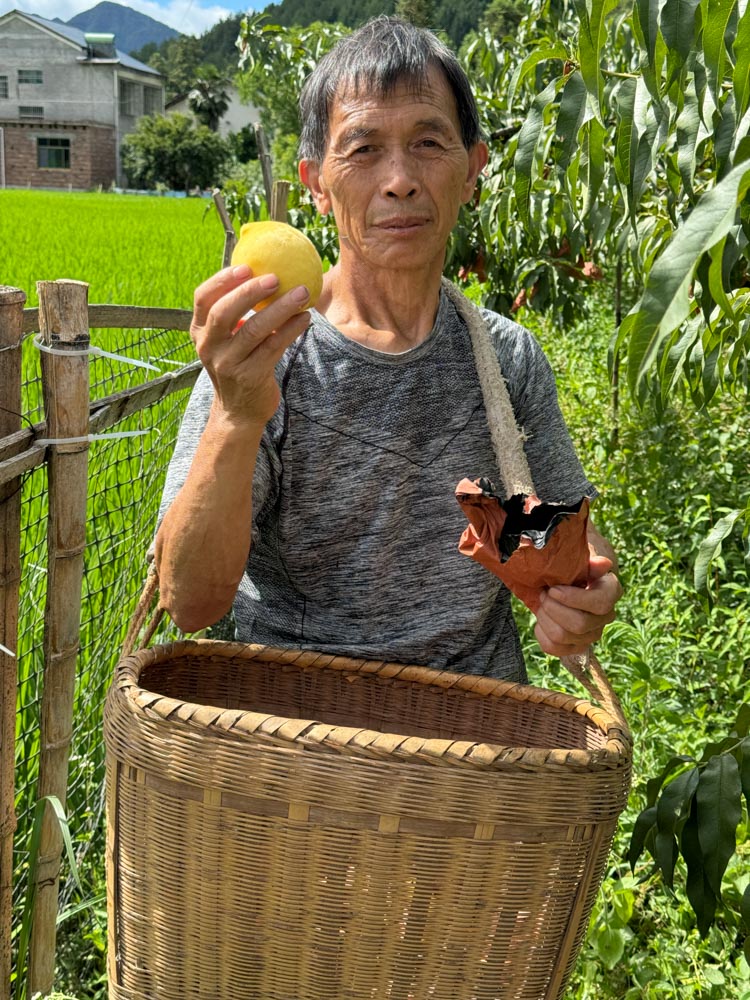
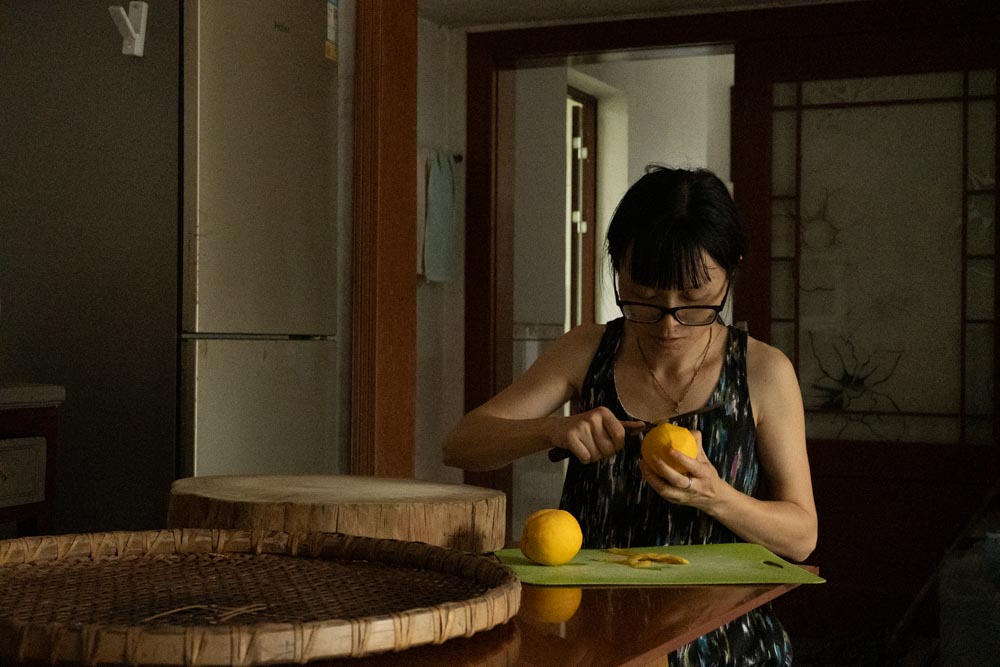
The excuse for my invitation to Li Xian was peaches. Yellow peaches. Pale yellow. Some wore a slight tinge of orange. Every peach was wrapped in its own salmon coloured double layer protection bag. Because of this the peaches were kept safe from not only pests but also the sun so that they remained yellow; they were not allowed to turn to sunset orange/pink. The area is known for yellow peaches. At sunrise Ba, my friend Liya’s dad, picked the peaches. When needed, Pedro and Liya helped. Martin and I unwrapped those peaches which had been very gently dumped from their bamboo baskets into vibrant yellow plastic crates when they were brought in from the field. We placed them in one of three piles (hard and yellow, softer with a kiss of orange, damaged or simply too ripe for shipping). Then we wrapped the undamaged golden fruit (that could easily be mistaken for lemons) with a white, netted, plastic wrap for protection. We learned that there was a correct way to put the fruit in their sleeves and an even more precise method to packing the boxes that were prepared for shipping each mid-afternoon.


Ba is my age. Apparently, he has been tired for a long time. Very tired. He feels a general malaise and often gets sick with headaches. He has issues with his lungs. He takes a handful of pills. He makes a concoction of tea. He fears for his health. Several times during my stay at his home he did not get out of bed until we checked in on him. But he insisted on doing everything himself although, in fact, he did not. The four of us, we who came from Canada, Portugal, and Singapore helped him, did what we could. Liya did the brunt of the work alongside her father. The work never ended for either of them. As well as the physical work related to peaches, they collected orders from wholesalers or individuals. They yelled at each other because they were fully dedicated workers with their own ideas about how things should be done. Often Ba escaped with his cell phone. He was as addicted to it as he was to his cigarettes. Liya, luckily, had us. In between our work we played. We laughed. In the future she will remember this when she sees the many photographs Martin and I took of her laughing.


Yanling County is known for its isolation and poverty. It was well known as being red – closely tied to China’s red culture campaign. According to Chinese history books, Mao launched the Land Reform Movement of New China in Zhongcun Town.
Lian Xi village is across the Xielia river from Zhongcun Town center, sitting on the west bank. The name of the village is Lian Xi 联西 (lián xī). 西 Xī is west and 联 lián means unite/united, adjacent. The population is about 700, although many do not permanently reside in the village because of migration to urban areas.


Liya says that when she hears or see the words Lian Xi, what comes to her head is her primary school, mountains, rice paddies, dialects… She says that Lian Xi, overall, has not changed since she was a girl; she is now 35.

One big change is the new Chinese National Highway. The old one-lane highway winds around this mountainous region. Mudslides get in the way during heavy rains. The new highway consists of many tunnels that burrow through and go around the mountains. Getting to Zhongcun Town and Lian Xi is easier and faster than on the old highway. However, many people still rely on the more economical local bus that takes the old highway to get from one place to another.

China is a populous and agricultural country. Land is state and collectively owned. Private ownership is prohibited. Since the 1980s rural (village) collective committees assign parcels of land for cultivation to eligible households.
Liya’s dad (Ba) is not originally from Lian Xi. He and two of his younger sisters moved there after their parents and grandparents died. Ba was 17 at that time and discovered that it was too difficult for him to raise his younger siblings. It was during the Mao era; food was extremely scarce for impoverished families like his. Ba and one of his sisters were assigned to a couple without children and his other sister went to another family. Liya’s mum is from Lian Xi. When she married Ba she moved in with his adopted household, as is tradition for women in China in mostly rural areas and amongst less educated couples.
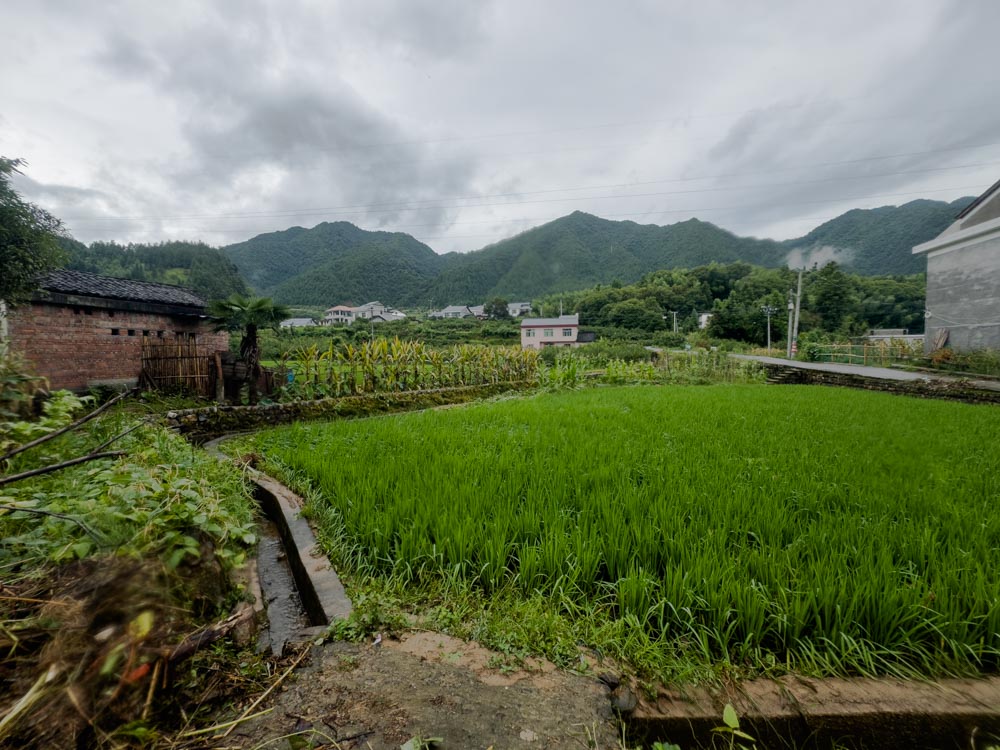
Providentially and purely by happenstance, Ba inherited some of the land he cultivates today. The land belonged to the couple that sheltered him, and, for some reason, it was never taken back by the committee after they died. Once there were two mu but now there is only one mu because the new national highway superseded it. A mu is approximately 0.17 acres. Most women do not own land, even today. However, if a woman’s husband dies, even if she moves out, his land belongs to her (so to speak – since the land doesn’t belong to anyone but the collectives). Plots are no longer relied on for full food provision nor does everyone cultivate rice, as was the case when Liya was young.


Should Liya decide to move back to China from Portugal and want to “buy” land, she can only do this in Yanling county because the hukou system ties her to her village home. This system, which was started in the 1950s, was created to control and limit rural migration to the cities, but has subsequently created social inequity between rural and urban China. An individual’s hukou registration and labeling as agricultural or non-agricultural, determines jobs, benefits etc and these classifications are nearly impossible to change.
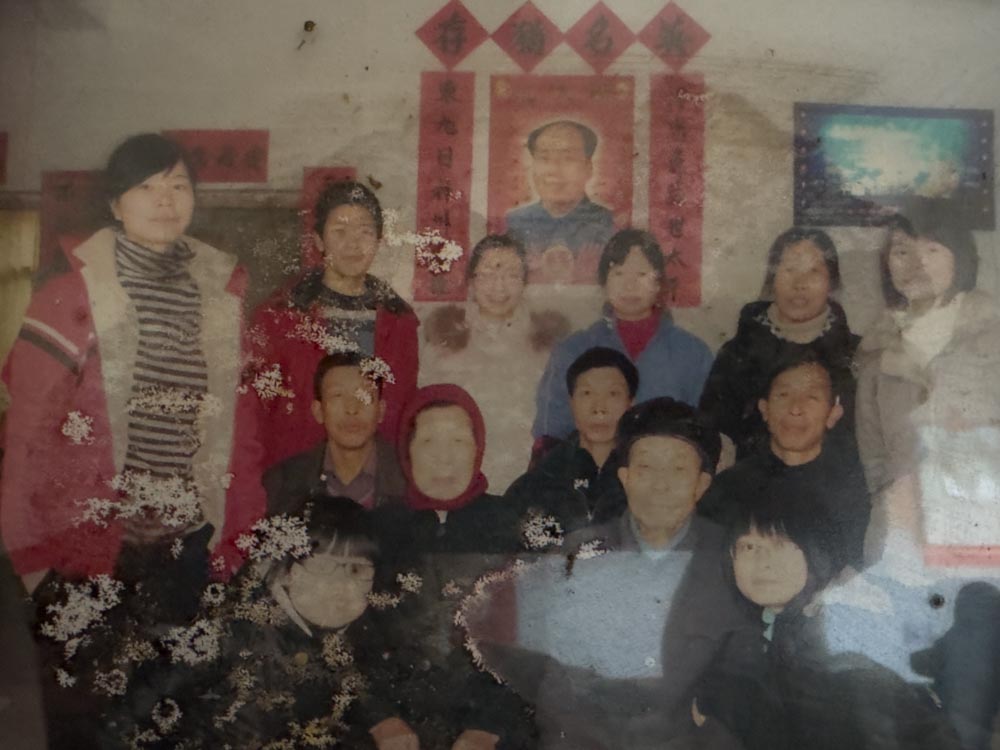
My two weeks in Li Xian made me think about rural China, the lives there, and the roles women play in this country. Liya is a young woman who broke with tradition when she left her village and then China, where the potential for her economic, and personal, growth would have been severely limited. She transformed herself, overcame the challenges and pursued her dreams on her own terms. While I was with Liya at Ba’s home in Li Xian (under the ever-watchful eye of Mao, whose larger than life photo and image is omnipresent across China) I witnessed a family dynamic of almost constant tension and struggle for authority and understanding between Liya and her father. This inter-generational battle might never have taken place if Liya had followed tradition and stayed in the village or moved to Yanling.
Liya and her friends Yishuai and Xiaoting, both of whom I met and who were also from small villages, are all unusually accomplished young women who had thought about their situations, taken on tremendous challenges and transformed their lives through sheer determination.
It was a hopeful sign that even in a country still so tied to rural life and steeped in traditional roles, new generations are capable of setting their own paths.



 Tamar Granovsky | Wanderings Afar and Near