Monthly Archives: July 2013

Hong Kong

Sunday at Central (Filipino gather with friends to spend the day together), Hong Kong

Sunday at Central (Filipino gather with friends to spend the day together), Hong Kong

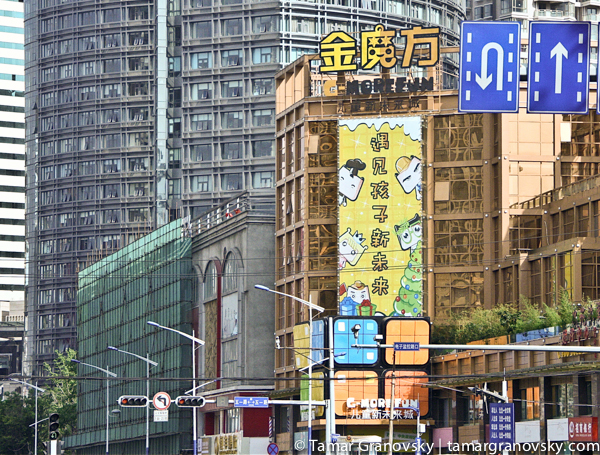
My last few days of this trip were spent in Hong Kong. It is an absolutely terrific place so it was a very nice way to end my 3.5 months of travel abroad. I was afraid it would be too big a city but I suppose I worked my way up to it by starting in Kunming, going to Beijing, hitting Shanghai, and ending with Hong Kong. I liked Kunming, truly enjoyed Beijing, loved the faster paced and larger Shanghai, and really fell for Hong Kong – it is a large city with heart and soul.

Hong Kong

Hong Kong

Hong Kong

Hong Kong

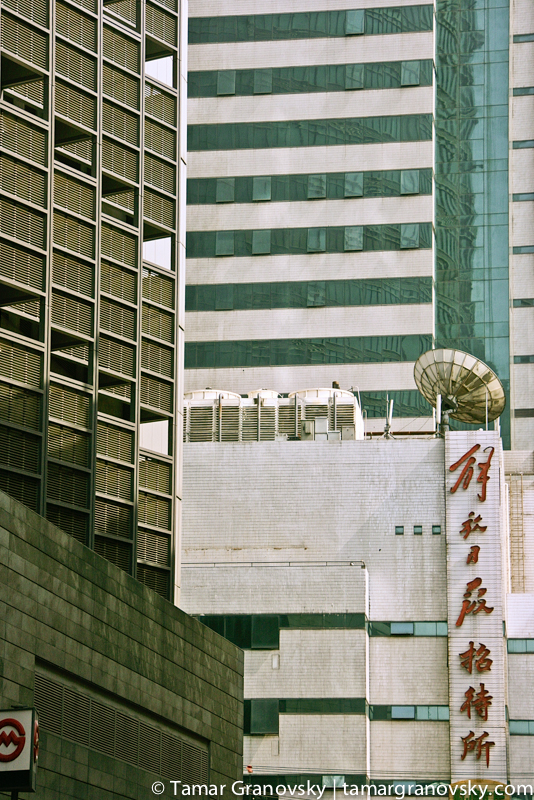
The greater Hong Kong area is made up of islands and even though places like Hong Kong and Kowloon are composed of a dense concentration of concrete towers and glass sky scrapers there are green mountains and water all around. There is no lack of places to escape from the city sprawl. Hong Kong is clearly old. It was also a British colony so has somewhat of a western feel to it despite the old Chinese ambience, too – a nice balance of both, I think. There are certainly tourists in Hong Kong but the locals are out and about with a vengeance. Part of this, I suspect, is due to the fact that homes/apartments are small so people want to get out and enjoy the city that has so much to offer.

I ate wonderful food, starting the day with congee and shrimp rice rolls along with milk tea every morning for breakfast. I sometimes even ate a toasted bun with condensed milk as an add-on to my breakfast.  Lunch was usually made up of noodle soup with fish balls and supper, and twice I had a supper of bbq pork, rice, and Chinese brocolli. I also went for dim sum multiple times and once went to a VERY nice Sunday afternoon high tea at the fancy Mandarin Oriental. Michelle’s friend Carina (I know Michelle from Boston) took me out for dinner one night. I was taken around Kowloon and introduced to the toasted bun with condensed milk by Michelle’s other, long time, friend Pauline; she later treated me to a contemporary dim sum place that had traditional Cantonese fare. Here, you order what you want, beforehand, and then have the food brought to you.

Pauline and I hit the jade, bird, and flower markets, in Kowloon. I got to experience an old-style department store, a walk along Temple Street – a street mall that sells  imaginable every type of cheap “stuff” (apparently Temple Street used to be full of street women; now you only notice a few hanging around).  We also went to Shanghai Street (the street has a number of stores which carry hardware and housewares) because I wanted to find chopstick holders that double as soup spoon holders (I had never seen this until I hit Hong Kong). When I commented on a terrible smell in the air Pauline said it was fermented tofu and that she has never tried it because the smell is so off putting. Of course I had to give it a whirl and found it (and its accompanying hot sauce) delicious!!! You can taste the fermentation, but just barely. I had tried cold fermented bean soup in Beijing (that you dip fried dough into) and that was truly horrible –  to my taste buds, anyway.

The day I arrived in Hong Kong would have been perfect time for a trip to Victoria Peak (it was sunny without a cloud in the sky — unlike the other three days I had spent in the city) but I was up at 5 that morning and did not hit my hotel until 2pm. By the time I had showered and had a bowl of soup for lunch it was 3. So, instead, I just wandered my new neighbourhood, Sheung Wan, which I thoroughly enjoyed. The area is JUST outside the district called Central. Sheung Wan neighbourhood consists of all sorts of dry goods shops — shops selling dried fish bladders for $5000+HKD as well as other dried fish, tea, nuts, dried fruit, etc. There are also all sorts of cheap(ish) clothing stores, magazine shops, and an English language used book store.

Hong Kong

Hong Kong

Central includes the financial district as well as very high end shopping malls, both fancy and simple restaurants, and hotels that are interspersed with local and older Hong Kong shops. To get to the Central boat pier you have to go through this area.  I had, here, the best rice and bbq pork I’d eaten in Asia and the best noodle soup, too. Neither cost more than $4USD!  But, of course, being Central, this is also where I had my very civilized afternoon tea and where I spent much more than $4USD! Definitely worth it.

It was a cloudy the day I went up by tram to Victoria Peak to see the view of the city and islands from up high. I walked around the park and for a very short while the clouds cleared so I was able to get some good views, after all!!

Another day, I took a boat to Lamma Island and hiked for almost two hours around one section of this island. My intention was to do the two hikes the island has to offer but it was over 30C with 100% humidity; my body would not have been happy with more hiking. Part of travelling far and long is knowing when to take a break. Lamma Island is sparsely inhabited, has two small residential and tourist areas and otherwise is green with hiking/walking trails. So the hike, although cut short, was worthwhile.

Lamma Island

Lamma Island

Finally, one other Hong Kong outing consisted of a tram ride westbound, looking around and taking photos from the top and front of a double decker bus. There is so much more to do in Hong Kong but unfortunately I just did not have enough time. This was true for Beijing and Shanghai, too. I guess I’ll have to return to these places!

I had an absolutely marvellous 3.5 month trip, met mostly marvellous people, ate mostly marvellous food, enjoyed the mostly marvellous countryside, and feel that I gained greater insight into Asian culture, as a whole. And of course, how I love Hong Kong!

Shanghai

Shanghai

Shanghai

I arrived in Shanghai after a five hour bullet train ride from Beijing at 310 km/hr. The ride was so smooth and unlike the American Amtrak Acela train – it puts the U.S. rail to shame!. Shanghai is SO different from Beijing. Beijing is steeped in the past and Shanghai is about the present and future. Unlike the Beijing apartment complexes that are identical and look like they were just plopped down, Shanghai consists of apartment complexes of varying styles and skyscrapers of every size, shape, and material. This city has a very different feel from the nation’s capital.

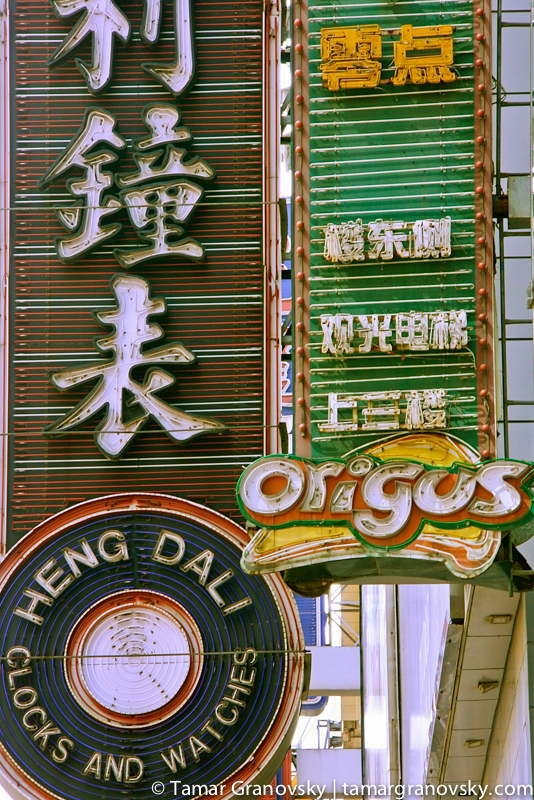
The first day I walked the Bund which is made up of buildings from colonial times. It was originally a towpath for barges – and barges galore still populate the Huangpu River. It was transformed into the banking area and the Bund is where the majority of art deco and neoclassical buildings were built in the early 20th century. Today, it is filled with fancy shmancy hotels and retail stores like Cartier. Across the river is the Pudong area where they have built, in the last 20 years or so, the futuristic part of Shanghai. This includes the site of the famous Oriental Pearl Tower. I also walked along Nanjing East Road which is a pedestrian mall with simple stores, primarily, but some fancier stores too, and Chinese delicacies and tourist shops. Nanjing East Road is where the first department stores in China were opened in the 1920s. There are still many neon signs from the bygone days that mingle with the contemporary shops.

Shanghai

Shanghai

I stayed with my new Italian friends, Laura and Luca, who I met in Yunnan Province and whose company I enjoyed very much. Their children, Vanni and Ada, are a pleasure and Luca has a great sense of humour. I spent time with Laura talking about the arts and exploring parts of the city when she could join me. I was so fortunate to have met such gracious and welcoming people. My whole 3.5 months in Asia, in fact, was virtually nothing but pure pleasure and wonderful people. I was very lucky.

One of the only sour notes was that on my first day out and about in Shanghai I was scammed. I kind of realised it was happening but I do believe that one tends to doubt oneself. And the funny thing is that I had approached these people. Had I not done so I would not have lost $320USD. I read in the guidebook, after the fact: Beware of English-speaking students asking you if you want to walk around and spend some time together and then wanting to take you to a tea house… Two days later I knew better when I was approached…

On a happier note, I took the time in Shanghai to go to a few museums: The Shanghai Museum and the Shanghai Jewish Refugee Museum. I tried to go to the Museum of Contemporary Art but they were closed and in between installations; that was a disappointment. I went to M50 where, unlike at the very vibrant Art Zone 798 in Beijing, I saw a lot of mediocre to bad art. There was though, one truly wonderful exhibition, “Across the Waibaidu“, at Island6 Gallery. I also spent time wandering The People’s Square and Park as well as the Yuyuan Gardens.

Shanghai

Shanghai

Shangai

Shanghai

I had the opportunity to dine with the brother of a friend and his girlfriend. In typical Chinese fashion they treated me to quite a feast and it was nice to get to know them a bit.

Shanghai

Shanghai

On my final day in Shanghai Laura and I went to the French Concession. As the Lonely Planet says: “Once home to the bulk of Shanghai’s adventures, revolutionaries, gangsters, prostitutes, and writers, the French Concession is the most graceful part of the city. Today a residential, retail and restaurant district with atmosphere tree-lined streets… The cream of Shanghai’s old residential buildings and art deco apartment blocks, hotels and edifices are preserved here… The district naturally tends toward gentrification, but it’s also a trendy and happening enclave, excellent for random exploration…..” The neighbourhood was excellent for walking and exploring and I was tempted into splurging a bit.

Shanghai, so different from Beijing. How I love Shanghai!

Beijing

How I Love Beijing!

Beijing

Beijing

The flight from from Guilin to Beijing is 2.5 hours and as we approached Beijing I could see a ceiling of smog. I have been told the city’s population is over 20,000,000 which is hard to fathom. It is a huge city and when you fly toward the airport you see apartment block upon apartment block one next to the other — a whole skyline of them. I couchsurfed in the old city centre, in a hutong. Hutongs are narrow alleyways that zigzag inside Beijing’s 2nd ring in the centre of the city. They consist of one storey buildings/dwellings with courtyards that are hidden behind the entrance-ways. The city centre is full of young and old people, small shops, and lots of cafes, food stalls, and cheap restos. There are not many tall buildings here and I was situated in the northeast corner of the Dongcheng District which includes Tiananmen Square, the Forbidden City, and many other such sites (these are all more toward the middle and south of this district).

My Couchsurfing hosts took me, a Russian tenant of theirs, and her visiting mother to the Great Wall on my first full day in Beijing; on the way we stopped off at KFC to pick up chicken to eat when we got there. This felt like a bad omen. BUT! They made up for that by stopping at a halal resto with typical Beijing snack food when we returned to the city. We ate savoury as well as sweet dishes: fermented soybean soup that you dip fried dough into (not the tastiest thing I’ve eaten but I did not hate it) , sheep’s intestines, a mung bean custard, a few cold noodle dishes, a kind of very soft thick grit-like soup that you mix with what tasted like a ground sesame seed sauce, and more….. The table was filled with these Muslim specialties – a “cuisine” that is called hui cai and which often includes mutton. My first real Beijing food experience was exactly what I had hoped it could be and quickly erased the memory of KFC at the Great Wall.
The Great Wall is surrounded by mountains. I was surprised that we didn’t see more tourists when we were there. We went there via the Mutianyu entrance (the one President Clinton went to — though not President Reagan or the Queen of England). We took the chairlift going up and walked down. There is a chute/slide that one can take down and I would have loved to try it but my hosts wanted to walk down.

Great Wall Chute

Great Wall Chute

Xian Hong and Zhen Ou — my hosts – speak very little English so our attempt to talk to each other was pretty funny. Luckily we each have patience and a sense of humour so we laughed a lot!! They were SOOOOOOO generous of their time – taking me around to various sites, essentially taking me under their wing. The two of them insisted on treating me to everything and were unbelievably kind. There seemed to be nothing I could do to repay them… but I came up with an idea. I took them, my friend Xiao Xi, who I met in Shuhe (Lijiang, in Yunnan Province), and the Russian women, out for Peking duck and I bought Xian Hong two Cordon Bleu cookbooks (in Chinese) since she has been to France a few times and mentioned how she’d like to learn how to cook French food – particularly dessert. I also bought her a Chinese dessert cookbook and got the two of them flowers. It wasn’t easy to find a way to treat them, but I was pleased that I succeeded.

On the second day of my stay in Beijing , Xian Hong and Zhen Ou took me to Art Zone 798 (which I had mentioned wanting to visit). Art Zone 798 used to be an electronics warehouse that was built in the 1960s in conjunction with East Germany. Now it is filled with galleries, small and large (including PACE Beijing and a North Korean museum) as well as shops and studios. Ten years ago it had mainly studios with some galleries but rents went up and many artists had to move elsewhere (about 4km away to a new artists’ district).

Beijing, Art Zone 798

Beijing, Art Zone 798

Beijing, Art Zone 798

Beijing, Art Zone 798

We started at Zhen Ou’s brother’s studio, A-One Design Studio. His brother, Professor Shi also teaches at Tsinghua University, Beijing. He is a well known designer in both China and elsewhere and his wife helps him but is also an interior designer. Here is an A-One Design Studio lecture given by Shi: http://spaces.kisd.de/netzradio/2011/01/18/a-one-design-studio/. I went back to the studio a second time and spent the morning listening to Chinese music with Professor Shi, talking about art and design, and using an app that has voice recognition and translates accordingly. This tool was very necessary since his English is not good and my Chinese is worse. He is a man who appears to love life and I was pleased to have the chance to meet him and even join him for lunch. Here is a video created by one of the student interns at A-One studio: http://v.youku.com/v_show/id_XMzg3MTk3ODQ4.html (please click “Turn Off Chinese” to access this video)

The week I arrived in Beijing coincided with May Day which is a four-day celebration in China. The streets were more crowded than usual so, since I am not inclined to visit places just to tick them off a list, I did not go to the Forbidden City. Instead, I spent one day walking around Beihai Park and the lake in the middle of Beijing with Xiao Xi. She and I went to the Temple of Heaven and the surrounding park and then we went taste testing teas with Xian Hong before going out for supper.

Beijing, Dancing in the Park

Beijing, Dancing in the Park

I do love Beijing. I particularly love the area I stayed in since it was so central to everything including buses and the subway for destinations that were beyond walking distance. Mind you, as I mentioned above, my hosts did tend to take me places; every morning they called me from their home (I had my own tiny apartment in the hutong, while couchsurfing) to ask what my plans were and the next thing I knew they, by some coincidence, were on their way to see me and show me around! If i lived in Beijing this is the area I’d choose to live in.

Beijing

Beijing

Beijing

Beijing

Other food I ate: donkey; shuan guo — a broth kept hot under fire in a copper pot with a cone in the middle with mutton and vegetables added to it and a sesame seed sauce that has a little chili mixed into it.

A couple of observations:

  • In Beijing, waiters and waitresses stand looking over your shoulder until you have decided what you want to order
  • In China: babies’ and toddlers ‘pants are not sewn all the way to the crotch to make for easier diaper changing and toilet training which is done on the street (sometimes in a discreet place, sometimes literally on the street — in either case it is a brilliant design that should be adopted in the west!)

China: Guangxi Province

Xingping

Xingping

Xingping

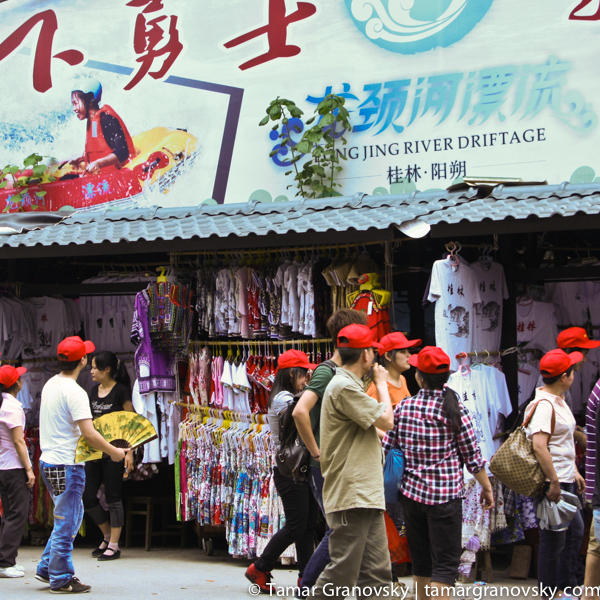
Chinese tours walk by in what seems to be the hundreds – up and down the streets, going to the water to ride a boat on the Li River, or heading back for lunch and their buses. The hostel in XIngping in Guanxi Province and just south of Guilin is on the main thoroughfare (albeit very small) and between the people, cars, trucks, and motorcycles and the noise is unbelievable. Drivers in this country seems to LOVE honking horns as they pass every moving thing – although the same was true in Vietnam.

I hiked along the spectacular karst mountains in the area as well as the country roads surrounding the town. Xingping is small and very walkable. It has a market that I visited and at which I ate lunch several times. I also found a few places, introduced to me by Li Ya and Baozi (two young women who worked at the This Old Place International Youth Hostel and with whom I became friends), that I frequented almost daily. Here is a recipe for ginger milk tea which I drank every afternoon in Xingping and which I now make and drink at home in the U.S.

XIngping

XIngping

XIngping

XIngping

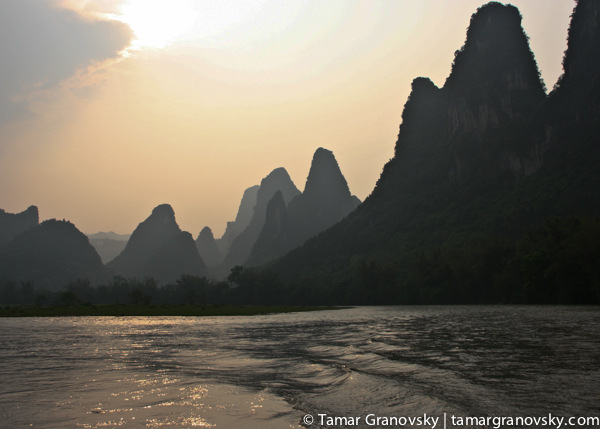
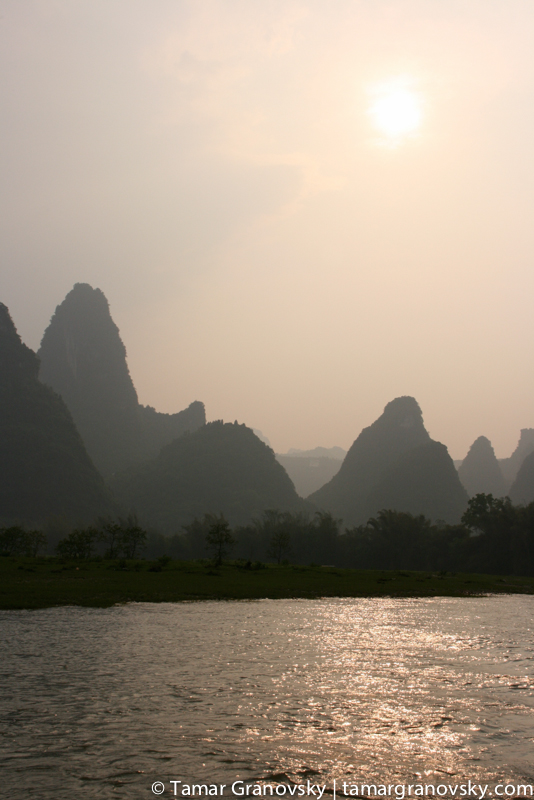
I had plans to stay in Xingping for a few days but loved it so much that I used it as a resting place and spent over a week there. It is truly a lovely region. You can, as I did, hike around the mountains but also walk along pathways or even do some real mountain climbing. It is easy to get into the countryside and see the many farmers (the majority of people here are farmers or are in the tourist business) pick vegetables or fruit, plant seeds, work in the rice fields, and tend to their crops. Depending on the clouds and sun on a given day the mountains appear otherworldly. And of course it’s so much fun to be asked/told, “hello, bamboo!” This is an invitation from those working in the tourism industry for you to take a bamboo boat ride along the Li River. I learned to cut the women short when I received a “hello” and not allow them to continue on to “bamboo.” Instead I quickly had to say “bu shi, xie, xie.” Thank you but no.

XIngping

XIngping

XIngping

XIngping, People Preparing for a Funeral

One day I spent three hours in the market, going up and down the stalls, taking photographs, “talking” with people, and checking out and buying food for lunch (not knowing what in the world I was buying/eating). I was invited by three men to join them for tea and I accepted. They did not understand a word I said and I did not understand them but we had a hoot sitting and attempting to talk with each other. They laughed every time I answered, “bu mingbai” — I don’t understand.

XIngping

XIngping, Woman Carrying Goods from Market

I discovered that despite *completely* adoring Lao, Cambodian, Vietnamese, and Thai food — as well as the variety and excellence of food in Singapore — Chinese food remains my favourite. It’s such a big country and every region has its specialty. As my friend Michelle has said multiples times, I must have been Chinese in another life. And the Chinese people I met were uniformly surprised that I – unlike most tourists – ignored western food and ate what the locals eat.

There are three things, though, I may never get used to in China: 1) the retching sound just before a big gob of spit comes flying out of a mouth (mostly men) and onto the street; 2) people smoking everywhere (mostly men) and; 3) trash thrown with abandon on the street — all of the time (everyone). I have to admit, though, that even I ended up throwing garbage onto the street when there was so much of it around me and I could not find a container to throw it in. Maybe I am getting used to that!!??!!!  😉

China: Yunnan Province

Lijian and environs

Lijian and environs

Yunnan 2012

Twenty-five of China’s fifty-six ethnic groups live in Yunnan Province. Close to 40% of the province’s population are members of minorities, including: Yi, Bai, Hani, Tai, Dai, Miao, Naxi, Yao, Tibetan, Mongolian, and many more. I learned that there are some minority groups who do not live in separate settlements or do not even reach the required threshold of five thousand, in order to be given the official minority status in the province.

Yunnan’s landscape is beautiful. And the truth is it is almost completely landscaped. When you are not in a city or town but on the road you see some small towns or large factories but mostly completely landscaped land for farming – much of the land is terraced in Yunnan (at least until Lijian which is the furthest north I travelled). Even forests seem to have been burned so that trees can be planted.

I met mostly very sweet people. A few came up to speak with me in mixed English and Chinese so I had some very good conversations – or at least as best as we could manage. A few Chinese speak excellent English (there are 11 universities in Kunming, alone) although the majority of people in Yunnan and Kunming, so far, do not understand English at all – even in banks and hotels..

In this part of the country, I saw very few Western visitors. Most tourists are from China.

Chinese Tourists in Xingping

Chinese Tourists in Xingping (Guanxi Province)

Part of this, of course, has to do with the fact that there are so many people in China and everyone who can, travels. So, no matter how many Westerners may be travelling at any given time they are completely outnumbered. When I went to the Stone Forest — 1.5 hours south of Kunming – there were *throngs* of Chinese and I bumped into a very small handful of Westerners.

One thing I noticed is that many people speak VERYLOUDLY!!!
I have to admit it took some getting used to. However, it is simply a cultural difference and I learned to accept it.

The worst driver I have ever experienced was on my trip from Mohan to Jinghong. The driver of the bus looked everywhere but at the road, kept on grabbing this or that from under his seat, stuck his head out of the window to look behind him, smacked his hand o his head multiple times and kept on jerking his head as if he was dozing off and was trying to stay awake. Luckily that kind of driving was not the norm.

I stayed in Jinghong for two nights, enjoyed my 1.5 days ambling the city, and ate some excellent spicy Dai food.

Dai Food Cooking, Jinhong

Dai Food Cooking, Jinhong

Dai Food Cooking, Jinhong

Dai Food Cooking, Jinhong

Dai people eat mostly plain rice often along with ground meat made into thin patties, grilled on sheets of metal, and then cut. They eat a lot of green seaweed which is found on rocks at the edge of rivers near their houses on stilts. The seaweed is roasted and wrapped in banana leaves. Many of their dishes are very spicy hot and/or sour and are filled with coriander, onion, sour pickled olives, VERY hot peppers, and pickled bamboo. Beef and fish are usually roasted. In Jinghong, on the streets, are a wide array of fruit and vegetable stalls selling among other produce: breadfruit, papaya, pomelo, dragon fruit, etc. As you can see I found Jinghong very food-centric (as is the whole country, actually) and happily ate a lot, there. Lastly, I discovered a stall (part of a food chain) where you could buy an amazingly fresh, hot, soybean drink. SOOOOOO delicious.

Leaving Jinghong, I took an 18-hour overnight, local bus, to Jianshui and then another three-hour bus ride to the Yuang Yang Rice Terraces. On the night bus to Jianshui I was seated next to a man who received telephone calls hourly, almost, and repeatedly lit up cigarettes. I was the only westerner on the bus and no one else seemed to mind/complain (despite the bus being a no-smoking bus) so I just said nothing and suffered, quietly.

I spent one full day in Yuan Yang Rice Terraces; I walked 18km and took photos of the land (the rice paddies were flooded so there were reflecting pools – spectacular to my eyes) and people (with whom I tried to talk – not easy since the majority of people there are of the Hani tribe).

Yuan Yang Rice Terraces

Yuan Yang Rice Terraces

Yuan Yang Rice Terraces

Yuan Yang Rice Terraces

Yuan Yang Rice Terraces

Yuan Yang Rice Terraces

Yuan Yang Rice Terraces

Yuan Yang Rice Terraces

Yuan Yang Rice Terraces

Yuan Yang Rice Terraces

At the guesthouse, I met an Italian couple and their two children (ages 7.5 and 6). We ended up travelling together for a few days and I spent  my stay with them in Shanghai (Luca was teaching at the Jaio Tong University for 6 months).

The five of us travelled next to Jianshui together and met up each night for supper.  Jianshui is considered a state historic and cultural city. It is one of the earliest developed cities in south Yunnan. It was the political, cultural and communication center in south Yunnan for centuries. Because of the Jianshui Confucius Temple, the city has been called “the Cultural City” since the Ming Dynasty (1368-1644). The food in Jianshui was excellent – lots of grilled tofu and bamboo and marinated vegetables and meat. I also saw a stall selling, along with garlic, grilled beetles, larvae, grasshoppers, etc. As well, I spent time walking beyond the historic part of the city in alleyways and areas where the older buildings were in the process of being torn down.

Jianshui

Jianshui

Jianshui

Jianshui

Jianshui

Jianshui

Jianshui

Jianshui

Kunming is known as the “Spring City” because of its climate; temperatures, throughout the year, do not get much colder or warmer than a typical spring in places that have four seasons. It once was a laid-back place, so I was told by a retired Canadian now living in Australia – who I met at the youth hostel we were both staying at. He was last in Kunming five years ago and claimed the city hired a governor to turn it into a prime Chinese city. Kunming is clearly that, now.

Kunming

Kunming

I found an excellent and cheap resto that I returned to a few times where I tried Kunming’s famous “across the bridge noodles.” This consists of a bowl of very hot soup  (stewed with chicken, duck, and ribs) on which a layer of oil floats. Alongside the broth: side dishes of raw pork, vegetables, an egg, and noodles are given to you and you put all these sides into the bowl of soup right away so that the ingredients cook quickly.

One day the project manager/coordinator of the hostel in Kunming invited me to join him for supper. He’s from Hong Kong, originally, and lived in Great Britian for many years while he worked at the International Youth Hostel headquarters in London. He was asked, ten years ago, to coordinate different youth hostels in China and is now based in Shenzhen and Kunming while travelling around the country. Here is what I learned from our conversation, in no particular order of importance:

  • Some Chinese speak loudly because they are from the north. Apparently it is considered macho/manly for men there to talk loudly. Others speak loudly because they are from small agricultural villages and are used to yelling at each other across the fields
  • Almost all motor bikes in China are electric
  • Chinese call the Chinese language Chinese (zhongwen)orPutonghua (the common language)whichis based on the Beijing dialect
    • Westerners called/call the Chinese language Mandarin because the upper classes and ministers during the Mandarin Dynasty in the 19th century were based in Beijing and this was the standard for the language in the country
  • China now has its goods manufactured in countries like Cambodia and Sri Lanka because labour is cheaper. Hmmm… sounds familiar!
  • Many cars and trucks madeinChinaare exported to Eastern European countries as well as some Latin and South American countries (and I ignorantly thought they were only sold in China since I have never seen a Chinese car elsewhere in my limited world travels!!)
    • What you also see:  a number of VWs, Mercedes Benzes, Suzukis, and some Fords and Buicks which are all manufactured in China

Lijiang (Shuhe) and Beyond

Lijiang

Lijiang

Lijiang

Lijiang

After a nine hour ride by bus to Lijiang I moved to the youth hostel in Shuhe which is about 4km away from Old Lijiang as well as the new city of Lijaing. The common areas as well as rooms allowed smoking which was the first time I experienced this at a Chinese youth hostel; this was disappointing but I simply had to adjust. Most tourists who go to the Lijiang area are from China so few people speak English which sometimes made it difficult for me. However I met a lovely young woman from Beijing who spoke English and was travelling on her own for the first time (I met up with her again in Beijing). We spent one afternoon cycling the countryside together. Another woman I met is part of the Naxi ethnic group. I ate a number of meals at her little resto and this helped me to feel at home. Strolling through both Shuhe and old Lijiang was very pleasant. They are quaint places with fantastic architecture, often made of mud bricks. However, because of tourism, both are also full of tacky shops with jewellery, clothing, trinkets, etc.

If you have looked at the links above, you will have have noticed that there are a couple of rivers running through Shuhe. In the “olden days” there were three wells — one was used for cleaning oneself, the 2nd for washing vegetables and dishes, and the 3rd for drinking water. I don’t know where the drinking water comes from today but the rivers are used by all the locals for washing oneself, washing food, and washing dishes. I also saw little boys pee in the rivers and, unfortunately, garbage is thrown into it too….

I met a Canadian man in Shuhe who had worked as a chemical engineer. Having worked and travelled in China he decided he wanted to start a new career. He and his Chinese girlfriend had taken a trip to Shuhe 2.5 years ago and fell in love with the place. He went back to Ontario to save up enough money to build a small hotel. When he returned, a year later, the place had almost tripled in size and had lost its quaint small village feel. Despite this they built the hotel: Lijiang Lazy Tiger Inn. The nearby town of Baisha which is 8km away is slowly growing, too; he (and I) believe the two towns will become one at some point soon. Both are officially part of the Unesco World Heritage Site — they used to be just off the radar but the Chinese government wants to increase tourism to these places.

When I returned to the youth hostel in Kunming it felt like returning home. I guess when you go from bed to bed you (or at least I) began to crave staying in one place.

First Impressions of China

Jianshu, Yunnan Province, China

Jianshu, Yunnan Province, China

It took me a while to decide how I felt about this country. It is so full of contradictions. It is clear that China is a communist country yet capitalism is everywhere. On the whole it is an impoverished nation – at least Yunnan is –but there is also apparent wealth and growth. Kunming, for example, is becoming a very large city and will have the 4th largest airport in a few years. They are building a metro system and in general this province is viewed as a gateway to many neighbouring countries: Vietnam, Laos, Myanmar, and Ruili. In any area, here, that is larger than a small town, growth is at work in a grand way. When I left Laos, I saw that in its border city, Boten, nearly the whole centre of town was torn down  – and surrounding it were humongous but still empty buildings. In Mohan, a Chinese town on the other side of the Laos border, it seemed as if perhaps the Chinese had joined Laos in turning Boten into a big town that could some day serve as a destination for tourists or even a place for Chinese citizens to move to – from the countryside. Meanwhile, Jinghong and Kunming, the two largest cities in Yunnan, are for their part very enjoyable centres and are growing and growing.

Everywhere else that I travelled to during the first 1.5 weeks in China it was clear that the people there are poor. I wondered about all the old being torn down – replaced by new, large, concrete buildings. Some of the work is done mechanically but much of it is achieved by manual labour. However, when I stop to think about it – despite the fact that tourists want to see the “old China” – no one wants to live in a home without plumbing and heat and with dirt floors. From what I understand as long as you stay in your own province then you obtain benefits from the government as compensation if your home has to be demolished. But (and I am not sure if I am correct — this information is all from my pidgin conversations), if you move to a different province then you do not receive these benefits.

Jianshui

Jianshui

SO!!!!! From the perspective of writing these posts over a year after my trip to China in 2012: China is neither a third nor first world country and is changing at tremendous speed; transportation is is fairly top notch, construction is faster than lightening, consumption is high, and it is hard to tell whether the infrastructure will be able to take all this rapid growth. China is truly a country of contradictions.

It seems to me from what I read in the news that, even though in the financial world China is still considered an emerging market, the power is shifting from the West (read: U.S.) to the East (read: China). It was clear to me during my six-week trip to China that the Chinese are undergoing the shift from a producing country (they, too, now outsource to other countries) to a society of consumers. Even in small towns and villages people have cell phones. The income gap in the west is growing but it is the same in China. So, for instance (and this may seem a little silly) many people still cook over a charcoal burning fire with their one pot or wok and not with a stove and oven.

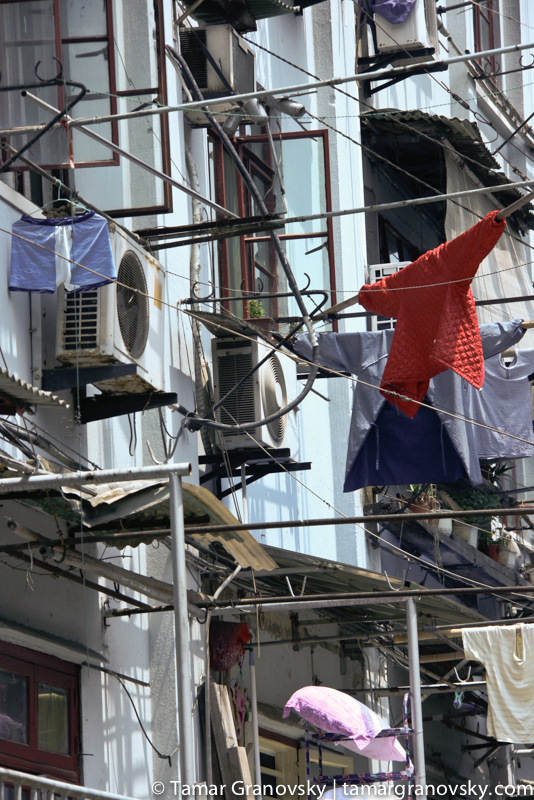
Clothing is hung up to dry since people do not have electric driers, typically, and many people do not have washing machines (those who do often have the type that was used decades ago in North America where you have to attach and detach the hose to the water tap).

Shanghai

Shanghai

From what I can tell, China is going to have to learn to have a smaller footprint as it grows at such an exponential rate. There is an unbelievable amount of garbage on the streets — especially in the smaller towns and villages.  Flying over Beijing the pollution is like a wall that you bump into.  The pollution is tragic but China does aim to reduce its pollution by 2017. Farmland and village homes are being razed while cities are being developed for the new migration from the countryside to the city. By learning the language and living in the country for a period of time, beginning this September, I hope to start to have a deeper understanding of the country and people than how I get information through the western media. And of course, this will give me an opportunity to speak to the people I meet in their language rather than in English – a language that currently is the lingua franca.