Monthly Archives: October 2013

A Trip to Tuan Jie Township

Tuan Jie Zhen

Alleyway in Tuan Jie Zhen

A friend and I recently took at weekend trip to Tuan Jie Zhen – a township that is about 30 kilometres outside Kunming. Bogi, a classmate from Hungary, and I stayed at the Heart 2 Heart Youth Hostel which is run by Heart to Heart Community Care.

Heart 2 Heart Youth Hostel (Courtyard)

Heart 2 Heart Youth Hostel – Courtyard (Photograph Courtesy of Fenyvesi Boglarka)
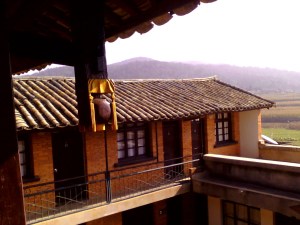
Heart 2 Heart Youth Hostel

Heart 2 Heart Youth Hostel (Photograph Courtesy of Fenyvesi Boglarka)

Because there are very few social welfare benefits or resources for migrants, this organization works with these men, women, and families, in Kunming and the surrounding area. It helps them find housing and acquire skills for jobs, provides education to the children, and arranges health care for them. In addition to working with migrants, Heart to Heart Community Care sponsors cultural and educational activities and classes for the local community, with all profits from the hostel going to this organization. The hostel is located in Da He Village, on the outskirts Tuan Jie Zhen – a village-come-town that is sometimes referred to as an “urban village” and is mostly surrounded by farmland and forested hills.

My main purpose for the trip, besides getting away from Kunming for a couple of days, was to visit Rawdon Lau (who I met last year when I stayed at the Camellia Youth Hostel in Kunming). Rawdon heads the “Best of the Best” project which promotes cultural exchange, helps with environmental conservation on a grassroots level, and is socially active in local communities. Some time after my stay in March 2012, the Camellia Youth Hostel, and the hotel next door, were razed to the ground, falling victim to the rapid expansion and growth of urban China (the youth hostel was a stone’s throw from the Keats School, where I am currently studying Chinese, and I can see from my bedroom window the rubble that was left behind; nothing has been rebuilt since they tore the buildings down). Rawdon helped oversee the development of the Heart 2 Heart Youth Hostel and is now based there — when he is not shepherding other projects in China, returning to his home in Guandong Province, or travelling the world for work.

Tuan Jie Zhen

Tuan Jie Zhen

Bogi and I arrived in Tuan Jie Zhen close to suppertime that first afternoon so we took it easy and simply unwound from hectic Kunming. We ate bbq meat, fish, and vegetables and drank beer with the staff and one other hosteller. I enjoyed the stars for the first time in a while – something I hadn’t done since I was on my slow boat to China because the sky in Kunming is too polluted for them to be seen!

The next day, we headed out for a walk in the farmland near the forest of Woyunshan, and surrounded by other mountainous forests in the distance. We did not get very far since so much of our time was spent stopping to take photos. We happened upon a dozen or so black, tent-like structures which really piqued my interest.

Mushroom Farm - Tuan Jie Zhen

Mushroom Farm – Tuan Jie Zhen

There was a woman walking among the tents so I prodded Bogi (who speaks far better Chinese than I do) to ask her if we could take a look. It turned out that inside these tents is a mushroom growing business.  The next thing we knew we were being given a tour of this mycological enterprise.

In her article, “Season of Plenty: Yunnan’s Mushroom Harvest,” (Saveur, August 11, 2011), Beth Kracklauer writes:

“More than 800 varieties of edible mushroom grow in Yunnan,” said Zhou Yuankuang, secretary general of the Yunnan Mushroom Association, as he walked me through the workings of the local trade. “It is one of the most biodiverse places in the world.”

He explained that every day, between two and three in the morning, mushrooms arrive from all over the province. Large-scale dealers and exporters operate independently of the mushroom market, buying in quantity in county seats around Yunnan and taking the mushrooms back to Kunming or transporting them by airplane directly to other parts of China and to Japan, Italy, France, and the United States. Annually, mushroom exports earn dealers in Yunnan more than 650 million yuan ($100 million); sales to the rest of China bring in another 3 billion yuan ($450 million).

Mushroom Farm - Tuan Jie Zhen

Mushroom Farm – Tuan Jie Zhen

The man who gave us the tour oversees the business of growing what appeared to us to be porcini-like mushrooms. The following description of the mushroom farm is based on our understanding of his Chinese. Any inaccuracies are ours alone.

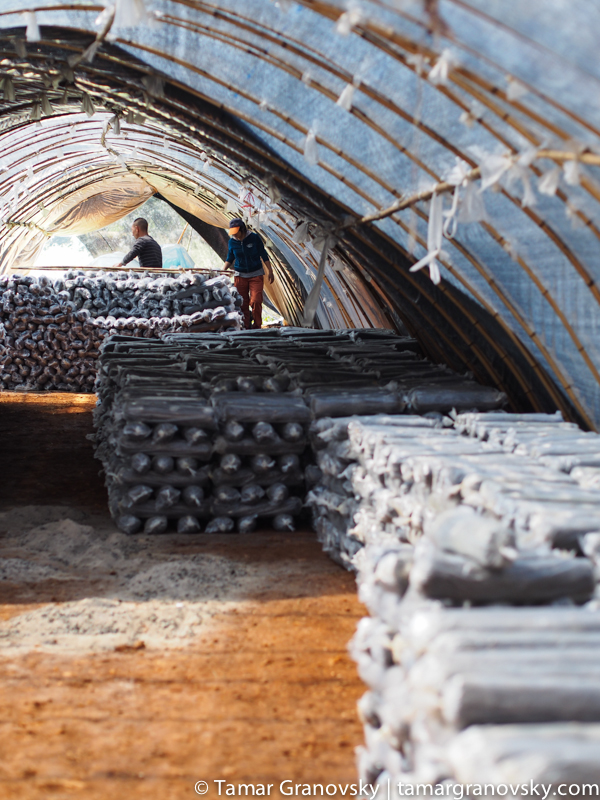
He told us that this part of Yunnan has the perfect climate for growing mushrooms because it is foggy, has dewy/moist mornings, and cool to warm temperatures. The area is a wide, fertile valley between forested mountains. Inside the tents, the temperature is kept at 27°C for growing and 17°C during harvesting/cropping. Each tent is made from black plastic tarp which helps keep the space warm, humid, and shady and each is used for a different phase of the mushroom growing cycle.

Our guide started the tour by showing us how the soil is prepared; it is a compost made from sawdust, wood shavings, nitrogen, gypsum, and older soil. It is all turned by hand, using pitchforks to aerate the soil, and is watered from time to time and covered with a plastic tarp to further promote decomposition. The compost develops as the raw ingredients are changed by the activity of microorganisms, heat, and chemical reactions.

The compost is then scooped and stuffed into, clear, oblong plastic (we are not actually certain of the composition of these bags) grow bags for mushroom cultivation; when filled they look like small logs.The filled bags are punctured and injected with mushroom spawn, laid one on top of the other on a bed of ash (to deter disease-like fungi and insects) and turned regularly to allow the air to circulate. It takes approximately 120 days for this spawn to take hold and grow in the bags. The bars are watered regularly and the relative humidity is kept high to minimize drying of the compost or the spawn. When they are ready, the mycelium (the vegetative part of the fungus) grows in multiple directions and the colour of the logs changes from brown to a yellowish-grey, pockmarked with white spots – fungus – throughout. These changes indicate that fusion has occurred. By paying close attention to the colours the mushroom farm employees can tell which log take has taken to the fungus injection; those that do not are re-injected.

Tuan Jie Zhen-7

After 120 days the grow bags are moved to another tent. The logs are removed from the bags and are leaned vertically against wires that are they strung horizontally between posts. They are then covered with plastic sheeting for a few more days, after which the farmers begin harvesting the mushrooms and can continue to do so multiple times over a six-month period. When this final process is complete the whole operation is repeated.

Mushroom Farm - Tuan Jie Zhen

Mushroom Farm – Tuan Jie Zhen (Rejected Logs)
Mushroom Farm - Tuan Jie Zhen (Ash on Ground)

Mushroom Farm – Tuan Jie Zhen (Ash on Ground)

Mushroom Farm - Tuan Jie Zhen (Fungus-filled Growbags)

Mushroom Farm – Tuan Jie Zhen (Fungus-filled Growbags)

Mushroom Farm - Tuan Jie Zhen (Opening Growbags)

Mushroom Farm – Tuan Jie Zhen (Opening Growbags)

Mushroom Farm - Tuan Jie Zhen (Mushroom Growing on "Log")

Mushroom Farm – Tuan Jie Zhen (Mushroom Growing on “Log”)

We were told that there are three qualities/sizes of mushrooms: small (just opened – the freshest and the most expensive), medium (more open and less expensive), and large  (the cheapest because they must be sold within a few days, before becoming too old and dehydrated). They sell these mushrooms in Yunnan and across China. However, the fungus-impregnated bars are also sold to mushroom growers in Japan, Korea, the U.S., and Europe.

Mushroom Farm - Tuan Jie Zhen

Mushroom Farm – Tuan Jie Zhen (Photograph Courtesy of Fenyvesi Boglarka)

Mushroom Farm - Tuan Jie Zhen

Mushroom Farm – Tuan Jie Zhen (Photograph Courtesy of Fenyvesi Boglarka)

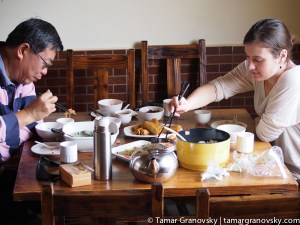
That afternoon Bogi and I met Rawdon for a large and delicious lunch;we ate soup, spring rolls, bitter melons with pork, a spicy tofu dish, and a very typical dish found throughout China: tomato and scrambled eggs. Among the options we were offered as ingredients for our dishes were eel, and honey combs with fresh grubs. We decided against them.
Lunch with Rawdon and Bogi

Lunch with Rawdon and Bogi

After our lunch together, the three of us walked to a mostly abandoned Le Ju Village just a few kilometres outside of Tuan Jie Zhen. The village is located on a hillside and its most recent architecture is 100-200 years old. However, the village actually dates back much further; it has been occupied for about 600 years. The people of this village were Yizu (Yi minority).


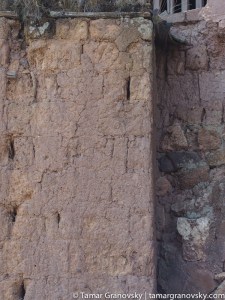
Many of the houses there are two stories high and all are constructed from bricks made from the iron-filled local soil. A number of the outer walls are, additionally,covered with a paste of red clay. Some bricks contained hay, bran, and corn which helps keep the walls strong.
Tuan Jie Zhen - Le Ju Village

Tuan Jie Zhen – Le Ju Village

The layout of each house is a square and surrounds a central outdoor courtyard. The kitchens and communal areas are on the bottom floor and the bedrooms and other communal areas on the top, and each home has an outhouse. A multi-generational family would live together and additions were built as needed, next door to the homes. Family members could freely come and go from one house to the other via a gate between the two side-by-side homes.

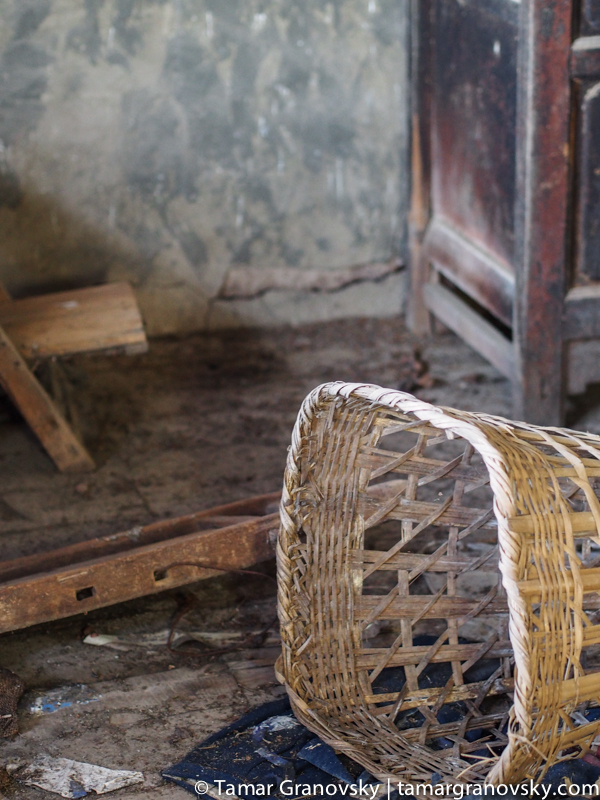
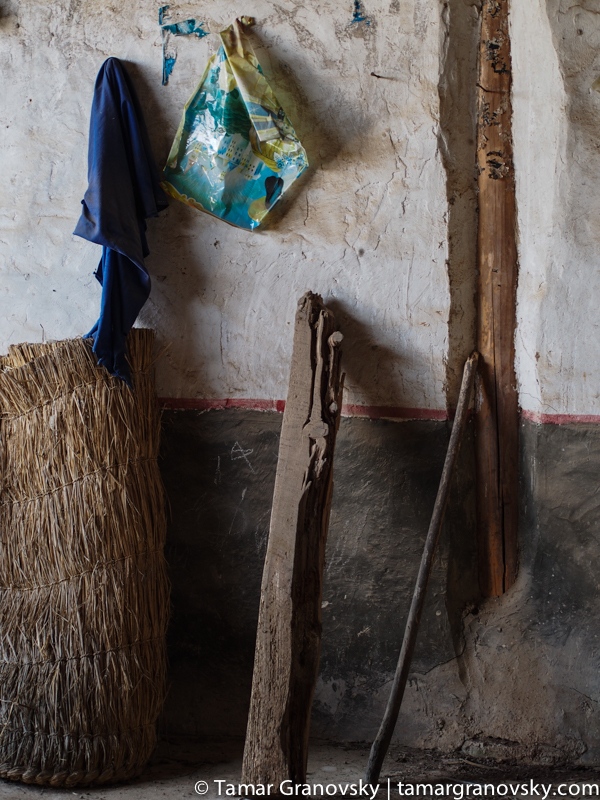
Today, when walking through the alleyways, one can see that the houses are covered in vegetation and the inside wooden stairs and floors are in the process of decaying. A few everyday items from the most recent generation remain in these homes as vestiges of the past. We noted a number of such items, including, pots, shoes, furniture, textiles, and even an unused coffin. It seems that only a few homes remain occupied. As Rawdon described the village to us Bogi and I could imagine what it might have been like there, not too long ago, despite its ghost-like emptiness today.

Tuan Jie Zhen - Le Ju Village

Tuan Jie Zhen – Le Ju Village

Tuan Jie Zhen - Le Ju Village

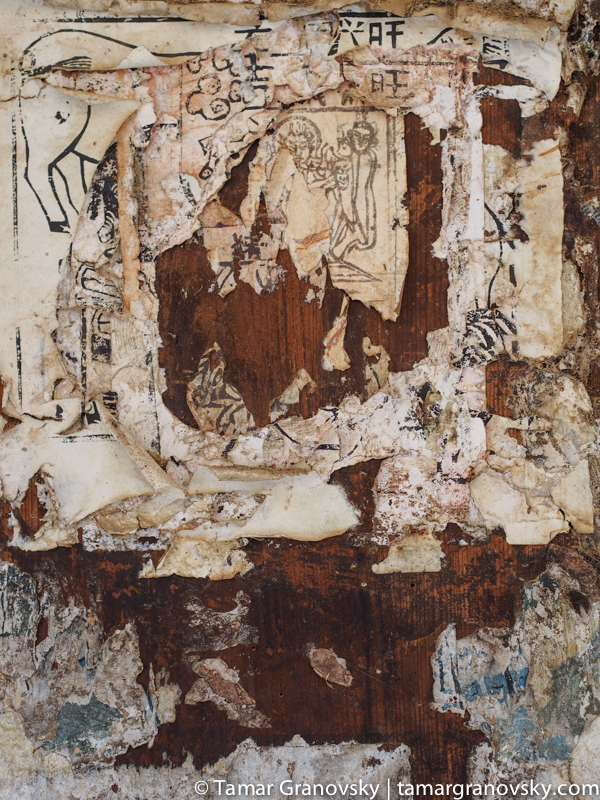
Tuan Jie Zhen – Le Ju Village (Writing on a Wall)

Tuan Jie Zhen - Le Ju Village

Tuan Jie Zhen – Le Ju Village

Tuan Jie Zhen - Le Ju Village

Tuan Jie Zhen – Le Ju Village

Tuan Jie Zhen - Le Ju Village

Tuan Jie Zhen – Le Ju Village

Tuan Jie Zhen - Le Ju Village - (Kitchen)

Tuan Jie Zhen – Le Ju Village – (Kitchen)

Tuan Jie Zhen - Le Ju Village

Tuan Jie Zhen – Le Ju Village

Tuan Jie Zhen - Le Ju Village

Tuan Jie Zhen – Le Ju Village

Tuan Jie Zhen - Le Ju Village

Tuan Jie Zhen – Le Ju Village

Tuan Jie Zhen - Le Ju Village

Tuan Jie Zhen – Le Ju Village

Tuan Jie Zhen - Le Ju Village (Gateway from One Home to the Addition)

Tuan Jie Zhen – Le Ju Village (Gateway from One Home to the Addition)

Tuan Jie Zhen - Le Ju Village

Tuan Jie Zhen – Le Ju Village

Tuan Jie Zhen - Le Ju Village (Unused Coffin)

Tuan Jie Zhen – Le Ju Village (Unused Coffin)

Tuan Jie Zhen - Le Ju Village (Kitchen)

Tuan Jie Zhen – Le Ju Village (Kitchen)

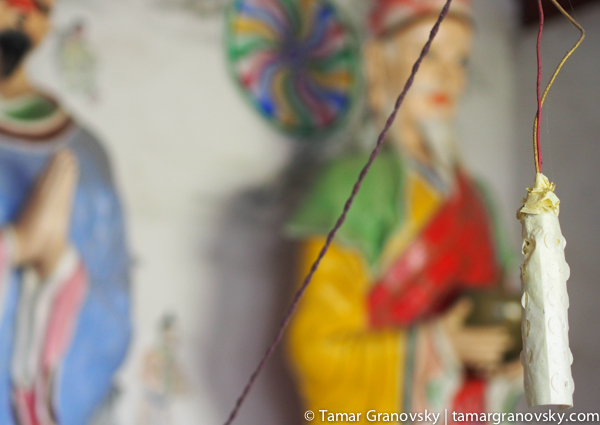
Finally, at the top of the village and hill, we reached a surprisingly large temple (for such a small community of homes) that still has a permanent caretaker. He unlocked the doors so that we could go in and give a little prayer and some offerings (candy, apples, money, etc. – to bring us luck), as well take photographs. At the bottom as well as the top of the stairs leading to the temple is a protected votive offering and incense area. At the entrance of the temple itself, people leave pine needles on the ground. We asked the caretaker about some of the traditions but his dialect was so localized it was impossible for us to understand his answers – even Rawdon had difficulty following him. What Rawdon did tell us is that there are women who still come to pray monthly at this temple. The temple is graced by a variety of religions. Both Buddha and the local “Earth” Gods are worshipped. Two alters are housed just outside the temple: one contains a statue of Guan Yin (the Goddess of Mercy/Compassion that changes his/her form and gives protection and help to those in need. Families without children often pray to him/her). The second alter houses a statue of the God of Fortune.

Tuan Jie Zhen - Le Ju Village (Temple, Guan Yin)

Tuan Jie Zhen – Le Ju Village (Temple, Guan Yin)
Tuan Jie Zhen - Le Ju Village (Temple)

Tuan Jie Zhen – Le Ju Village (Temple)

Tuan Jie Zhen - Le Ju Village (Temple)

Tuan Jie Zhen – Le Ju Village (Temple)

Tuan Jie Zhen - Le Ju Village (Temple)

Tuan Jie Zhen – Le Ju Village (Temple)
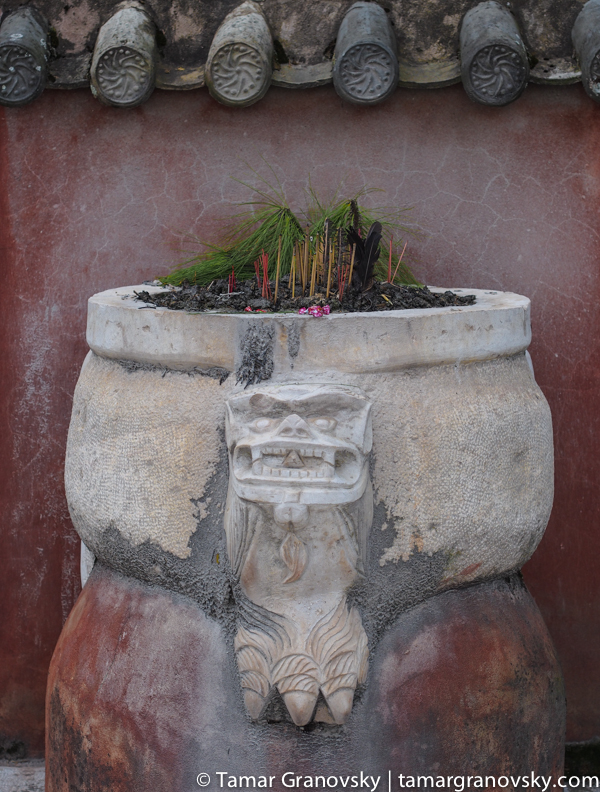
Tuan Jie Zhen - Le Ju Village (Temple)

Tuan Jie Zhen – Le Ju Village (Temple)

Tuan Jie Zhen - Le Ju Village (Temple Caretaker)

Tuan Jie Zhen – Le Ju Village (Temple Caretaker)
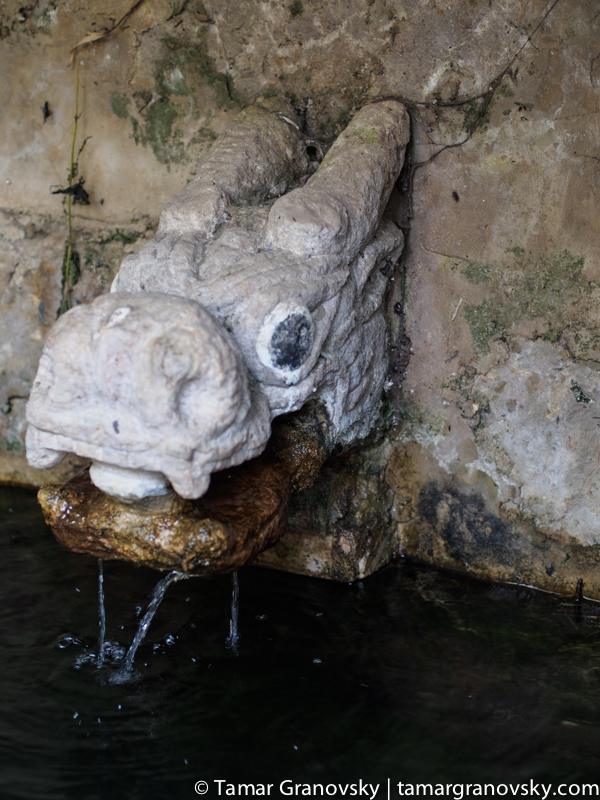
Tuan Jie Zhen - Le Ju Village (Fresh Spring Water)

Tuan Jie Zhen – Le Ju Village (Fresh Spring Water)

In Tuan Jie Zhen many homes have spells written right on the walls/entrances as well as others written on paper and pasted up. Animal hooves and bones that are meant to offer protection can be seen hanging on the doors; cacti on the roofs serve a similar purpose. Additionally, the doors are decorated with mirrors, which are also meant to ward off the devil. As a common tradition in China, a lucky character “Fu” (which means good fortune, happiness, luck, and richness) is hung upside down on the doors of people’s homes. The character is upside down to mean “fu dao” which translates to “this fu is upside down” (literally). This is actually a play on words since the pronunciation for “fu dao le” is the same as another word with a different meaning and written in different characters – a word which means “arrived.” As a result “fu dao” suggests that fortune and good luck have arrived.

That night was quiet; Bogi and I went out for supper and then returned to our room. We were invited to Rawdon’s for breakfast for the following morning, met a colleague of his from Beijing, wandered the local market, had lunch, and returned to Kunming.

Tuan Jie Zhen - Woman Selling Goods at Market

Tuan Jie Zhen – Woman Selling Goods at Market

Tuan Jie Zhen - Chicken Processing Stall

Tuan Jie Zhen – Chicken Processing Stall

Acknowledgement: I wish to thank Bogi and Rawdon for helping me remember details for this blog entry.


So, Just How Difficult is it to Learn a New Language? My First Five Weeks Studying Chinese

Unbelievably difficult. So damned hard.  Not easy. Challenging. Herculean. Trying. Frustrating. Easier said than done, though none of it is easier said! It’s a truly formidable undertaking. I take one step forward and then twenty steps backward. I am working hard at it but feel as if I have not yet begun to acquire the skill. At times learning Chinese has been emotionally trying and I wonder if I will ever get the hang of it. This is very disconcerting and my pride feels a tad bruised. Yet, I have been told that this is how it goes.

While languages do not come easily to me, I want to learn them. For instance, I love the melodic sounds of Arabic and Greek and would be in heaven if I could speak them. I would like to learn Spanish and Italian, too. I fancy the fact that a language can reveal so much about communities or nations. People are distinct and language is part of this diversity.

Class Outing

Class Outing. Here we are outside the Yunnan Nationalities Village. It is said: Among all places of interest in China, one that stands out immediately is the Yunnan Ethnic Village near Kunming. This is a special place which sprawls over a huge area and houses a number of ethnic minorities of the country. If one wants to witness the nuances in the cultures of different Chinese ethnicities, this is the place to be. Here people live according to their traditional lifestyle in small villages that have been created for them in the premises. It is a perfect exhibition of the diverse Chinese culture. I found it more like Disneyland. (Photograph courtesy of Nathalie Karlsson)

I speak and understand both French and Hebrew but cannot say that I have ever mastered either of these languages; I just get by. And yet here I am, in Kunming, trying my hand at Chinese – which is considered one of the most difficult languages to learn. Nonetheless, after having visited China for ~7 weeks in 2012 I decided that I wanted to commit myself to acquiring the language – in China. As I mentioned in an earlier post, “By learning the language and living in the country for a period of time… I hope to start to have a deeper understanding of the country and people.” It really is as simple as this. I have no great plans, nor a practical reason (work, for instance) to study this language except to be able to actively communicate / have a dialogue with people in this region of Asia.

So, I am now attempting to immerse myself in the country and language. This, however, is not easy. I am at a private school with other foreigners (lao wei), and where English is the common language spoken outside of class. I go out onto the street and attempt to speak with people by ordering food, asking for directions, etc. Many just stare at me – not understanding a word I say. I clearly need more study and  practice so I have decided that I will ask my few Chinese friends in XIngping and Beijing to Skype with me for five minutes every few days so that we may speak in Chinese, together. Perhaps over time (I am hopeful) I will be able to have a simple conversation – but a conversation, nonetheless!

The only way I will be able to improve is to practice listening and speaking. This has to be done steadily and with persistence and determination. I also have to remind myself that it will take time to overcome the various challenges; there are no shortcuts.

But then there is the reality of stretching my brain in order to grasp the nuances of Chinese. I am discovering that the best way for me to learn is to listen first and then attempt to repeat/speak – over and over and over again. I constantly return to the very basic sounds of the initials, finals, and tones.  Little by little (and I do mean little) I am developing a vocabulary. At the moment though, my grammar is still practically non-existent. Perhaps one day I will be able to converse with someone on the street and not sound like an 18-month-old. For now, I am trying to have fun with this experience, to stay committed, and to applaud my very small achievements. It is in the end, all about personal satisfaction and opening up my opportunities.

I am memorizing vocabulary, I am listening to various online Chinese language resources, and I am trying to follow and understand Chinese films. I watch the movies and take note of the English AND Chinese subtitled words; it is unbelievably useful to a student of Chinese when there are subtitles in both English and Chinese. I listen, watch, read, and match words and characters as best as I can.

SO! Here I am studying at a Kiwi Cafe... how the hell can I immerse myself in Chinese? Fortunately, the workers here are Chinese and do not seem to speak English.

Here I am studying at the Kiwi-owned cafe, Slice of Heaven. How can I immerse myself in Chinese, this way?  Fortunately, the staff are Chinese and do not speak English so we have to talk in Chinese with them. This is a nice, little cafe/resto that two friends and I have discovered. We find it a nice place to go to to drink excellent coffee and eat Western dessert and to study.  (Photograph courtesy of Nathalie Karlsson)

At this point I have not yet started learning Chinese characters; this will begin in the next few weeks. I came to the Keats School expecting to learn through oral language, only, but I have been told by numerous teachers and students that Chinese characters represent words and that studying them will make learning the language easier, not more difficult; it will train my brain and help me visualize the words I learn, and also help me pay attention to detail. We shall see. In the meantime, learning to pronounce Chinese Initials, Finals, and Tones is a very difficult endeavour. With a lot of listening and repetition I am slowly becoming able to reproduce the sounds. Sometimes, it seems almost impossible to do this. I have to remind myself that fluency in Chinese is not about how fast I can speak, or how I put a sentence together, but rather about tones, pronunciation, and grammar. I have no choice at this point but to slow down, focus on the tones and get them right. Perhaps one day I will utter a sentence that is actually correct!

I have been told that it can take many years to become fluent in Chinese. Six months will certainly not quite do the trick but at least I am benefitting from one-on-one classes for four hours/day. If I am able to “get by” at the end of this sojourn in China, as well as I do in French and Hebrew, I will have the satisfaction of having accomplished something. And perhaps, in the process, I will have met and even conversed with some interesting people in this country and gained greater insight into their culture. There are some signs of hope, mind you.

The other day, I went to my favourite baozi (steamed, filled, dumplings) stall and was told by the woman who serves me, almost daily, that my Zhongwen (Chinese) is improving. Conceivably this is true; I had my first 4-sentence conversation with the school’s cook that same day and we understood each other! As I’ve mentioned, little by little…  “A journey of a thousand miles begins with a single step.” Lao-Zi, Chinese philosopher and the father of Taoism (604 BC – 531 BC; The Way of Lao-tzu)

Addendum: Five months into learning the language with one month left and I barely get it. JUST!!! I have been told I try to make my sentences too complicated and I cannot easily communicate simply. This is a very tough habit to break because I want to express more complex thoughts….. all in all… not easy.

My Slow Boat to China: Travel on a Cargo Ship

Yours Truly on the Hanjin Lisbon Cargo Ship

Yours Truly on the Hanjin Lisbon Cargo Ship (Photograph courtesy of Martin Wildi)

For years (decades, in fact) I have wanted to travel overseas by ship. I had always imagined that if I went this route it would be to Europe – and I never pictured travelling via luxury liner/cruise ship. In any case, it never happened. Then one day this past Spring, my friend Martin, from Switzerland, sent me an email saying that he would like to take me up on my offer to visit me and Steve in Boston. He had plans to travel in the U.S. for about a month and then take a cargo shipping vessel from San Francisco to Asia in July. Of course I said come and stay with us. What he did not expect was for me to ask if he minded that I join him on the ship. I figured I could change my plans to returnto China in 2014 and head westward by sea in August 2013 instead. I received a positive response and thus began my preparation for a trip on the Hanjin Lisbon.


When I told people I would be crossing the Pacific and other sea waters to get to Hong Kong via cargo ship,  many of them asked, “Why would you want to do that? Don’t you think you’ll get bored?”  My answer was that I wanted to experience slow travel. I wanted to know what it feels like to cross such a distance in more than the 24-or-so hours it takes to fly it. I didn’t want to once again go from one airport to another similar one across the world, in an airplane where people are encouraged to keep the shades down and sleep, or watch a movie or two or three… on their own private monitors so that they barely feel that they are travelling. I also very much wanted to leave the hustle and bustle of land-bound life. I wanted to listen to the wind and look out at the sky and the sea.  I wanted to not be plugged in to the internet atevery moment of the day or night. I guess I just wanted to completely disconnect from the world for a time.Perhaps I’d even spot some sea life in the form of birds, flying fish, dolphins, whales…

Martin had booked his trip via the German shipping company, NSB Reiseburo, and I worked with their travel office settling everything with them – including getting a medical certificate confirming that I am healthy and able to travel (since there is no doctor on board ship). I booked a flight to San Francisco for August 6th; the vessel was expected to leave the Port of Oakland on the 7th and I was told we would be on the water for 20-23 days. This was exactly what I wanted – slow travel.

San Francisco Seen from the Port of Oakland

San Francisco Seen from the Port of Oakland

I arrived in San Francisco and stayed with my cousin Rachel not for one night but for five. Cargo ships have *somewhat* fixed schedules for port arrival and departure but an exact itinerary is not guaranteed – this kind of uncertainty is in the nature of freighter travel. Our initial departure date jumped forward first by one and then three days. I then started receiving email notices two or three times daily from the Oakland Port until boarding confirmation was finally settled.  The working vessel is the priority and a late passenger, for instance, would just be left behind; passengers are incidental. Also, ships may be cancelled or re-routed with little notice.

Port of Oakland

Port of Oakland

Port of Oakland

Port of Oakland

In the early afternoon of August 11, Martin and I walked up the Hanjin Lisbon’s gangway at the Port of Oakland, with the second mate leading the way, holding on to the hand rails that were covered – in places – with machine oil. He took us to our cabins; mine was comfortable and spacious – approximately 18 square meters in size – with a bed, sofa, table, desk and chairs, fridge, wardrobe, television and DVD player, boom box, and en-suite bathroom. It also had a window overlooking containers. No ocean view for me until the last three days of travel on board.

We were given a tour of the Mess Hall and told that we would eat with the Captain of the vessel and the Chief Engineer (CE). We were also shown around of the rest of the ship and informed that though we were free to come and go as we pleased, we were expected to stay out of the way as people worked. As requested, I did not rock the boat, so to speak.

The ship was to depart at 1800 on the 11th but did not actually leave port until 0309 on the 12th.

On the Water

On the Water

As you can imagine, travelling by cargo ship is certainly not the greenest form of travel and therefore is not guilt-free for the eco-conscious. Unfortunately, cargo ships are responsible for extremely high levels of pollution, although sustainability is starting to be addressed. Because a container ship carries cargo from point to point anyway, I did feel as if I had simply stuck out my thumb to hitch a ride; no great harm in that! My choice to travel by container vessel would not affect the route; the ship would still go on its way. This is not the case with air travel, in which fewer passengers means fewer flights.

There are other pluses and minuses to the shipping industry, as cited in Michael Causey’s review of Rose George’s, “Ninety Percent of Everything: Inside Shipping, the Invisible Industry That Puts Clothes on Your Back, Gas in Your Car, and Food on Your Plate” (Washington Independent Review of Books):

George deftly outlines a central paradox about shipping: It is everywhere yet remains unnoticed. Preferring to hide behind a cloak of disarming dullness and ubiquity, the shipping industry is increasingly intent on downplaying any outward appearance of swashbuckling, high seas turmoil or excitement. The shipping industry, in fact, purposely tries not to be noticed and pestered by regulators, which has resulted in the mistreatment of workers (including rapes by fellow crewmen), often without legal recourse, and a failed “security” system. For example, U.S. ports receive 17 million containers a year and physically inspect only 5 percent of them. Thus, these Swiss-cheese-like security programs often miss illegal drugs, counterfeit goods and stowaways, who either are trying to attain a better life outside their country or forced into sex trafficking.

There were also a couple of things I learned from the Chief Engineer (CE): a) Fuel: The ship uses vast quantities of low-grade fuel. Three types of fuel are used on a container ship and, except in countries where higher-grade fuel is required, the low-grade fuel is most often used. b) Ballast Water: Ships pull in sea water at one location and release it in another, which means that the vessel could be transporting ocean life with it –  this of course, like low-grade fuel, has to be destructive to the ecosystem.

Despite all of this I can say I LOVED travelling via cargo ship and would do it again in an instant!

My Partner in Crime, Martin

My Partner in Crime, Martin

NSB’s ship officers are mostly German and the crew is predominantly Filipino. Viktors, the CE, was born in Russia and has lived in Riga, Latvia, since his early 20s.  The Second Engineer was Polish. I found that some of the crew and officers were friendly while others kept to themselves. Over time, I met all 24 crew and officers on board the ship and discovered who was willing to have conversations and who would prefer to be left alone.

Viktors, Chief Engineer

Viktors, Chief Engineer

One of the Crew

One of the Crew

The Captain, CE, first and second mates, and second engineer spend two months on board, followed by two months at home. The rest spend four to six months away from home and return to work two to three months after their leave. Many of these workers have families waiting those many months for them.  On occasion, the crew and officers have the opportunity to take short shore leave, but often at port they simply work extra long hours.

Most employees have laptops and spend time in their rooms on their own or with their fellow crew-mates watching DVDs, listening to music or playing games. But they also often gather together in the lounge watching television, singing along to music videos, drinking, smoking, and playing cards. I noted that The Officer’s Lounge is twice the size and was always empty. Never once used.

One Sunday afternoon I went to take photos of the crew (this the only time off for the crew and this afternoon/evening of rest is cancelled if the ship is at port and at work). At first they acted a bit goofy and seemed embarrassed by the camera but then they just let me shoot. They invited me to join them in their games of rummy and of course I did and had a blast. I won most of the games and they tried to force numerous beers on me (big drinker that I am!!) after each win.

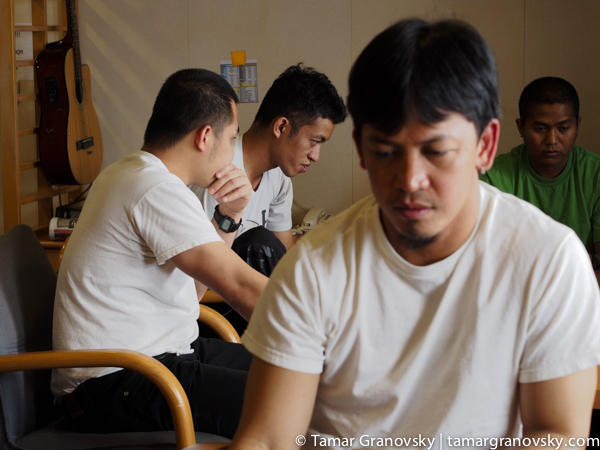
Cargo Ship Crew's Day Off

Cargo Ship Crew’s Day Off

I got to know the people, little by little. I had only small glimpses into their characters and spent a relatively short time with them but my interaction with them was one of the things I thoroughly enjoyed. The crew were so much more fun than the officers but I gradually got to know the officers as well. The CE was very easygoing and a sweetheart.  One morning at breakfast, he asked me if I was on my 4th book. He had taken note that I am a reader; I was almost done with the Nick Cave novel, “And the Ass Saw the Angel.” Yes, it was my 4th book.  The Captain, on the other hand, was a very moody man and under much stress when on board the vessel. However, I learned to go with his unpredictable temperament and even made him laugh on occasion.  And then there was the first mate – born in Poland but living in Germanywith his American wife. He mostly spoke German (despite English being the official language on board), and ignored me until nearly the end of the trip when one night I caught him in a good mood, I suppose. He did not let me get a word in edge-wise as he told me all about himself. People are curious.

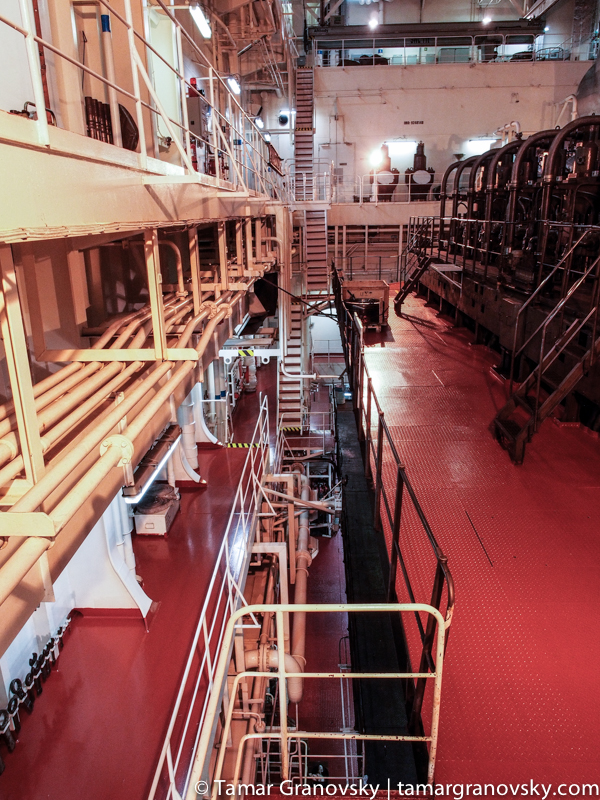
The CE gave Martin and me a tour of the cavernous engine room which is situated below the upper deck and takes up the length and width of the whole vessel. I took photos that afternoon as well as the next, on my own. The noise level and vibration are high in the engine room and ear protection is a must, to muffle the sound. In general the roar generated by the engine intake fans, located on the upper or A decks, is very loud and even reached deck E, where I was living – but I only heard it outside on the deck.  Engine exhaust blare is always felt and heard on larger vessels. This is just the way it goes, but all in all it was not too bad.

Engine Room Overview (Engines are 2-strokes slow speed)

Engine Room Overview (Engines are 2-strokes slow speed)

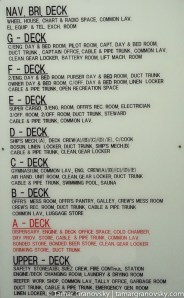
The ship’s above-water decks are 9 “floors” high and the engine room is probably 6 “floors” deep – to the bottom of the ship. Inter-modal cargo containers take up the majority of the above-water space on the Hanjin Lisbon; this vessel can carry close to 9000 containers. Living quarters are a relatively small section in the four middle floors of the ship. Below the living quarters are the kitchen and mess halls. The A Deck has a gym and one large office. The Upper Deck the lowest of the eight decks (but the first above water) has the entrance to the engine room as well as the laundry room, etc.

Stairwell

Stairwell

Stairwell

Stairwell

I had the impression that I ate a lot. Breakfast was at 0730 – although I had a first breakfast prior to the official time (I was up at 0500 every morning and hit the mess hall a little after 0600 — the cook and steward knew my morning schedule and coffee was made as soon as I arrived). Tea time was at 1000 and lunch, at 1130.  A second tea time was at 1500 and supper was served at 1730.

Meals were large, and heavy on meat although on Fridays fish was served. I attempted to eat lightly but it was not easy since there were few vegetables offered. Meals were served separately for officers and crew: in the mess hall for the officers and passengers, predominantly German food was served. The crew ate mostly Filipino food in a separate mess hall. Below is a typical menu:

  • breakfast: strammer max, (eggs with meat – here is a recipe for a fancy version of what we ate) – or some other style of egg with meat – bread, cereal, cheese, juice, coffee, tea, milk, fruit
  • lunch: meat of some kind, potato, and a frozen vegetable, perhaps
  • dinner: more meat or eggs of your choice, rice or potatoes, perhaps a frozen vegetable, an iceberg lettuce salad  with cucumber, carrots, radishes, green peppers, and tomatoes, cold cuts, cheese

Martin and I socialized primarily during meals and tea time. I spent a lot of time on my own, which was perfectly fine with me. Over the course of those 20 days I was able to read  six books and five New Yorker magazines as well as take notes on my experiences and photograph the ship. Several evenings a week we played backgammon together, drank beer, watched a video, or looked at the photographs we had taken.

Every day was more or less the same and I had my own routine. As required, I set the clock back an hour before I went to bed. At some point during the voyage we had to change the date forward a day less an hour, before bedtime. As I mentioned above, I’d wake up early, so I would grab coffee and a snack from the crew’s mess hall. I would then head down to write to Steve and my family – using the ship’s email service. After breakfast I visited the Naval Bridge to check how far we’d gone since the previous morning. With the officer on watch, I’d review the sea charts andthe vessel’s hourly progress as well as take a look at the three radar screens. Then I’d go back to my cabin or onto the deck and read. If it was not wet I would climb up and down the stairs and walk the “walkable” decks. I’d then read some more. For a few days I even tried to add cycling at the gym to my daily “regimen” but that did not last long. And of course there were mealtimes.

The waters, on the whole, were extremely calm. There were perhaps two or three days of rougher movement, which was barely felt on such a large vessel, but one day, as I walked down the hall of A deck I could feel the to and fro, back and forth, rock and roll, pitch, writhe… While looking out the windowat the end of the hall I could see only sky one moment and only water the next.But even this did not induce seasickness – which I had expected to experience at some point during the voyage.

Glasses in the Wheel House

Glasses in the Wheel House

One morning the entire sky was filled with sheet lightening reflected in the clouds. I could hear thunder far in the distance. It had rained all night. The morning started very dark but then the sun slowly, slowly forced its way through the clouds. Quite a few days saw very calm waters – sometimes so calm the water was like a shimmering mirror. At times fog came along with these calm waters, but on other days they were accompanied by a perfectly clear blue sky.

On the Water, Pacific Ocean

On the Water, Pacific Ocean

On the Water - the North Pacific Ocean (photograph courtesy of Martin Wildi)

On the Water – the North Pacific Ocean (photograph courtesy of Martin Wildi)

I had often wondered what cargo we were carrying but thought, for some reason, that the answer might in fact be nothing! My suspicion was finally confirmed one day by the Captain; we were travelling with mostly empty containers. Full containers had been off-loaded in Long Beach, CA, and many empty containers put on the vessel in Oakland. These empty containers would be off-loaded at ports in Asia and beyond and would be replaced with full ones. He also informed me that a Captain never knows what cargo his vessel is carrying unless it is flammable.

I realized that I had become a savvy sea-farer when, while doing a crossword puzzle one day, I came upon the following clue: Korean strait port – and I actually knew the answer: Busan!!  We were supposed to arrive at the Busan, Korea port on the 23rd.

It took almost four fulldays to pass the Aleutian Islands and we were, at one point, south of Russia in the North Pacific. To the north of us, were Russian shipping vessels. South west, within easy view, was another cargo ship, on its way to a different port in Korea, and there were fishing ships within eye sight – almost touching distance from us. This was a strange sensation because prior to that, we could only see other vessels via radar – a hundred nautical miles or more away. It was the first time we had passed a ship within sight in about eight days – since being on North Pacific waters. That day we were expecting to begin passing through Japan (due north of Yukusha) –  through contaminated waters from Fukushima…. so there was no water intake around that area (in nautical map-speak, I learned that this means: from 30° – 50° latitude to 130° – 150° longitude).

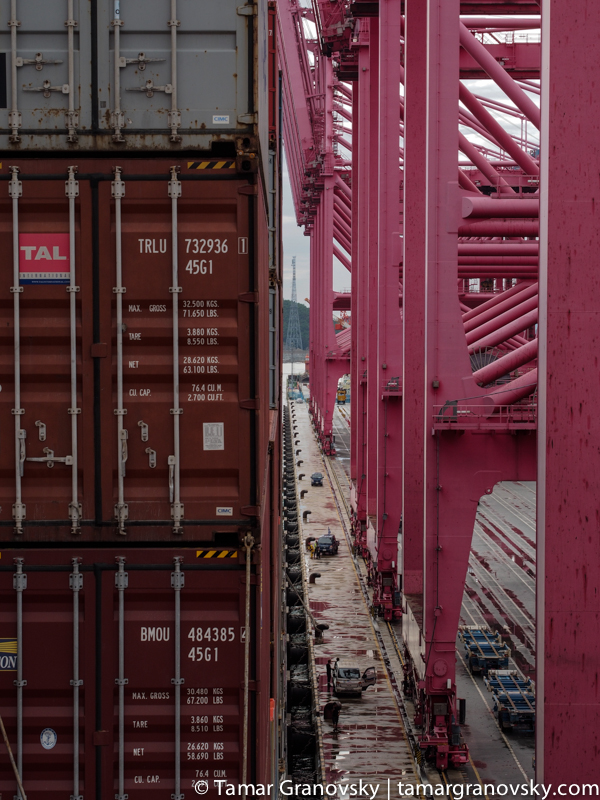
We arrived in Busan port at 1530. The actual city is far from the port so instead of taking shore leave, Martin and I watched the Port of Busan workers – on land – do their thing. Complex pulleys and chains lift containers off the vessel and literally plop them onto trailers and then drop different containers back onto the ship. Upon arrival at our berth in Busan, we saw rows of empty trailers just sitting in wait. Suddenly the air was filled with the sound of little trucks whirring around and backing up as the trailers appeared to just attachthemselves to these trucks. They were ready to accept containers, take them away, and return empty for new ones or, hours later, return full so that new freight could be put on board.

At Port

At Port

From my observations at the Ports of Oakland and Busan it became quite clear that these cargo ports are very busy places, built to handle tremendous numbers of container movements efficiently. Crew (and most certainly passengers) are not permitted to wander around within the terminal. Cargo ports are quite different from cruise ports. Each port handles very different cargo (sometimes one particular type of cargo and sometimes numerous types), which may be loaded / unloaded by very different mechanical means (cranes, pulleys, etc.). Individual cargo ports are divided into separate operating terminals which handle the various cargoes, and are run by different companies. Take a look at this very interesting National Geographic piece, “Megastrucures: China’s Ultimate Port,” to get a feel for what I saw at the ports. In fact, we had to anchor ship for almost 24 hours before we could enter Shanghai’s Yangshan Port, which is what this video is about.

So, my trip began at the Port of Oakland, continued on to the Ports of Busan, Yangshan, Ningbo (where Martin and I took off for a few hours to wander this small place that seems to exist solely for its port), and finally ended, at the Port of Hong Kong. By the time my voyage was over I had travelled on the North Pacific Ocean, through the Yellow (or East) Sea, and on to the South China Sea. My trip on a slow(ish) boat to China had lasted a total of 20 days. Here is the vessel’s complete route:

La Spezia – Port Said – Suez Canal – Singapore – Vung Tau – Hong Kong – Yantian – Ningpo – Long Beach – Oakland – Busan – Shanghai (Yangshan) – Ningbo – Hong Kong – Yantian – Singapore – Suez – Port Said – Naples – Livorno – La Spezia

I highly recommend this mode of transportation. As I’ve said, I’d travel this way again without hesitation and hope that I will have the opportunity to do so. If you are not in a hurry to get where you want to go, are in fine health, and are not afraid of the wide open sea then I suggest this unique mode of travel. It’s relatively inexpensive (certainlycompared to cruise ships) and easy to arrange, as more and more freighter companies are offering passenger service.