Author Archives: Tamar Granovsky

Unknown's avatar

About Tamar Granovsky

Tamar Granovsky began working in photography in Boston, Massachusetts. She is now based in Montreal, Quebec. In 2018 she was named LensCulture’s Top 50 Emerging Talents. She has been included in various juried group exhibitions including the 5th Biennial of Fine Art and Documentary Photography in Barcelona; Photography Now 2017, at the Center for Photography in Woodstock; and the 22nd Juried Show: Peter Urban Legacy Exhibition at the Griffin Museum. In 2020 her work appeared in Boston as part of 8th Edition Regional Photographers Showcase of The FENCE. Her first solo show was at Cambridge’s Multicultural Arts Center, in September / October 2019. Prior to her career as a photographer, Tamar had several solo and group exhibitions, in Canada, in mixed media sculpture installation and was a recipient of a Canada Council Exploration Program Grant. Her pursuit of photography follows a career in sculpture, with a 17-year hiatus from the arts, as an archivist. The reflective, evocative, and grounding properties of the medium feed Tamar’s love for photographic work.

Picture my Parents

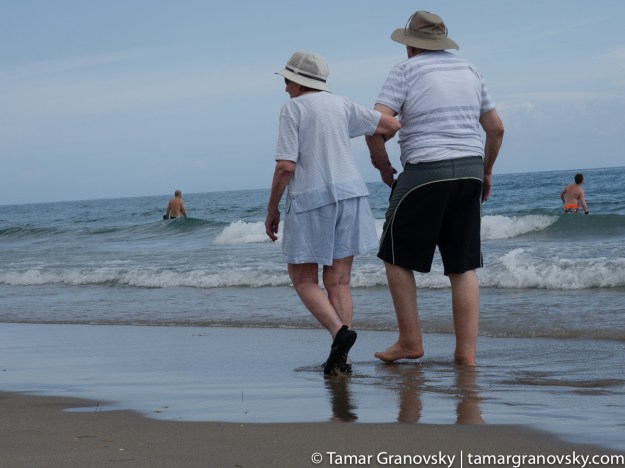
At the Beach

At the Beach

I usually photograph people who are strangers, and in places away from home. I take photographs of friends and family only from time to time. But since I photograph that which touches me – and of course friends and family do exactly this – it may be time to consider photographing the people I love, more often.

Almost four weeks ago I arrived in Florida to spend 2.5 months with my parents – specifically to help my mum take care of my dad and to help her around the house. She turns 87 tomorrow; as will my father, in six months. I have written about them in my blog before. Since we live far apart (I live in the Boston area and my parents live in Canada), every time I see them I realize how they have aged. It is strange, almost surreal, to be taking care of someone who once was your care-taker. Doing just that, this year and last, has made my admiration and love for them change and grow.

It was about ten years ago that my mum noticed small, subtle changes in my dad’s behaviour – short-term memory loss and moments of confusion. He continued to decline in slow intervals. Even though he has never been diagnosed, based on the various dementia descriptions on the Mayo Clinic and NIH sites, my sister, mum, and I have figured out that he has had multiple “mini” strokes (confirmed by his doctor) and (probably) has vascular dementia. No matter, it gave us comfort to put a name to what was/is going on with his memory. His decline is slow but steady. There are physical changes, and loss of the interests and personality he once had.
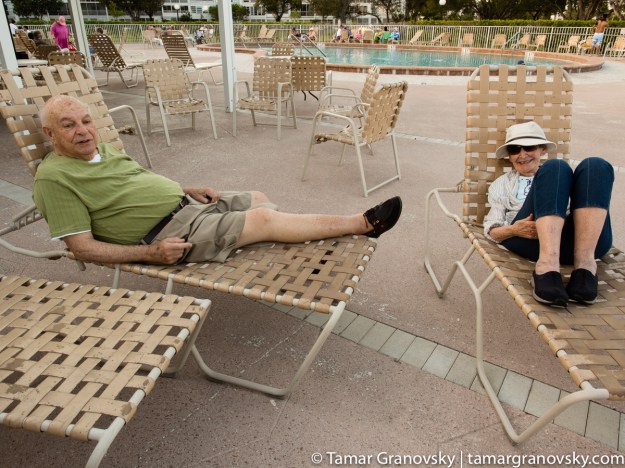
At the Pool

At the Pool

My mum suffers the most from this situation, although she will deny this. It is not unusual to hear that the caregiver is the one who fails in a more critical way because of stress. I have seen my mum age quickly and her friends have made note of this, too. It is all due to her hard work and great worries this past decade. Day in and day out she spends her time loving, ministering to, and monitoring my dad. This wears her down far more than she is willing to admit.

Living with them in Florida is my little way of giving my mother a breather and enabling them to escape the snow, ice, and frigid temperatures of Montreal (it is also a way to give my sister a break – she is the one who is there for them the rest of the year – and for that I am truly grateful). I drive them around and do whatever I can. Most of my time is spent with my dad. I don’t dress or shave him (he is still capable of doing both although he needs a little help at times), but I look after his mental well-being. This helps structure his life so that he does not constantly sleep or binge-eat – as is his wont. When we play scrabble, somehow his mind is fairly clear; this is the one intellectual activity that still really works for him. When we’re together, we play five, six, seven games a day.

Game of Scrabble

Game of Scrabble

After three weeks of this I must say that I am exhausted each night. With this experience, I worry even more about my mum – much more than I worry about my dad who, with good and bad days, remains in good humour despite awareness of his own disconnectedness and decline (which he pokes fun at).

My mum is a fiercely independent woman. She makes sure that I (and my sister who lives in Montreal) respect her independence while we remain supportive and ready to help her manage. My mother is a strong and intelligent woman; she’s also sad, angry, nervous, and stressed. She’s angry with herself, angry with my dad, and angry with aging, to a certain extent. But she still laughs because my dad can still make her do so. She is in pretty good shape and her head is “mostly working” (as she likes to say). My father, in his simplified condition, has faced aging differently. He goes with the flow and is content to be alive. He has always embraced life and is mostly good humoured. When he is not, it is largely due to his illness and in reaction to being pushed to do something he does not want to do.
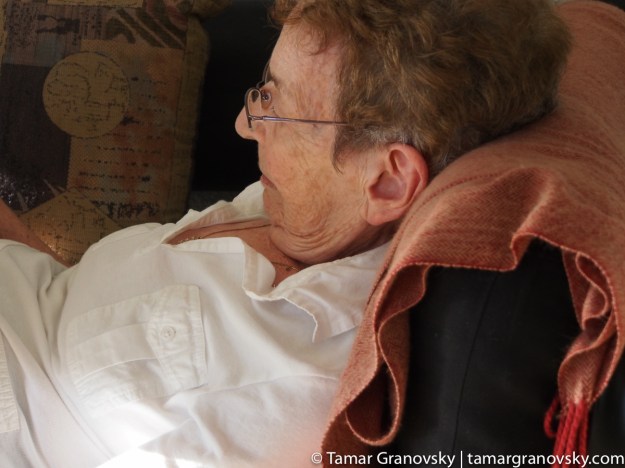
Reading

Reading

I am very aware that I am still an intruder, of sorts, in their lives, and that taking pictures of them makes me more of one. But with these photographs I hope that I am able to capture my parents and their relationship with one another.

The three of us live under the same small roof 24 hours a day. The photographs I have taken of them in the last few years are not many – partially because my mother does not want to be the center of attention. But! I realize it is critical to capture them before they are lost to me, before this chapter of our lives together ends. I am fortunate to have this period with my parents – seeing them love and care for each other or even get frustrated with one another. For me, it is all about watching their changing relationship and appreciating that as well as valuing my relationship with them.

Addendum: Out of respect to my mum (per her request), I have aborted this project.

At the Pool

At the Pool


On the Road Again

Self-portrait. Newark, Delaware, United States

Self-portrait in motel. Newark, Delaware, United States

Last year I spent three months in Century Village, Deerfield Beach, Florida, with my parents. They are “snowbirds.” That is, each winter they fly the coop from frigid, snowy, and icy, Montreal to the warmth of Florida. I was there to help my mother with my father who suffers from vascular dementia and with errands and daily tasks around their condo. This year, they arrived a few days ago, and I preceded them by half a week. For many reasons they hope to sell their condominium. This shall be their last year in Florida after almost 20 years of the sun’s felt heat and wintertime comfort. But this is what life is about. Change.

On my drive down from Boston, I sampled some of the motel chains off U.S. highway I-95.  I imagine that what I saw there goes for the rest of the U.S., and Canada, as well.  What the chains look like and offer may differ a little, place to place; but from what I saw, the change from one to the other is barely noticeable. This homogeneity or standardization is not particularly appealing to me but staying at these motels made my trip a quicker one since I did not have to deviate from my route in any way. Each evening, as I signed in and spoke with the motel desk clerks, it was clear that the outward appearances of these places certainly do not reveal the cultural differences of the locality I landed in.

Still, camera in hand, I was given “variations on a theme” to photograph.  Here are a few shots that I took of these different places that are all the same.

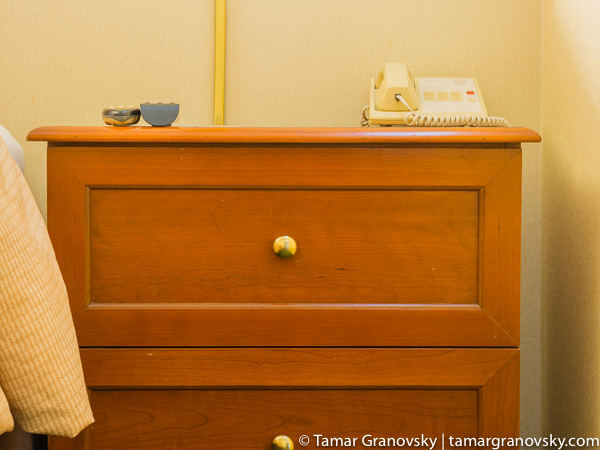
Motel room in Newark, Delaware, United States

Motel room. Newark, Delaware, United States

Motel Room. Lumberton, North Carolina, United States

Motel Room. Lumberton, North Carolina, United States

The view outside my motel room. Lumberton, North Carolina, United States

The view outside my motel room. Lumberton, North Carolina, United States

Motel room. St. Augustine, Florida, United States

Motel room. St. Augustine, Florida, United States

The view outside my motel room. St. Augustine, Florida, United States

The view outside my motel room. St. Augustine, Florida, United States

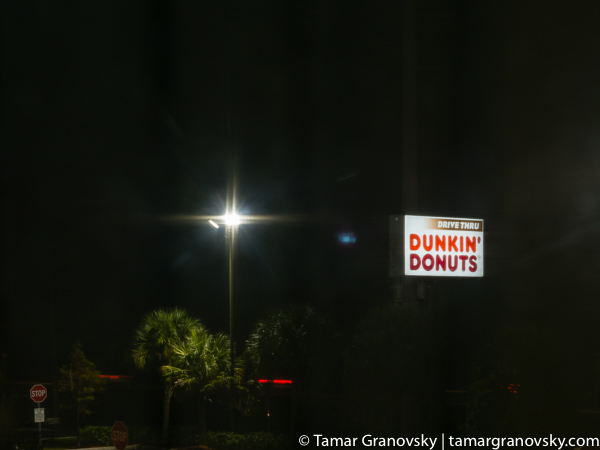
Best Breakfast on the Road and certainly NOT Dunkin’ Donuts:

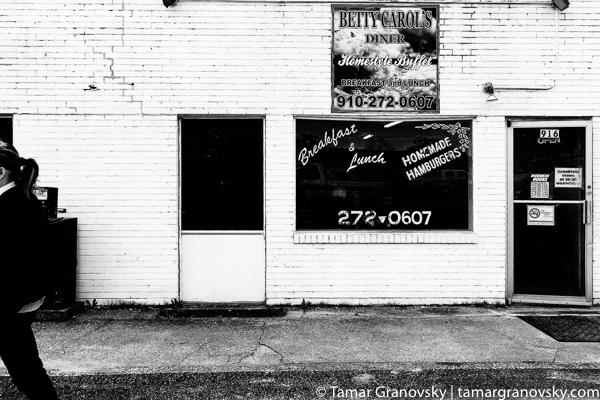
Betty Carol's, Lumberton, North Carolina, United States

Betty Carol’s Diner, Lumberton, North Carolina, United States

Betty Carol's, Lumberton, North Carolina, United States

Betty Carol’s Diner, Lumberton, North Carolina, United States

Betty Carol's, Lumberton, North Carolina, United States

Betty Carol’s Diner, Lumberton, North Carolina, United States


The Salton Sea


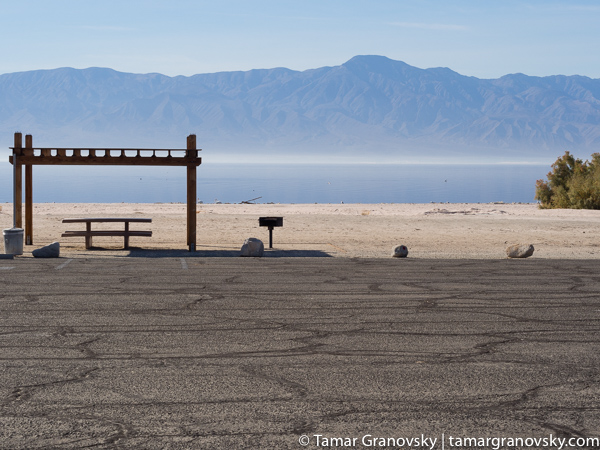
Salton Sea State Recreation Area, State Park, California

Salton Sea State Recreation Area,State Park, California

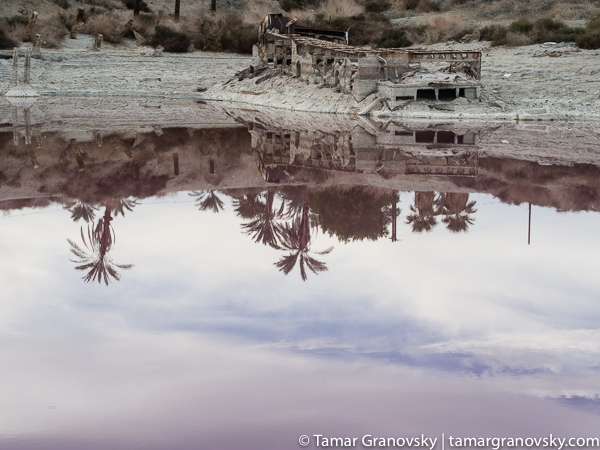
This past June I took a photo workshop with Gerd Ludwig at the Salton Sea in California. Little did I know beforehand, that this would be the start of a long-term project. I found a place that grabbed my curiosity in a strong hold; I wanted to dive right in. The idea that I can go back, over and over again, and pay close attention to this place so that I am more than superficially acquainted with it is thrilling. How lucky!!  It is an evolving process, a non-trivial idea, and utterly amazing that I can do this.

This project examines overlooked features of a desert that bares witness to the human touch. In 1905, the Colorado River Dam flooded a low-lying valley and created the Salton Sea. Up through the 1960s, real estate developers worked to make this the next Palm Springs and a magnet for movie stars.

They failed. Today the Sea – California’s largest lake – is polluted and near-dead. Fish carcasses rot along the shore, and have turned the Sea’s perimeters into oddly sanded beaches of their remains. The sea of hope quickly evaporated.

Desert Shores, Salton Sea, California

Desert Shores, Salton Sea, California

The Salton Sea is a part of an Americana whose culture is a world apart from the rest of the United States. Places like Bombay Beach and Salton City represent the decaying vision of the Sea’s hopeful future; Slab City is a hovel for squatters; Calipatria, and Niland are ordinary city-towns where the life-bloods are agriculture, solar farms, geo-thermal energy.

Calipatria, California

Calipatria, California

Silence, emptiness, banality, and “rawness” attract me to this environment. Everything seems to stare at you; the illusory unpeopled streets give me the sense of something invisible. Other photographers have been drawn to the fallen romanticism of the Salton Sea. My own photographs are less about this lost promise; the inescapable “hereness” of this desert landscape and its surroundings opens my eyes to the everyday and the richness of the prosaic.

Desert Shores, Salton Sea, California

Desert Shores, Salton Sea, California

Niland, California

Niland, California

Highway 111, Salton Sea, California

Highway 111, Salton Sea, California

The railway tracks outside Calipatria, California

Railway tracks outside Calipatria, California

Desert Beach, Salton Sea, California

Desert Beach, Salton Sea, California


On Photographing People


Kunming, Yunnan Province, China

Kunming, Yunnan Province, China

As some of you know, over the last year I have taken several photography workshops to help me get beyond my self-taught, working-on-my-own, vacuum. One of the (many) things Ive discovered while at these workshops is that some people have a fear of approaching and photographing strangers. During my travels I realised that this is certainly not one of my issues. I take complete pleasure in going up to people and striking up conversations. Some of my images are informal street photographs but many are straight “portraits,” taken after asking permission or at least having been acknowledged by the subject. The latter approach is my preferred way of working.

I believe that I reach out to strangers with humility, curiosity, and openness. I have no qualms about asking someone who captures my interest if I may photograph her. I tend to spend a little time chatting with the person as s/he becomes more comfortable with the idea of being photographed. This actually makes the interaction more congenial and collaborative which is how I like it. There are those who say no but then, of course, there are those who simply say yes and allow me to shoot away, without particularly wanting to chat.

Bahia, Brazil

Bahia, Brasil

My inclination when taking these portraits is to get very close to the person. I have an M43 camera and utilize the 24mm and 90 mm full frame lens equivalents. The first enables me to get close to my subjects yet shows them in the context of their surroundings. The second lens lets me get wholly closer. The 24mm lens facilitates a story (should the viewer want to read one) because it is a wide one; there is no need to step back to get the background and diminish the subject while doing so. I believe that by getting closer to the person I create a more powerful image.

Camden, Maine, U.S.

Camden, Maine, U.S.

Kunming, Yunnan Province, China

Kunming, Yunnan Province, China

As I spend time with my subjects I try my best to follow these simple rules of my own making: be honest and direct with people, and always be respectful. By doing this I am being true to  myself and feel I am inching a little closer to the emotional lives of the people I photograph.

Outside of Xingping, Guangxi Province, China

Outside of Xingping, Guangxi Province, China

Charleston, South Carolina, U.S.

Charleston, South Carolina, U.S.

Bahia, Brazil

Bahia, Brasil