Category Archives: China

Be Prosperous : Throw Yourself and Enjoy. Travels in China.

Perfectly aligned cigarette boxes on display and for sale.

I still feel China in me. I smell it and taste it.

The stench of cigarette smoke was all enveloping; it seemed that every man held a cigarette between his pursed lips or fingers; Ba was almost always with one. But there were other odours. My throat closed as I inhaled the remarkable potency of chili oil as lunch dishes were being prepared. More importantly, though, were the marvelous fragrances of those meals themselves. I recall the scent of fried eggplant or slivered potatoes, hung shao rou (braised pork belly) or, delicious stir fried amaranth with garlic.

I can also hear China. The sound of roosters in the distance and the content murmurs of “auk, auk auk auk, auk” or “rrrrRR!!” of the hens in the yard. At night, in the dark, there was an orchestra of frogs. The background vocals of the cicadas was even louder. Clearer. Crisp.

The hens were everywhere, In the front and backyards as well as in the house. They ate peaches. They loved the peaches. And watermelon. And anything else we gave them. They defecated everywhere and from time to time I would catch a dog eating the excrement.

This is the backdrop.

Yellow peaches.

Lian Xi Cun (the village)
Zhongcun (the town)
Yanling County
Hunan Province
China

Zhong Cun, Yanling County, Hunan, China.

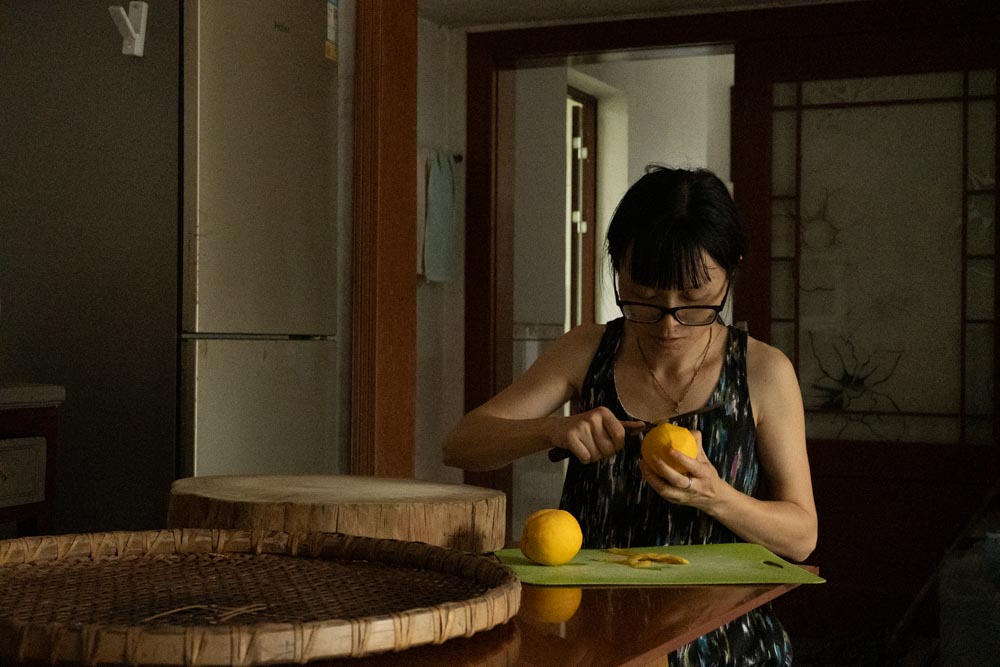
The excuse for my invitation to Li Xian was peaches. Yellow peaches. Pale yellow. Some wore a slight tinge of orange. Every peach was wrapped in its own salmon coloured double layer protection bag. Because of this the peaches were kept safe from not only pests but also the sun so that they remained yellow; they were not allowed to turn to sunset orange/pink. The area is known for yellow peaches. At sunrise Ba, my friend Liya’s dad, picked the peaches. When needed, Pedro and Liya helped. Martin and I unwrapped those peaches which had been very gently dumped from their bamboo baskets into vibrant yellow plastic crates when they were brought in from the field. We placed them in one of three piles (hard and yellow, softer with a kiss of orange, damaged or simply too ripe for shipping). Then we wrapped the undamaged golden fruit (that could easily be mistaken for lemons) with a white, netted, plastic wrap for protection. We learned that there was a correct way to put the fruit in their sleeves and an even more precise method to packing the boxes that were prepared for shipping each mid-afternoon.

Peach crates to be sent out wholesale.
Ba picking peaches.
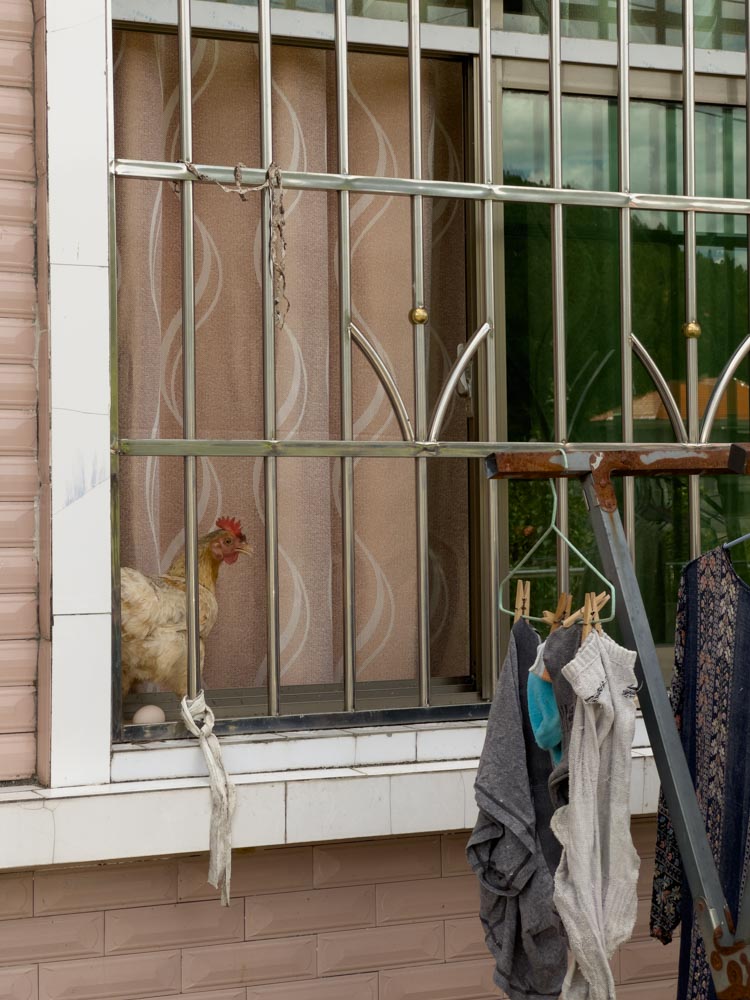
A hen laying an egg on the windowsill.

Ba is my age. Apparently, he has been tired for a long time. Very tired. He feels a general malaise and often gets sick with headaches. He has issues with his lungs. He takes a handful of pills. He makes a concoction of tea. He fears for his health. Several times during my stay at his home he did not get out of bed until we checked in on him. But he insisted on doing everything himself although, in fact, he did not. The four of us, we who came from Canada, Portugal, and Singapore helped him, did what we could. Liya did the brunt of the work alongside her father. The work never ended for either of them. As well as the physical work related to peaches, they collected orders from wholesalers or individuals. They yelled at each other because they were fully dedicated workers with their own ideas about how things should be done. Often Ba escaped with his cell phone. He was as addicted to it as he was to his cigarettes. Liya, luckily, had us. In between our work we played. We laughed. In the future she will remember this when she sees the many photographs Martin and I took of her laughing.
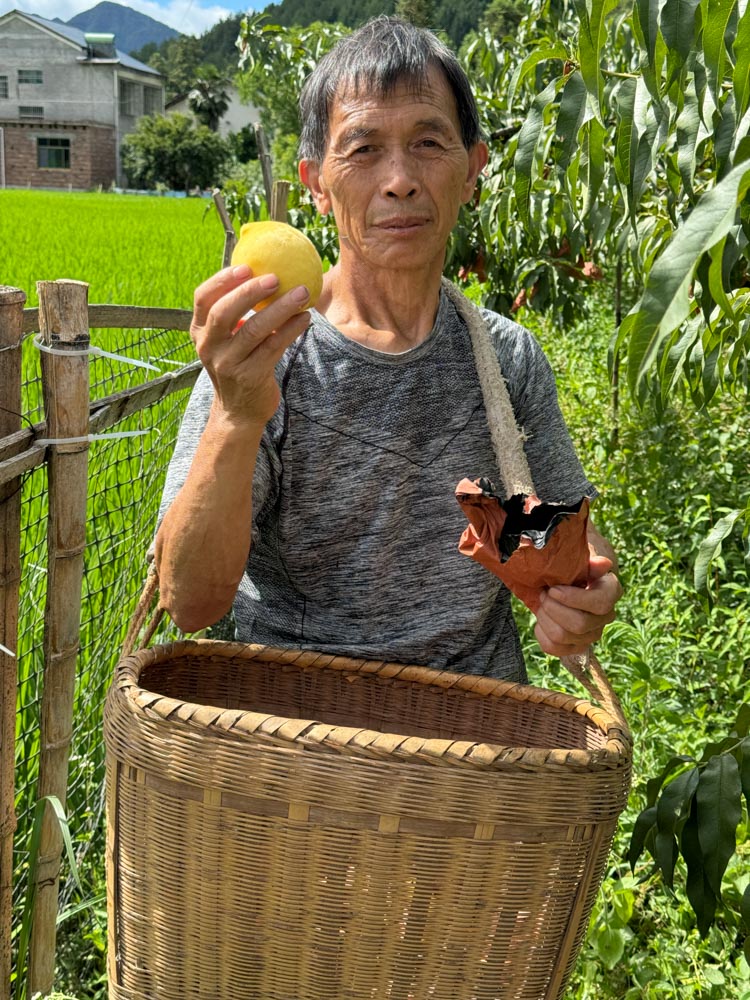
Ba with a perfect peach.
The blue thermos is the one Ba drinks his tea from.
Liya beginning the task of preparing peaches for drying in the sun on the rooftop of a shed.
Liya and Martin laughing during a tea break.

Yanling County is known for its isolation and poverty. It was well known as being red – closely tied to China’s red culture campaign. According to Chinese history books, Mao launched the Land Reform Movement of New China in Zhongcun Town.

Lian Xi village is across the Xielia river from Zhongcun Town center, sitting on the west bank. The name of the village is Lian Xi 联西 (lián xī). 西 Xī is west and 联 lián means unite/united, adjacent. The population is about 700, although many do not permanently reside in the village because of migration to urban areas.

Market gathering in Zhong Cun.
Main Street. This is the tallest building in Zhong Cun and is six stories high. For now it towers over all the other buildings that are no higher than three stories.

Liya says that when she hears or see the words Lian Xi, what comes to her head is her primary school, mountains, rice paddies, dialects… She says that Lian Xi, overall, has not changed since she was a girl; she is now 35.

View from the 2nd floor of Ba’s house.

One big change is the new Chinese National Highway. The old one-lane highway winds around this mountainous region. Mudslides get in the way during heavy rains. The new highway consists of many tunnels that burrow through and go around the mountains. Getting to Zhongcun Town and Lian Xi is easier and faster than on the old highway. However, many people still rely on the more economical local bus that takes the old highway to get from one place to another.

The Xielia He (river) that separates Zhong Cun from Lian Xi.

China is a populous and agricultural country. Land is state and collectively owned. Private ownership is prohibited. Since the 1980s rural (village) collective committees assign parcels of land for cultivation to eligible households.

Liya’s dad (Ba) is not originally from Lian Xi. He and two of his younger sisters moved there after their parents and grandparents died. Ba was 17 at that time and discovered that it was too difficult for him to raise his younger siblings. It was during the Mao era; food was extremely scarce for impoverished families like his. Ba and one of his sisters were assigned to a couple without children and his other sister went to another family. Liya’s mum is from Lian Xi. When she married Ba she moved in with his adopted household, as is tradition for women in China in mostly rural areas and amongst less educated couples.
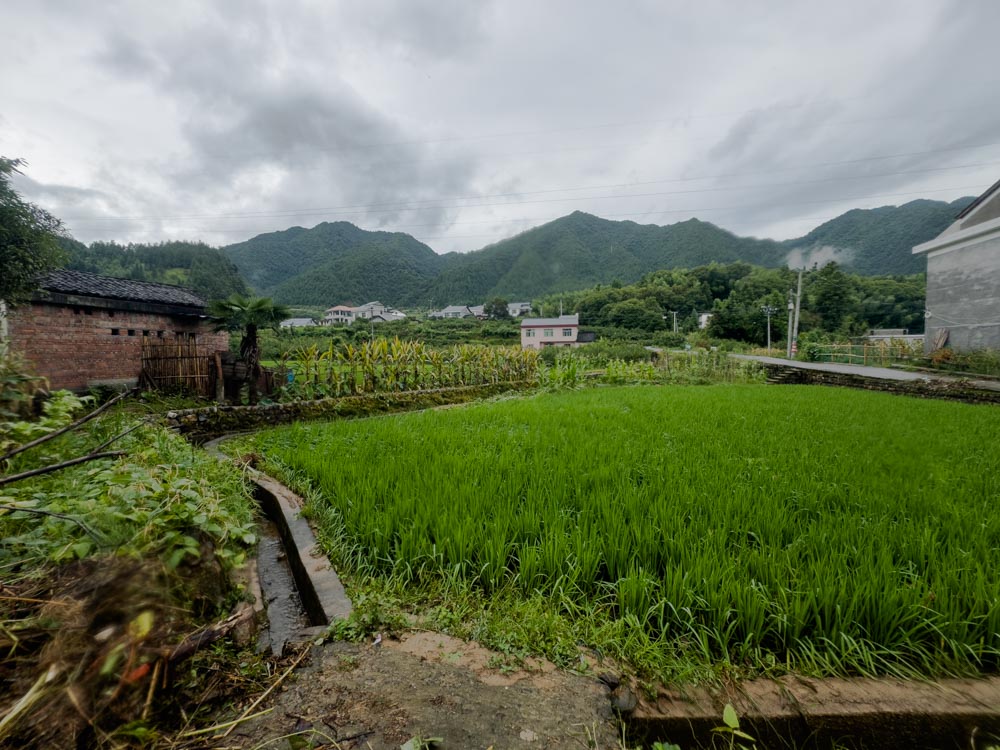
A rice field after a heavy rainfall.

Providentially and purely by happenstance, Ba inherited some of the land he cultivates today. The land belonged to the couple that sheltered him, and, for some reason, it was never taken back by the committee after they died. Once there were two mu but now there is only one mu because the new national highway superseded it.  A mu is approximately 0.17 acres.  Most women do not own land, even today. However, if a woman’s husband dies, even if she moves out, his land belongs to her (so to speak – since the land doesn’t belong to anyone but the collectives). Plots are no longer relied on for full food provision nor does everyone cultivate rice, as was the case when Liya was young.

Liya in the kitchen with help from a friend.
The stove top where all the magical food came from.

Should Liya decide to move back to China from Portugal and want to “buy” land, she can only do this in Yanling county because the hukou system ties her to her village home. This system, which was started in the 1950s, was created to control and limit rural migration to the cities, but has subsequently created social inequity between rural and urban China. An individual’s hukou registration and labeling as agricultural or non-agricultural, determines jobs, benefits etc and these classifications are nearly impossible to change.

My two weeks in Li Xian made me think about rural China, the lives there, and the roles women play in this country. Liya is a young woman who broke with tradition when she left her village and then China, where the potential for her economic, and personal, growth would have been severely limited. She transformed herself, overcame the challenges and pursued her dreams on her own terms. While I was with Liya at Ba’s home in Li Xian (under the ever-watchful eye of Mao, whose larger than life photo and image is omnipresent across China) I witnessed a family dynamic of almost constant tension and struggle for authority and understanding between Liya and her father. This inter-generational battle might never have taken place if Liya had followed tradition and stayed in the village or moved to Yanling.

Liya and her friends Yishuai and Xiaoting, both of whom I met and who were also from small villages, are all unusually accomplished young women who had thought about their situations, taken on tremendous challenges and transformed their lives through sheer determination.

It was a hopeful sign that even in a country still so tied to rural life and steeped in traditional roles, new generations are capable of setting their own paths. 

The dining area with Mao. The second, “guest” dining area bears a poster of Mao in his robe after his dip in the Yangtze River in Wuhan – the place where he set the stage for the Cultural Revolution. It was there that Mao showed off his physical fitness and general good health.
The large photos are of Ba’s father and mother. Take note that a picture of Mao (left) is included with the family photos.
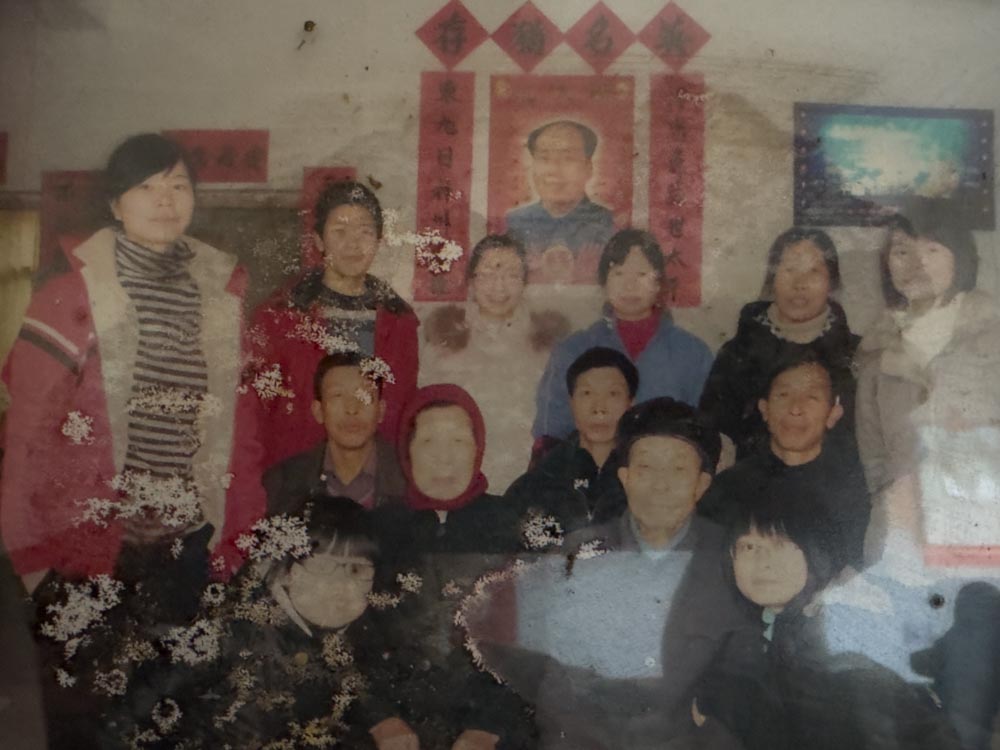
Family photograph of Liya’s maternal family.
Liya and her brother with their parents.

Street Life: Living Outside the Box

Xingping, Guangxi Province, China

Xingping, Guangxi Province, China

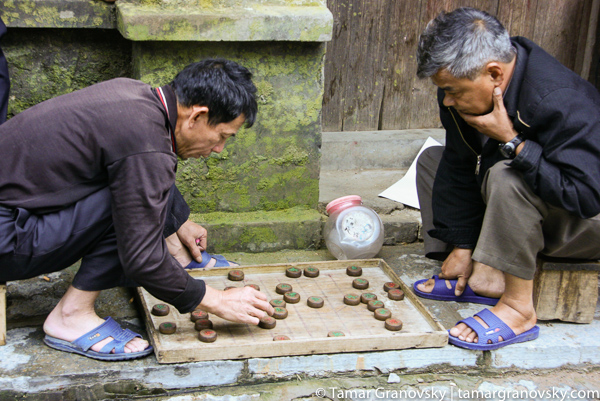
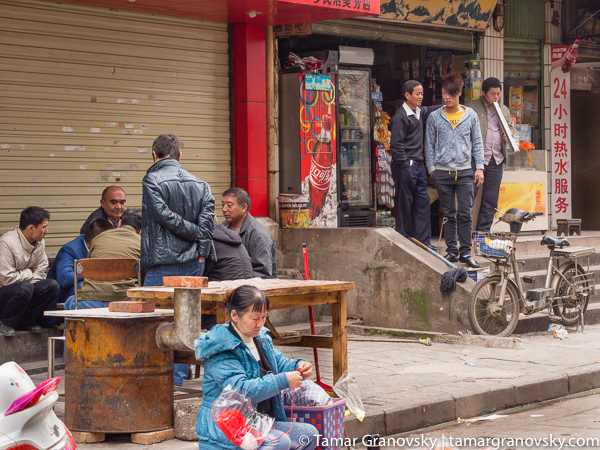
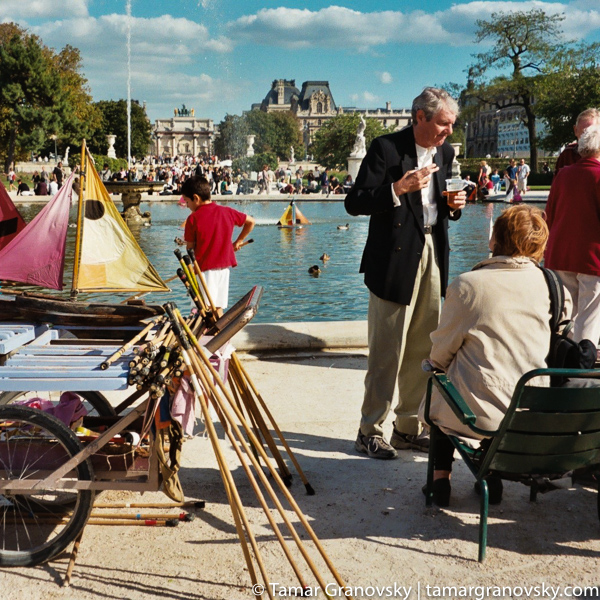
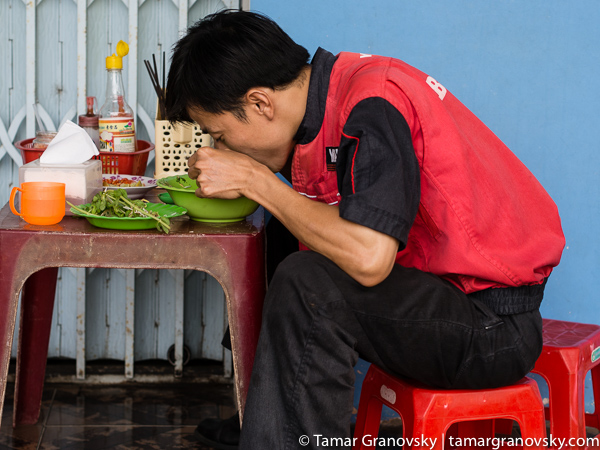
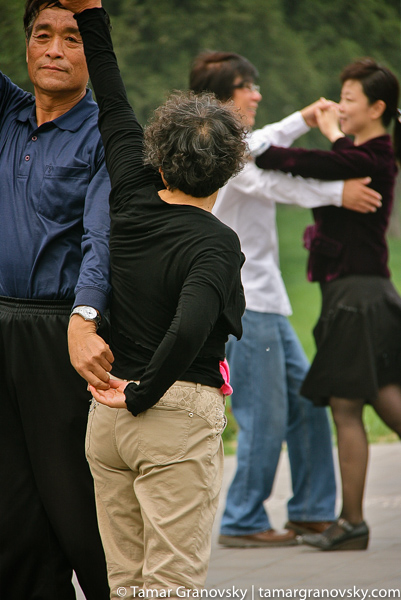
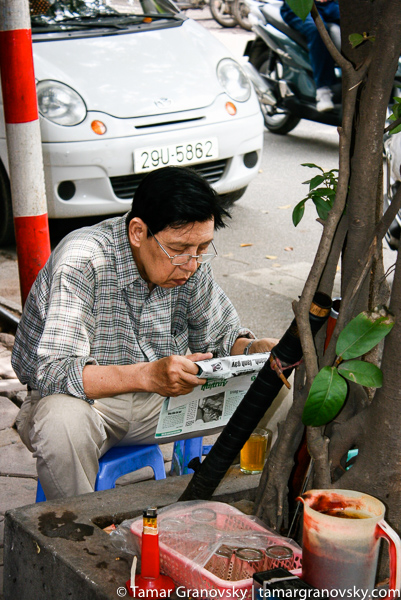
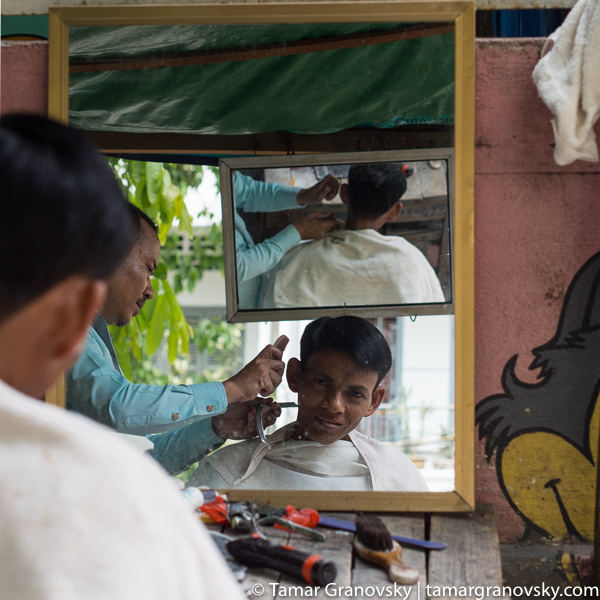
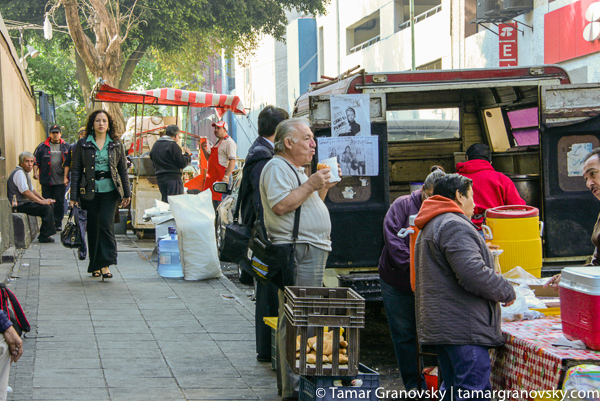
While watching a video clip from Cuba Feliz (a film of Cuban street musician Miguel Del Morales – known as El Gallo > The Rooster in English) I had a revelation. One of the reasons I absolutely adore countries such as Vietnam and Cambodia (or cities like Paris, Florence and, Montreal) is that people there live in the streets – almost literally. They spend much of their time in public spaces rather than inside their homes. They socialize, play, walk, eat, and drink together on the streets despite the hubbub of automobiles, bicycles, scooters, and other vehicles. The street is where it all happens!

Kunming, Yunnan Province, China

Kunming, Yunnan Province, China

Paris, France

Paris, France

In places like Vietnam and Cambodia, not only are dwelling spaces small, but the kitchens are particularly cramped and often poorly equipped. Additionally, everyday meals are inexpensive and readily available at any number of street vendors, cafes, and small semi-permanent food stalls. So, even though there are those who do have modern conveniences like stove-tops, washing machines, or televisions the tradition remains to gather with friends outside of the home. Western cities like Paris and Florence do not have the same street culture as Southeast Asia but, there too, just about everyone walks along the crowded streets, shops at outdoor markets, and rests or plays in public parks. Food vendors/hawkers are not as a common a sight there but open-air cafes, trattoria, tapas bars, etc. definitely are.

Chau Doc, Mekong Delta, Vietnam

Chau Doc, Mekong Delta, Vietnam

Chau Doc, Mekong Delta, Vietnam

Chau Doc, Mekong Delta, Vietnam

Streets are meant for people. This is eroding worldwide because of the ubiquitous car and streets that are getting wider to make room for these automobiles. Because of car traffic one rarely sees, in North American cities for example, children playing ball hockey, or hide and seek, jumping rope, or simply making up their own games on the street. Stoop or porch sitting is not a common site either. Spending time on our streets is no longer integrated into our daily lives and is rapidly becoming a thing of the past – so it seems to me. The social lives of city dwellers appear to be increasingly isolated. If I did not live directly next door to a community garden and park, or sit on the stoop of my house (which is facing our dead-end street), I would not know the people in my neighbourhood or have impromptu chats with complete strangers who walk by.

My neighbourhood is changing for the better. When I moved here 13 years ago there wasn’t much to do nearby. Today, there are a growing number of shops, restaurants, cultural centres, and parks which are within walking distance. There are even two farmers’ markets. The quality of life is better, street life is beginning to thrive, and there is little need to drive because this community has almost everything I need within walking distance or on the subway lines right nearby. It is a livable locale where neighbours run into each other on the street as they go about their daily business.

As I have mentioned multiple times in this blog, I am from Montreal. Despite it being a Northern city known for its very cold winters it somehow balances the frigid months with a French/Southern European mentality. Street life is substantial during the summer; people sit on their front stoops or balconies and are thus able to see and catch up with their neighbours. They eat in parks with omnipresent wine or beer so that public spaces become an extension of the private. Life, overall, takes to the streets and parks; the city pulsates with energy and activity.

Atwater Market, Montreal, Quebec, Canada

Atwater Market, Montreal, Quebec, Canada

 Vibrant streets call to me. Who wants to be cooped up indoors when there’s food, drink, fun, and people to meet or just watch? Healthy street culture abounds with respect for the other. In many quarters in Montreal or Paris, for instance, children come home from school and almost immediately go outdoors, on their own or with their parents, to play on the streets or on the playgrounds. In Italy, piazzas (squares) are the main gathering areas. During La Passeggiata, which is the time before dinner (around 5:30-8:30), people stroll about the central piazza or main drag of a town (in fact, La Passeggiata comes from the verb ‘to walk’).  This traditional daily ritual is more common in small towns but can also be seen in cities; it is a way for Italians to connect. During passeggiata many people hang-out in the piazzas or surrounding outdoor bars to have an aperitivo. It is a time when you see a mix of age and class. Children flock together yet are within shouting distance of their parents. Likewise, many Asian countries’ city and town residents still work within a block or two of their homes (often, in fact, the front of the home is the place of business). Thus, city blocks are like little villages.

Street life gives one the opportunity for chance encounters. Life outside our boxes and on the street is like being in an outdoor living room where everyone congregates and the community is the pulse of it all. The bottom line, it is good for the heart and soul.

Dancing in a Park, Beijing, China

Dancing in a Park, Beijing, China

Hanoi, Vietnam

Hanoi, Vietnam

Open Street Barber, Phnom Penh, Cambodia

Open Street Barber Stall, Phnom Penh, Cambodia

Cahors, France

Cahors, France

Mexico City, Mexico

Mexico City, Mexico

Apologies for no photos of the streets of Italy. Our camera was lost…


Under the Dome – Investigating China’s Smog


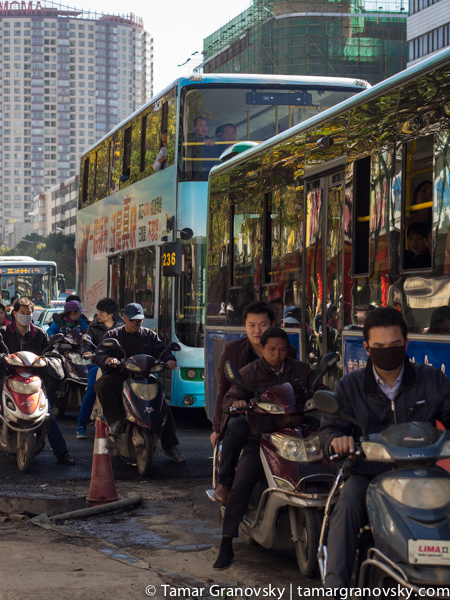
The exception to the rule (mask-wearing in Kunming, Yunnan Province, China)

Mask Wearing (Kunming, Yunnan Province, China

Almost a year ago I wrote in my posting “China as I See it“:

[I]t is not uncommon to see city-dwellers wearing face masks to protect themselves from dust, pollution, and germs in general. All across China, cities are experiencing extraordinarily high levels of air pollution. In Kunming, (where pollution levels are somewhat lower than in many other cities in the country), most people do not wear masks that filter pollution particulate matter. Instead, fashionable face masks are often worn as accessories; people want to look good while trying to avoid dust from ongoing construction, germs, and smog. When the pollution is “high” it looks as though there is fog outside. I have experienced this grey/yellow atmosphere in Beijing, produced by extremely dangerous levels of pollution (one can barely see a few blocks away). My teachers claim, as do many others, that it is just fog, but I have noticed that I am sensitive to the air quality as it worsens, and I monitor the air quality index so I know it is definitely not fog when the mountains surrounding the city, or the tall buildings in the distance, are shrouded in a cloud of grey. I bought myself approved masks for heavy pollution conditions, but the majority of the Chinese population buys its masks in convenience stores or other stores where the fashionable models are available. Very few people wear masks that really protect them – although this is beginning to change, thankfully. It’s a small first step because, of course, the greater issue of the pollution itself needs to be addressed.

In Kunming, where I lived from September 2013 until March 2014 and where the air was relatively clear and clean (you could actually see the stars at night), pollution levels would occasionally go above 150 – which means the air quality is unhealthy and that “[e]veryone may begin to experience health effects; members of sensitive groups may experience more serious health effects,” according to http://aqicn.org ). I sometimes found it insufferable. Yet, compared to other areas in China, the air in Kunming was relatively breathable.

Exception to the Rule (most people who drive motorbikes in Kunming still do not wear masks - at least not in early 2014)

Mask Wearing (Many people who drive motorbikes in Kunming still do not wear masks – at least not in early 2014)

Walking Kunming

Walking Kunming (During my six months in Kunming it felt as everyone wore a mask but when I looked through my photographs it was practically impossible to find anyone wearing a mask as the three photos in this blog posting attest to.)

Flying over Beijing the pollution is like a wall that one collides with. As you get closer, suddenly, you can barely see a thing outside the airplane window – and what you do see is masked in a thick haze of yellow. This situation is tragic and China has claimed that it wants to reduce its pollution by 2017. Unfortunately, the government has barely taken a stab at it and has censored Chai Jing’s film, Under the Dome – Investigating China’s Smog, which *was* posted on Youku and Tencent until about a week ago (it is still available on YouTube – a site that is blocked in China). This film could have had a key role in promoting public awareness to pollution’s environmental and health issues. No longer.

Yaxue Cao, the editor of the website China Change, comments in his article Under the China Dome – A Reality Check: “The film galvanized public opinion and consolidated its awareness to an unprecedented level. It peeled apart the multi-faceted causes of pollution. It is a mobilization of the public, and it sets expectations for a war against environmental disasters. The film works on many layers of the public psyche, and not all of them are welcomed by the government. This probably explains why it was spectacularly promoted and then shut down.”

And another article in China Change: The Four Forces of China’s Politics of Smog, by  Wu Qiang.

I can only hope the Chinese block of this film is lifted. If you are reading this, however, YOU can watch it: Under the Dome – Investigating China’s Smog

About Face

Yuang Yang Rice Terraces, Yunnan Province, China

Yuang Yang Rice Terraces, Yunnan Province, China

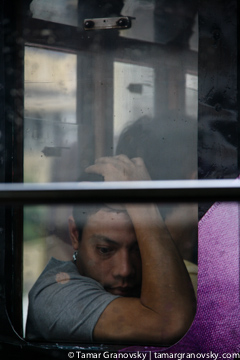
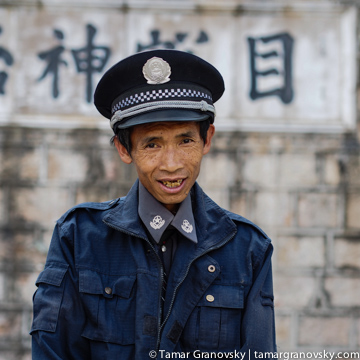
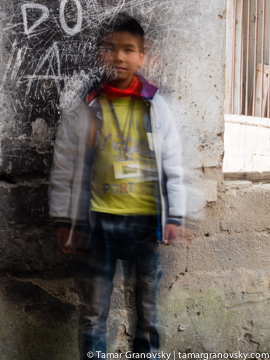
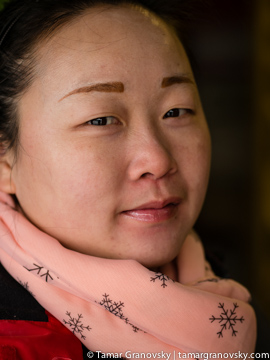
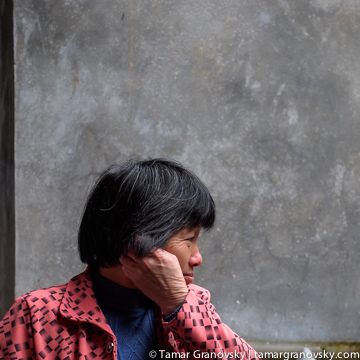
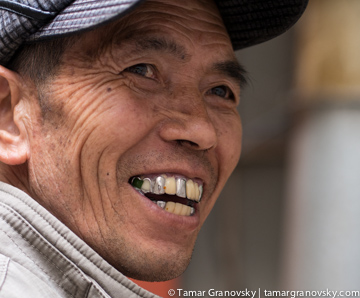
The portraits I took in China between September 2013 and March 2014 are predominantly of the elderly and the very young. As a “laowei” (foreigner), I was particularly struck by the faces of both the children, who will be carrying the impact of the country’s rapid change into the future, and the elders who remain the bearers of centuries-old history and tradition.

I have always considered connecting with people to be one of the central aspects of travel. At heart, instead of going to many of the “must see” travel sites, I would rather meander and observe, interact with, learn about, and photograph people I encounter.

Xingping, Guangxi Province, China

Xingping, Guangxi Province, China

I discovered early on that Chinese people rarely look someone in the eye. Apparently, steady eye contact is viewed as improper and can be regarded as an act of defiance. My attempts to establish a link in this manner were not always reciprocated. However, perhaps because I smile a lot I was often rewarded with eye contact and a smile in return. When I photograph, I approach a person because something about his/her face or demeanour strikes me as worth recording. I seem to have a facility for getting people to agree to let me take photographs of them. Despite the fact that I often get uncomfortably close to their faces, somehow they allow me into their personal space.

Kunming, Yunnan Province, China

Kunming, Yunnan Province, China

I met many wonderful individuals in China with whom I broke bread or had the opportunity for brief conversation (despite my fledgling Chinese). Asking permission to photograph them often allowed me to engage and connect with them. Even if we could not easily communicate, many still let their guard down. I tried to capture those moments.

inhong, Yunnan Province, China

Jinhong, Yunnan Province, China

Hong Kong, China

Hong Kong, China

Le Ju Village (Temple Caretaker), Yunnan Province, China

Le Ju Village (Temple Caretaker), Yunnan Province, China

Xingping, Guangxi Province, China

Xingping, Guangxi Province, China

Beijing, China

Beijing, China

Tulou, Fujian Province, China

Tulou, Fujian Province, China

Xingping, Guangxi Province, China

Xingping, Guangxi Province, China

Kunming, Yunnan Province, China

Kunming, Yunnan Province, China

A Letter to the Newton (Massachusetts) Community

“Henry Degroot is a student at Newton North High School, Massachusetts. He wrote a pro-democracy note in a Chinese student’s notebook during an exchange program in Beijing and signed it. A Chinese teacher found out. Henry was detained for five hours, forced to apologize by his American teachers, and, back to America, the school barred him from prom.”

Read more:  A Letter to the Newton (Massachusetts) Community from China Change


China Seen Through the Eyes of a Venture Capitalist

A friend read and forwarded a blog posting about China to me. It was written by a venture capitalist in the health care industry. She wondered if this person’s interpretation of China might have a slightly different slant than that of an artist. It turns out the article was of great interest and written clearly (i.e., not in business-speak so that I could enjoy it!!). I pass it on to you: VC Road Trip Across China.

And to round out the above posting… a blog entry from China Change: What does it mean for the world, for the US, and for us as individuals to have an authoritarian China, with the world’s biggest economy soon and 1/5 of the world population, that rejects universal values?