Category Archives: China

Have You Eaten Yet?

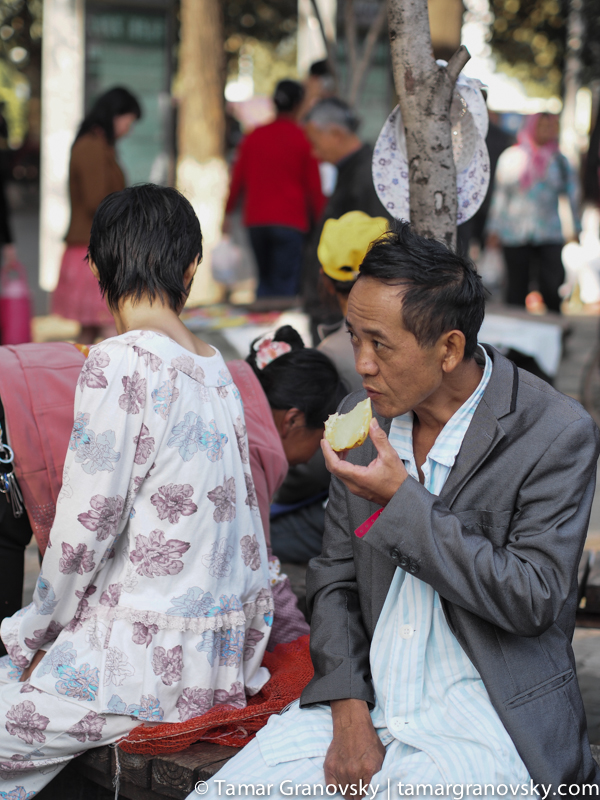
Man Eating on the Street, Kunming

Man Eating on the Street, Kunming

“Ni chi fan le ma?” is a greeting in China that is rooted in the country’s history and literally means, “Have you eaten rice yet?” but is also away to say “hello.” In previous centuries life, in many ways, was simpler and yet harsher. Taking care of one another meant trying to make sure that no one went hungry. Asking a person if s/he has eaten is the same as asking how somebody is.

At the time of the China’s Great Leap Forward (1959-1961) the country was forced to confront the difficult reality of famine. China recovered but the Chinese remember and embrace their history; in fact their collective memory goes back thousands of years. Perhaps because of this time of dearth, the Chinese have a significant obsession with food and eating. Today, the government is working hard to ensure that there is enough to eat in its country; Mainland China alone consists of over 1,300,000,000 people – the world’s largest population- and the country may well have trouble feeding its ever-increasing numbers.This problem is exacerbated by the dangers of land erosion, climate change, urbanisation, pollution, etc. However, to the casual observer (i.e., me), it appears that food is currently plentiful.
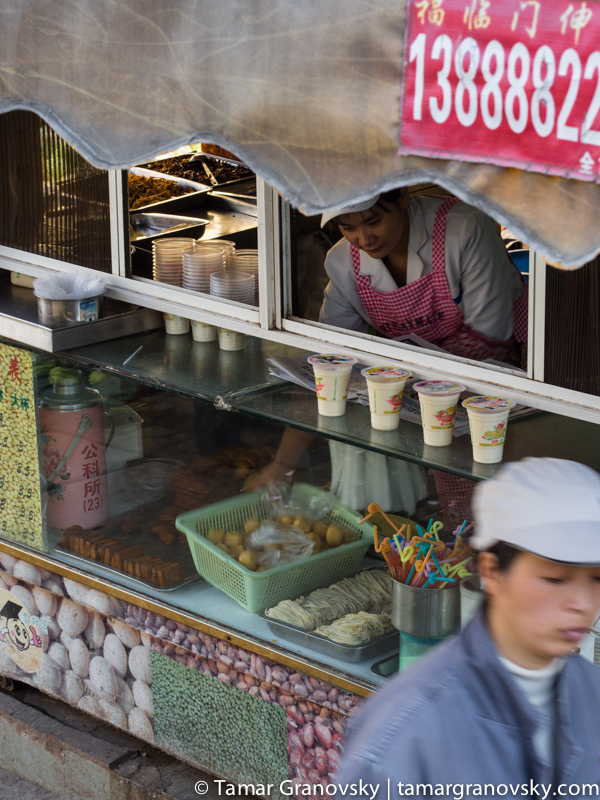
Snack Stall

Snack Stall

“Ni chi fan le ma” remains a greeting that you occasionally hear on the streets. Sometimes it is just a hello, when bumping into a friend, but other times it is meant as an invitation to join someone for a snack, meal, or drink. Any event may prompt family, friends, acquaintances, or business associates to feast together; eating is an important social activity. China strikes me as a nation that is preoccupied withfood, eating, and all things related. I am a “foodie” in the west and in China I have now learned that I am a “chihuo” – someone who gets excited about food. Many people in this ever-growing and prosperous country are chihuo.

China divides itself between North and South – two approximate regions with which, I have learned from my teachers, people identify themselves. The food is divided accordingly. Northern food tends to be heartier and more full-flavoured (it is colder in the north, after all), and incorporates more wheat, in the form of bread and noodles. Southern food is mostly rice-based (which includes rice noodles), due to the warm, rainy conditions in the region, that are conducive to growing this particular grain.

There are other culinary divisions as well. Each region, city, and town has its own native delicacies. In Kunming (a city with a population of more than 5,000,000) and across Yunnan that may mean: a) Pu-er tea (Pu-er tea undergoes fermentation and aging; apparently it can help lower cholesterol levels); b) Across the Bridge Noodles (Yunnan Guoqiao Mixian – which consists of three parts: a bowl of hot chicken broth, various slices of meat, including chicken, fish, seasoned meat, and rice noodles – all served in a very particular order); c) Steaming-Pot Chicken (Qiguo Ji – a dish of steamed chicken in a pot with a hollow tube in the centre. It is cooked for hours with ginger, shallots, salt and pepper, and water and steam in the tube flow into the pot to make a broth with the chicken) and; d) Lao Nai Yang Yu (recipe below) – a dish that is essentially mashed potatoes but stir-fried with oil, shallots and onions, and sliced or minced hot green peppers. The people of Kunming are also crazy about hotpot  – although this is not a dish specific to Kunming or Yunnan Province. However, in Kunming, hotpot includes not only meat, fish, and vegetables of all kinds but also a large variety of mushrooms because of the enormous number of species grown in Yunnan. Of course, there are numerous other local dishes that may be added to this very short list.

Street food in Kunming ranges from deep fried grubs/beetles/larvae (which I have tried and taste, to my mind, like crunchy cardboard) to more commonly seen dumplings, steamed buns, tofu, potatoes (cooked in multiple ways), grilled corn, sweet potatoes, meat and fish, sandwiches (made by spooning out dough onto an oily hot surface and frying it into a flatbread which is then spread with a spicy paste and wrapped around onions, cilantro, lettuce, and a fried egg), and tea eggs (stewed in a salted tea that also often includes soy sauce, anise, and Chinese five-spice powder). All of these snacks cost less than 50 U.S. cents.

Baozi Steam Pots Stacked in a Row

Baozi Steam Pots Stacked in a Row

At the same time, one can find all sorts of lavish dishes in high end restaurants; prices can easily top $40USD/dish. I discovered this recently when I ordered one minuscule piece of shark meat at a dim sum restaurant some friends and I had ventured to. On occasion I study in a cafe inside a pricey mall where, for $4.50USD, one can get an excellent cup of coffee and a piece of cake.

Kunming, because of it’s particular history and location has a wide range of food and it is easy not to repeat a meal for a very long time. Kunming street (stall, and restaurant) food is unique in China because of the many minority Chinese who have gathered in this city. Over 20 of the 55 minority groups in the country live in Yunnan Province, which shares borders with Myanmar, Laos, and Vietnam. Kunming was the last Chinese city on the southwestern silk route into South Asia so it is a melting pot of races, religions and cultures. Because of this confluence of cultures there is a myriad of nibbles in Kunming. The food in Yunnan is called Dian cuisine, which combines the cooking styles of the different ethnicities in Yunnan Province.

For example, Islam came to Kunming approximately 700 years ago and the Muslim community comprises about a third of the population in the city’s central district. Men in white caps stir vats of roasted coffee beans, make flatbread, and grill halal kebabs as well as cook other foods.

Flat Breads (savoury)

Muslim Flat Breads (savoury)

The Muslim quarter is a short walk from my school. I enjoy getting lost in the alleyways and tasting the offerings there.

Dai minority food is also fairly well represented in Kunming. It combines sour, spicy, and sweet flavors. The Dai practice Buddhism and are related to the Thai and Lao. Among the variety of tastes in these dishes, spiciness is usually predominant. Dai food is prepared in different ways – by roasting, steaming, boiling, frying, and pickling. Unlike in the rest of China, fresh vegetables often make up part of the meal, particularly if they have medicinal properties. Herbs are heavily used and coconut milk and/or fish sauce are frequent ingredients.
Dai Pineapple Rice

Dai Pineapple Rice

The Dai make a sweet glutinous rice (like that in Laos) that is often mixed with pineapple pieces and served in a hollowed out pineapple – a dish that is called “buoluo fan” (tribe rice). It is also common for the Dai people to grill fish or vegetables in banana leaves.

Most Kunming food vendors sell their wares in small shopsHowever, many simply carry out their business from a cart or even from a pot or wok over coals on the ground. There is a wide variety of local delicacies to be tasted here. People in Kunming (and Yunnan in general) tend to like their snacks and meals salty, savoury, and spicy. They do a lot of both grilling and deep frying – particularly deep fried potatoes of various sorts (my favourite is mixed with dried hot pepper, cilantro, spring onions, and garlic) and tofu in different forms (I love fried tofu, made quite similarly to the potatoes – mixed with scallions, cilantro, and sprinkled heavily with dried hot pepper). Hot oil is the start to many eats on the street. My eight (plus) weeks in China have proven to me that the food here is delicious and diverse. Almost everywhere you turn you can order something to consume as you walk, or you can just pull up a low plastic chair at a plastic patio table to sit, rest, and nibble right there. Starve I shall not!

Woman at Potato and Doufu Stall

Woman at Potato and Doufu Stall

Noodles are a popular favourite in Kunming. I don’t know for sure but I suspect more people here eat noodles than rice. In fact, noodles (made of rice or wheat) are often the highlight of a meal, and cold noodle dishes are traditional. Potatoes are also grown in this province, and as mentioned above, are prepared in assorted ways.

Thanks to the the Bai and Sani minorities of Yunnan province, another local specialty is goat cheese. Raising goats is one way for them to make a living on mountainous land that may be unsuited for growing crops but can support animals. The cheese is made by heating fresh goat’s milk with an acidic agent until it becomes firm. Once hardened, the cheese is often pan-fried or steamed. However in some  restaurants that serve Western food you can find it in bite-size pieces in salads.

Not surprisingly Kunming (like the rest of China) is changing. I’ve been told that the Muslim quarter in the old city district used to be filled with wooden houses and eaved roofs.These are gone now – replaced with many new buildings and shops including Carrefour  and Walmart. As much as I avoid these two stores (except to buy milk and almonds) they are experiences to be had — especially if it is food that you are interested in. At Walmart, for instance, not only can you find a carton of regular whole milk, but also mung bean, sesame seed-flavoured, and other non-western milks. There is produce of all sorts, including various Chinese cabbages, mangosteens, durians, and many other Asian fruit and vegetables. There are also bins filled with wheat, buckwheat, and rice noodles of various shapes and sizes as well as bins of meats, sausages, whole chickens (head and feet included), dozens of kinds of kimchi and other pickled vegetables, fish in tanks of water, and strips of raw beef  — all sold there as they are in nearby wet markets (i.e., markets that sell fresh and cooked foods). The dry goods section has every kind of Chinese packaged food imaginable. It is a store for the locals.

Despite many signs of the encroachment of Western corporate influence, Kunming is a laid-back city and is not as money-oriented as some of the other urban centres in the country (the few extravagant “designer” shops I’ve seen here are always empty!). It is a good and affordable place to eat whether you can read a menu or not. In fact, many have photographs of the food that is offered. Some restaurants and stalls do not even have the dishes advertised since they only sell one or two items. Even If a menu is written only in Chinese it is still easy to scan a crowd of diners and point to what looks tasty.
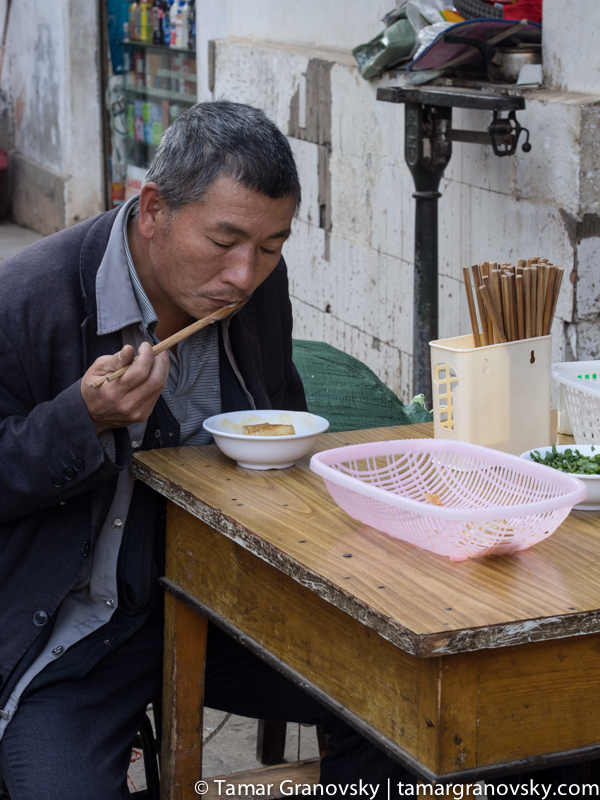
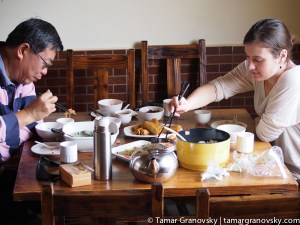
A Man Sits and Eats Doufu and Rice Sticks for Breakfast at the Table Across from Me. I Do the Same.

A Man Sits and Eats Doufu and Rice Sticks for Breakfast at the Table Across from Me. I Do the Same.

At the Keats School, our cook, Yi Yanling – who we call Ayi (auntie) – makes a dozen dishes, or so, for both lunch and supper. They consist of vegetables, tofu, and some meat but the majority are vegetarian due, no doubt, to the favourable vegetable-growing climate in Yunnan. Breakfast is predominantly Westernstyle, composed of fruit, fried eggs, bread, cakes, yogourt, and coffee; in addition there is always fried rice, a soup of some sort, tomatoes and cucumbers, and occasionally dumplings. Ayi has cooked over a hundred different dishes for us since September and I have been told she has at least two hundred recipes in her repertoire.

Rice Sticks

Youtiao (Deep Fried Twisted Dough Sticks)

On the weekend we are on our own and I go to the alleyways behind the school toorder my favourite breakfast: hot soy milk and dough stick (here is a youtiao recipe), a tea egg, and/or baozi (steamed buns) filled with mushrooms, or tofu, or vegetables.
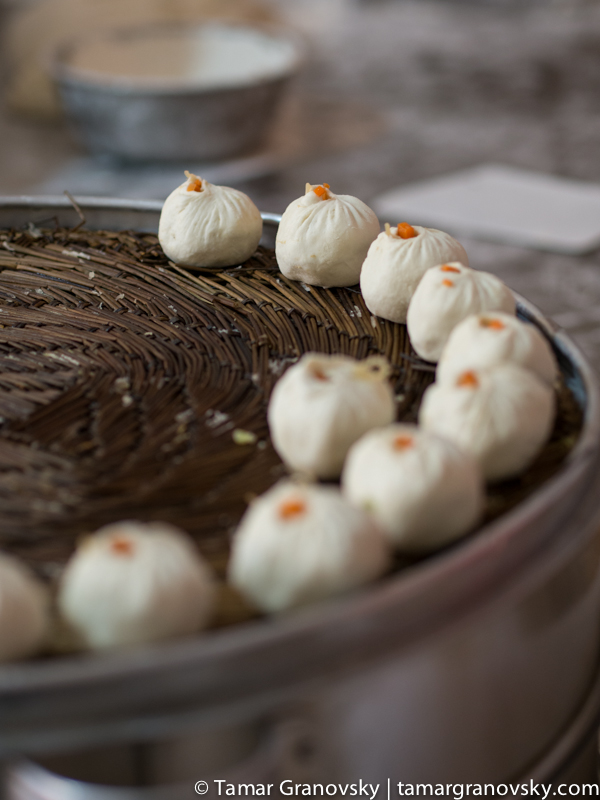
Baozi

Baozi

Kunming is a city of innumerable and delicious foods. Mushrooms, potatoes, noodles, and spice (which can also include Sichuan peppers)  – and the cooking of the many minority groups  – make eating an endlessly enjoyable activity.  Both the city and province offer countless dishes to taste and to savour. What more can a “chihuo” ask for?

As an aside, here is a link to China’s CCTV’s “A Bite of China” — seven 50-minute theme-based episodes filmed throughout the country by several of China’s filmmakers.

Below are three recipes for common dishes made in Kunming, Yunnan Province, and/or China.

Suhongdou (Crispy Red Beans) — Crispy red beans are made with mint or with the greens of the sow thistle plant (kucai – bitter vegetable). If youprefer you may substitute kale for the kucai or mint.

  • 1 1lb. cooked red or azuki beans
  • 1 small bunch (approx. 2 oz.) mint (kucai or kale), leaves chopped
  • finely diced red or green pepper (optional)
  • finely diced garlic (optional)
  • 2 oz. flour
  • salt
  • oil

Put the flour in a bowl and add in a handful of beans. Coat the beans well with the flour. Transfer the beans to a plate, keeping as little flour as possible along with them and  repeat this process until all of the beans have been covered. Add extra flour to the bowl if needed.

Heat 4-5 tablespoons of oil in a wok, allow it it to get very hot, then add the beans. Fry the beans for 3-4 minutes. Stir occasionally. Remove the beans to a plate, leaving any oil behind in the wok.

Add another tablespoon of oil to the wok. When hot add the mint/kucai/kale, peppers, and garlic to the wok. Fry for 30 seconds then add the beans back into the wok. Add salt and stir until the ingredients are well mixed. You may mash the mixture slightly before serving on a plate.

  Image Courtesy of the Keats School, Kunming, Yunnan, China

Laonai Yangyu (Grandmother’s Potatoes)  — In Yunnan potatoes are called “yangyu” whereas in the rest of China they are called “tudou.” Laonai means paternal grandmother, however it is also commonly used by children to address an old woman.

  • 1 lb. potatoes
  • 1/4-1/3 cup oil
  • 3-6 cloves of garlic, sliced
  • 4 whole dried red chilies OR 1-2 fresh jalapeno or Serrano peppers, diced
  • 4 green onions, chopped
  • 1 teaspoon salt

Peel the potatoes, chop them into large chunks and boil in salted water. Meanwhile, slice the garlic, cut the dried peppers with scissors into small pieces or dice the fresh peppers, and chop the green onion into very small pieces. When the potatoes are cooked, drain them, transfer them to a cutting board and roughly chop them.

Heat the oil in a wok on medium to high heat and add all of the ingredients except for the potatoes. Stir for one minute, then add the chopped potatoes. Stir the whole mixture, making sure that the potatoes are well coated with the oil and mixed thoroughly with the other ingredients.

Now, with the back of a spoon or spatula, flatten the potatoes in the wok so that they have maximum contact with the cooking surface. Allow them to cook for another minute. Stir the potatoes and repeat the flattening once or twice before transferring to a plate.
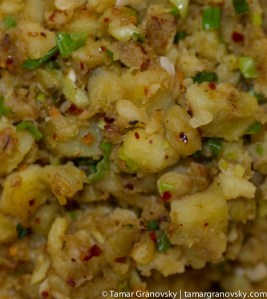
Laonai Yangyu (Grandmother's Potatoes)

Laonai Yangyu (Grandmother’s Potatoes)

Chayedan (Tea Egg) — Tea eggs are a popular savoury snack throughout China. I buy them on the weekends along with two baozi, as part of my breakfast.

  • 1/4 cup soy sauce
  • 1/8- 1/4 cup sugar
  • 1/2 tsp. whole black peppercorns
  • 4-8 whole cloves
  • 2-3 whole star anise
  • 1 stick cinnamon
  • 4 Tbsp. loose black tea or 4 black tea bags
  • 12 eggs

Place the eggs in a pot so that they are covered with water. Bring the water to a boil. Once the water boils, reduce heat to medium low and cook for 4-5 minutes. Remove the eggs and save the water. Once the eggs are cooled, crack the eggshells with the back of a spoon, with a knife, or on the countertop. The more cracks, the more designs on the eggs’ surface.

Add the remaining ingredients and the cracked eggs into the pot of reserved water. Bring this mixture to a boil, turn the heat down and simmer for 40 minutes. Turn the heat off and marinate the eggs further for two to six hours – and up to a day or two. The eggs will keep in the refrigerator for a few days.

The dark tea concoction imparts a sweet flavor that will be carried right to and through the yolk and adds a sepia marbled tint to the white of the eggs along with the cracks.

Tea Eggs

Tea Eggs

A short video on proper eating etiquette in China

A short video on fighting for the dinner bill – something I experienced: I literally fought and grabbed for the bill, making quite the scene with my Chinese friend in Beijing


·     

A Trip to Tuan Jie Township

Tuan Jie Zhen

Alleyway in Tuan Jie Zhen

A friend and I recently took at weekend trip to Tuan Jie Zhen – a township that is about 30 kilometres outside Kunming. Bogi, a classmate from Hungary, and I stayed at the Heart 2 Heart Youth Hostel which is run by Heart to Heart Community Care.

Heart 2 Heart Youth Hostel (Courtyard)

Heart 2 Heart Youth Hostel – Courtyard (Photograph Courtesy of Fenyvesi Boglarka)

Heart 2 Heart Youth Hostel

Heart 2 Heart Youth Hostel (Photograph Courtesy of Fenyvesi Boglarka)

Because there are very few social welfare benefits or resources for migrants, this organization works with these men, women, and families, in Kunming and the surrounding area. It helps them find housing and acquire skills for jobs, provides education to the children, and arranges health care for them. In addition to working with migrants, Heart to Heart Community Care sponsors cultural and educational activities and classes for the local community, with all profits from the hostel going to this organization. The hostel is located in Da He Village, on the outskirts Tuan Jie Zhen – a village-come-town that is sometimes referred to as an “urban village” and is mostly surrounded by farmland and forested hills.

My main purpose for the trip, besides getting away from Kunming for a couple of days, was to visit Rawdon Lau (who I met last year when I stayed at the Camellia Youth Hostel in Kunming). Rawdon heads the “Best of the Best” project which promotes cultural exchange, helps with environmental conservation on a grassroots level, and is socially active in local communities. Some time after my stay in March 2012, the Camellia Youth Hostel, and the hotel next door, were razed to the ground, falling victim to the rapid expansion and growth of urban China (the youth hostel was a stone’s throw from the Keats School, where I am currently studying Chinese, and I can see from my bedroom window the rubble that was left behind; nothing has been rebuilt since they tore the buildings down). Rawdon helped oversee the development of the Heart 2 Heart Youth Hostel and is now based there — when he is not shepherding other projects in China, returning to his home in Guandong Province, or travelling the world for work.

Tuan Jie Zhen

Tuan Jie Zhen

Bogi and I arrived in Tuan Jie Zhen close to suppertime that first afternoon so we took it easy and simply unwound from hectic Kunming. We ate bbq meat, fish, and vegetables and drank beer with the staff and one other hosteller. I enjoyed the stars for the first time in a while – something I hadn’t done since I was on my slow boat to China because the sky in Kunming is too polluted for them to be seen!

The next day, we headed out for a walk in the farmland near the forest of Woyunshan, and surrounded by other mountainous forests in the distance. We did not get very far since so much of our time was spent stopping to take photos. We happened upon a dozen or so black, tent-like structures which really piqued my interest.

Mushroom Farm - Tuan Jie Zhen

Mushroom Farm – Tuan Jie Zhen

There was a woman walking among the tents so I prodded Bogi (who speaks far better Chinese than I do) to ask her if we could take a look. It turned out that inside these tents is a mushroom growing business.  The next thing we knew we were being given a tour of this mycological enterprise.

In her article, “Season of Plenty: Yunnan’s Mushroom Harvest,” (Saveur, August 11, 2011), Beth Kracklauer writes:

“More than 800 varieties of edible mushroom grow in Yunnan,” said Zhou Yuankuang, secretary general of the Yunnan Mushroom Association, as he walked me through the workings of the local trade. “It is one of the most biodiverse places in the world.”

He explained that every day, between two and three in the morning, mushrooms arrive from all over the province. Large-scale dealers and exporters operate independently of the mushroom market, buying in quantity in county seats around Yunnan and taking the mushrooms back to Kunming or transporting them by airplane directly to other parts of China and to Japan, Italy, France, and the United States. Annually, mushroom exports earn dealers in Yunnan more than 650 million yuan ($100 million); sales to the rest of China bring in another 3 billion yuan ($450 million).

Mushroom Farm - Tuan Jie Zhen

Mushroom Farm – Tuan Jie Zhen

The man who gave us the tour oversees the business of growing what appeared to us to be porcini-like mushrooms. The following description of the mushroom farm is based on our understanding of his Chinese. Any inaccuracies are ours alone.

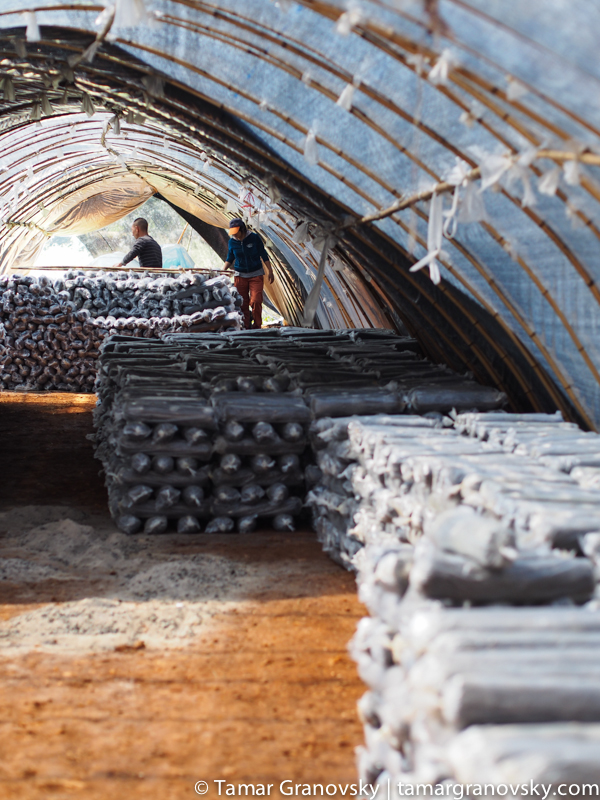
He told us that this part of Yunnan has the perfect climate for growing mushrooms because it is foggy, has dewy/moist mornings, and cool to warm temperatures. The area is a wide, fertile valley between forested mountains. Inside the tents, the temperature is kept at 27°C for growing and 17°C during harvesting/cropping. Each tent is made from black plastic tarp which helps keep the space warm, humid, and shady and each is used for a different phase of the mushroom growing cycle.

Our guide started the tour by showing us how the soil is prepared; it is a compost made from sawdust, wood shavings, nitrogen, gypsum, and older soil. It is all turned by hand, using pitchforks to aerate the soil, and is watered from time to time and covered with a plastic tarp to further promote decomposition. The compost develops as the raw ingredients are changed by the activity of microorganisms, heat, and chemical reactions.

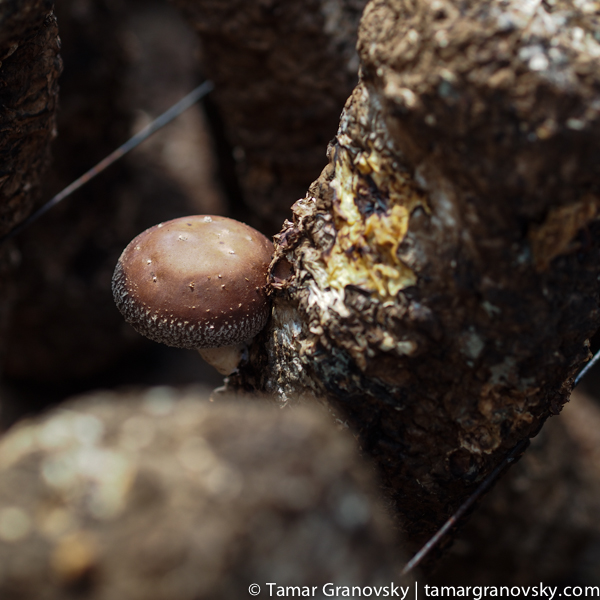
The compost is then scooped and stuffed into, clear, oblong plastic (we are not actually certain of the composition of these bags) grow bags for mushroom cultivation; when filled they look like small logs.The filled bags are punctured and injected with mushroom spawn, laid one on top of the other on a bed of ash (to deter disease-like fungi and insects) and turned regularly to allow the air to circulate. It takes approximately 120 days for this spawn to take hold and grow in the bags. The bars are watered regularly and the relative humidity is kept high to minimize drying of the compost or the spawn. When they are ready, the mycelium (the vegetative part of the fungus) grows in multiple directions and the colour of the logs changes from brown to a yellowish-grey, pockmarked with white spots – fungus – throughout. These changes indicate that fusion has occurred. By paying close attention to the colours the mushroom farm employees can tell which log take has taken to the fungus injection; those that do not are re-injected.

Tuan Jie Zhen-7

After 120 days the grow bags are moved to another tent. The logs are removed from the bags and are leaned vertically against wires that are they strung horizontally between posts. They are then covered with plastic sheeting for a few more days, after which the farmers begin harvesting the mushrooms and can continue to do so multiple times over a six-month period. When this final process is complete the whole operation is repeated.

Mushroom Farm - Tuan Jie Zhen

Mushroom Farm – Tuan Jie Zhen (Rejected Logs)

Mushroom Farm - Tuan Jie Zhen (Ash on Ground)

Mushroom Farm – Tuan Jie Zhen (Ash on Ground)

Mushroom Farm - Tuan Jie Zhen (Fungus-filled Growbags)

Mushroom Farm – Tuan Jie Zhen (Fungus-filled Growbags)

Mushroom Farm - Tuan Jie Zhen (Opening Growbags)

Mushroom Farm – Tuan Jie Zhen (Opening Growbags)

Mushroom Farm - Tuan Jie Zhen (Mushroom Growing on "Log")

Mushroom Farm – Tuan Jie Zhen (Mushroom Growing on “Log”)

We were told that there are three qualities/sizes of mushrooms: small (just opened – the freshest and the most expensive), medium (more open and less expensive), and large  (the cheapest because they must be sold within a few days, before becoming too old and dehydrated). They sell these mushrooms in Yunnan and across China. However, the fungus-impregnated bars are also sold to mushroom growers in Japan, Korea, the U.S., and Europe.

Mushroom Farm - Tuan Jie Zhen

Mushroom Farm – Tuan Jie Zhen (Photograph Courtesy of Fenyvesi Boglarka)

Mushroom Farm - Tuan Jie Zhen

Mushroom Farm – Tuan Jie Zhen (Photograph Courtesy of Fenyvesi Boglarka)

That afternoon Bogi and I met Rawdon for a large and delicious lunch;we ate soup, spring rolls, bitter melons with pork, a spicy tofu dish, and a very typical dish found throughout China: tomato and scrambled eggs. Among the options we were offered as ingredients for our dishes were eel, and honey combs with fresh grubs. We decided against them.

Lunch with Rawdon and Bogi

Lunch with Rawdon and Bogi

After our lunch together, the three of us walked to a mostly abandoned Le Ju Village just a few kilometres outside of Tuan Jie Zhen. The village is located on a hillside and its most recent architecture is 100-200 years old. However, the village actually dates back much further; it has been occupied for about 600 years. The people of this village were Yizu (Yi minority).


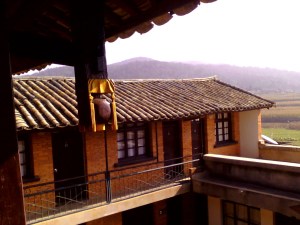
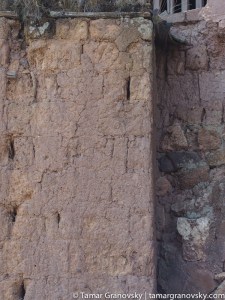
Many of the houses there are two stories high and all are constructed from bricks made from the iron-filled local soil. A number of the outer walls are, additionally,covered with a paste of red clay. Some bricks contained hay, bran, and corn which helps keep the walls strong.

Tuan Jie Zhen - Le Ju Village

Tuan Jie Zhen – Le Ju Village

The layout of each house is a square and surrounds a central outdoor courtyard. The kitchens and communal areas are on the bottom floor and the bedrooms and other communal areas on the top, and each home has an outhouse. A multi-generational family would live together and additions were built as needed, next door to the homes. Family members could freely come and go from one house to the other via a gate between the two side-by-side homes.

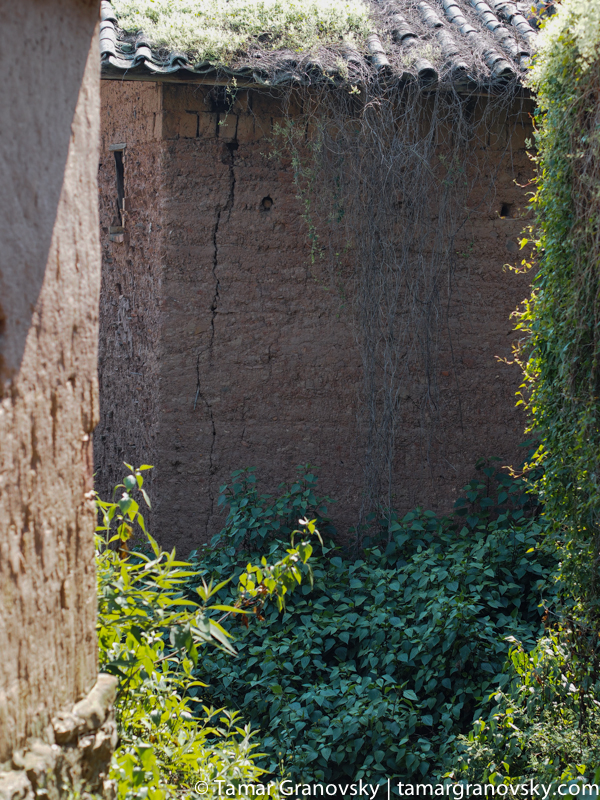
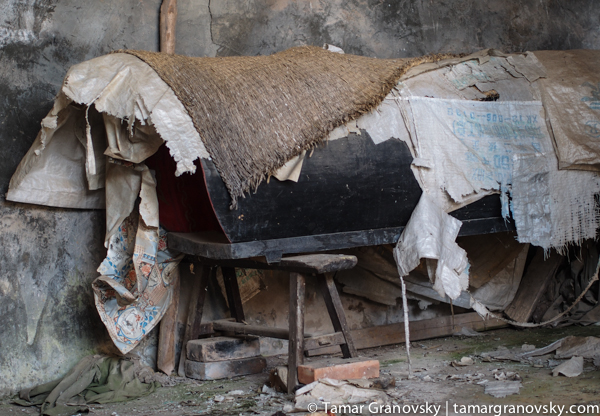
Today, when walking through the alleyways, one can see that the houses are covered in vegetation and the inside wooden stairs and floors are in the process of decaying. A few everyday items from the most recent generation remain in these homes as vestiges of the past. We noted a number of such items, including, pots, shoes, furniture, textiles, and even an unused coffin. It seems that only a few homes remain occupied. As Rawdon described the village to us Bogi and I could imagine what it might have been like there, not too long ago, despite its ghost-like emptiness today.

Tuan Jie Zhen - Le Ju Village

Tuan Jie Zhen – Le Ju Village

Tuan Jie Zhen - Le Ju Village

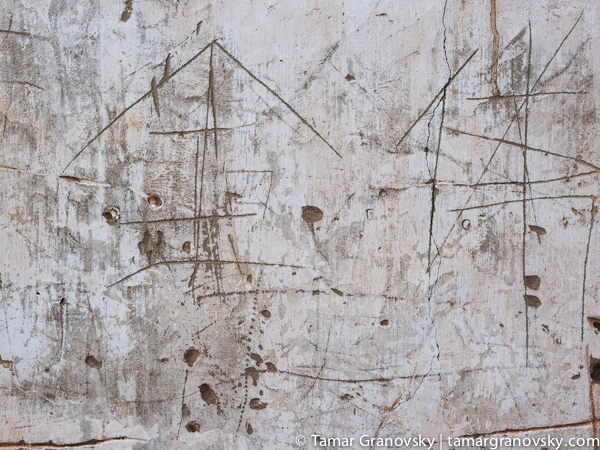
Tuan Jie Zhen – Le Ju Village (Writing on a Wall)

Tuan Jie Zhen - Le Ju Village

Tuan Jie Zhen – Le Ju Village

Tuan Jie Zhen - Le Ju Village

Tuan Jie Zhen – Le Ju Village

Tuan Jie Zhen - Le Ju Village

Tuan Jie Zhen – Le Ju Village

Tuan Jie Zhen - Le Ju Village - (Kitchen)

Tuan Jie Zhen – Le Ju Village – (Kitchen)

Tuan Jie Zhen - Le Ju Village

Tuan Jie Zhen – Le Ju Village

Tuan Jie Zhen - Le Ju Village

Tuan Jie Zhen – Le Ju Village

Tuan Jie Zhen - Le Ju Village

Tuan Jie Zhen – Le Ju Village

Tuan Jie Zhen - Le Ju Village

Tuan Jie Zhen – Le Ju Village

Tuan Jie Zhen - Le Ju Village (Gateway from One Home to the Addition)

Tuan Jie Zhen – Le Ju Village (Gateway from One Home to the Addition)

Tuan Jie Zhen - Le Ju Village

Tuan Jie Zhen – Le Ju Village

Tuan Jie Zhen - Le Ju Village (Unused Coffin)

Tuan Jie Zhen – Le Ju Village (Unused Coffin)

Tuan Jie Zhen - Le Ju Village (Kitchen)

Tuan Jie Zhen – Le Ju Village (Kitchen)

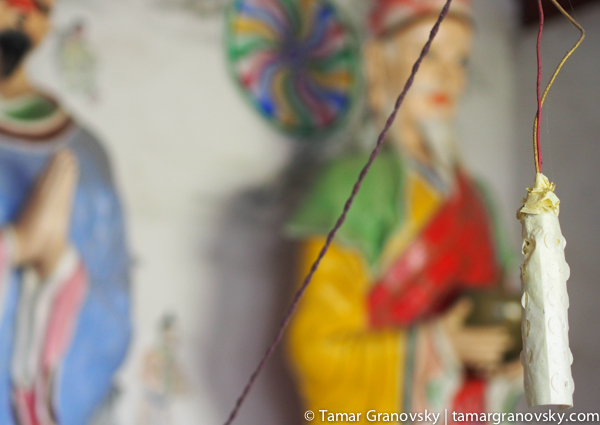
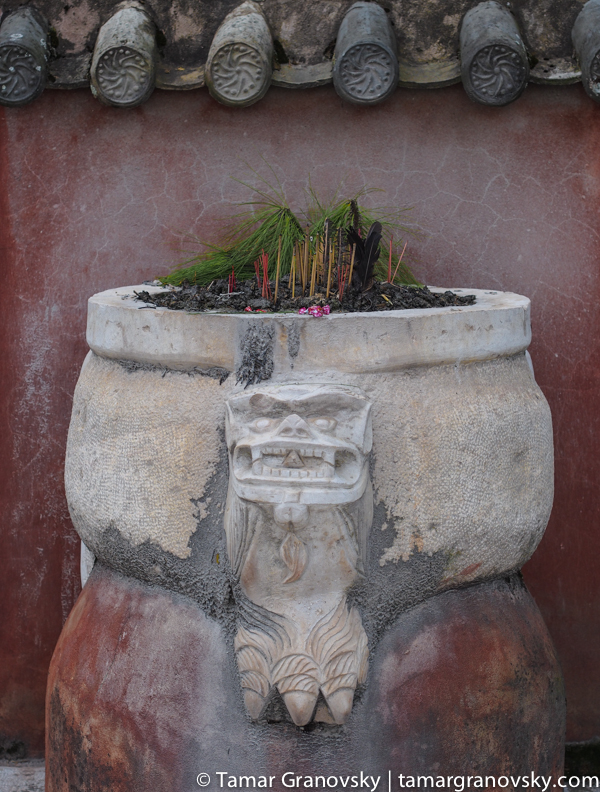
Finally, at the top of the village and hill, we reached a surprisingly large temple (for such a small community of homes) that still has a permanent caretaker. He unlocked the doors so that we could go in and give a little prayer and some offerings (candy, apples, money, etc. – to bring us luck), as well take photographs. At the bottom as well as the top of the stairs leading to the temple is a protected votive offering and incense area. At the entrance of the temple itself, people leave pine needles on the ground. We asked the caretaker about some of the traditions but his dialect was so localized it was impossible for us to understand his answers – even Rawdon had difficulty following him. What Rawdon did tell us is that there are women who still come to pray monthly at this temple. The temple is graced by a variety of religions. Both Buddha and the local “Earth” Gods are worshipped. Two alters are housed just outside the temple: one contains a statue of Guan Yin (the Goddess of Mercy/Compassion that changes his/her form and gives protection and help to those in need. Families without children often pray to him/her). The second alter houses a statue of the God of Fortune.

Tuan Jie Zhen - Le Ju Village (Temple, Guan Yin)

Tuan Jie Zhen – Le Ju Village (Temple, Guan Yin)

Tuan Jie Zhen - Le Ju Village (Temple)

Tuan Jie Zhen – Le Ju Village (Temple)

Tuan Jie Zhen - Le Ju Village (Temple)

Tuan Jie Zhen – Le Ju Village (Temple)

Tuan Jie Zhen - Le Ju Village (Temple)

Tuan Jie Zhen – Le Ju Village (Temple)

Tuan Jie Zhen - Le Ju Village (Temple)

Tuan Jie Zhen – Le Ju Village (Temple)

Tuan Jie Zhen - Le Ju Village (Temple Caretaker)

Tuan Jie Zhen – Le Ju Village (Temple Caretaker)

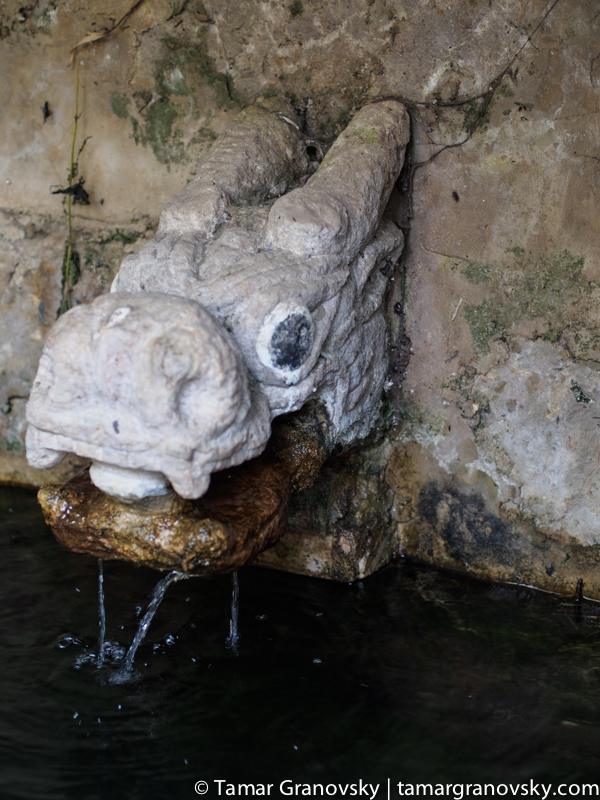
Tuan Jie Zhen - Le Ju Village (Fresh Spring Water)

Tuan Jie Zhen – Le Ju Village (Fresh Spring Water)

In Tuan Jie Zhen many homes have spells written right on the walls/entrances as well as others written on paper and pasted up. Animal hooves and bones that are meant to offer protection can be seen hanging on the doors; cacti on the roofs serve a similar purpose. Additionally, the doors are decorated with mirrors, which are also meant to ward off the devil. As a common tradition in China, a lucky character “Fu” (which means good fortune, happiness, luck, and richness) is hung upside down on the doors of people’s homes. The character is upside down to mean “fu dao” which translates to “this fu is upside down” (literally). This is actually a play on words since the pronunciation for “fu dao le” is the same as another word with a different meaning and written in different characters – a word which means “arrived.” As a result “fu dao” suggests that fortune and good luck have arrived.

That night was quiet; Bogi and I went out for supper and then returned to our room. We were invited to Rawdon’s for breakfast for the following morning, met a colleague of his from Beijing, wandered the local market, had lunch, and returned to Kunming.

Tuan Jie Zhen - Woman Selling Goods at Market

Tuan Jie Zhen – Woman Selling Goods at Market

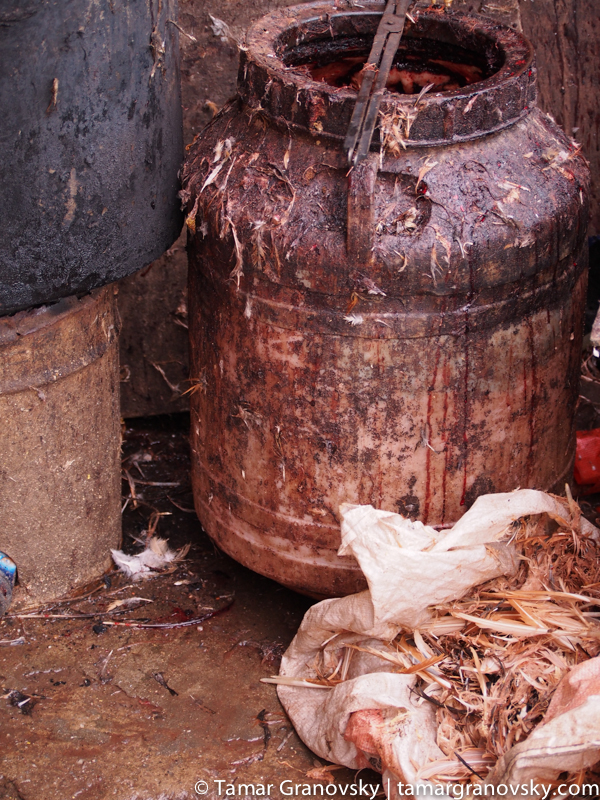
Tuan Jie Zhen - Chicken Processing Stall

Tuan Jie Zhen – Chicken Processing Stall

Acknowledgement: I wish to thank Bogi and Rawdon for helping me remember details for this blog entry.

So, Just How Difficult is it to Learn a New Language? My First Five Weeks Studying Chinese

Unbelievably difficult. So damned hard.  Not easy. Challenging. Herculean. Trying. Frustrating. Easier said than done, though none of it is easier said! It’s a truly formidable undertaking. I take one step forward and then twenty steps backward. I am working hard at it but feel as if I have not yet begun to acquire the skill. At times learning Chinese has been emotionally trying and I wonder if I will ever get the hang of it. This is very disconcerting and my pride feels a tad bruised. Yet, I have been told that this is how it goes.

While languages do not come easily to me, I want to learn them. For instance, I love the melodic sounds of Arabic and Greek and would be in heaven if I could speak them. I would like to learn Spanish and Italian, too. I fancy the fact that a language can reveal so much about communities or nations. People are distinct and language is part of this diversity.

Class Outing

Class Outing. Here we are outside the Yunnan Nationalities Village. It is said: Among all places of interest in China, one that stands out immediately is the Yunnan Ethnic Village near Kunming. This is a special place which sprawls over a huge area and houses a number of ethnic minorities of the country. If one wants to witness the nuances in the cultures of different Chinese ethnicities, this is the place to be. Here people live according to their traditional lifestyle in small villages that have been created for them in the premises. It is a perfect exhibition of the diverse Chinese culture. I found it more like Disneyland. (Photograph courtesy of Nathalie Karlsson)

I speak and understand both French and Hebrew but cannot say that I have ever mastered either of these languages; I just get by. And yet here I am, in Kunming, trying my hand at Chinese – which is considered one of the most difficult languages to learn. Nonetheless, after having visited China for ~7 weeks in 2012 I decided that I wanted to commit myself to acquiring the language – in China. As I mentioned in an earlier post, “By learning the language and living in the country for a period of time… I hope to start to have a deeper understanding of the country and people.” It really is as simple as this. I have no great plans, nor a practical reason (work, for instance) to study this language except to be able to actively communicate / have a dialogue with people in this region of Asia.

So, I am now attempting to immerse myself in the country and language. This, however, is not easy. I am at a private school with other foreigners (lao wei), and where English is the common language spoken outside of class. I go out onto the street and attempt to speak with people by ordering food, asking for directions, etc. Many just stare at me – not understanding a word I say. I clearly need more study and  practice so I have decided that I will ask my few Chinese friends in XIngping and Beijing to Skype with me for five minutes every few days so that we may speak in Chinese, together. Perhaps over time (I am hopeful) I will be able to have a simple conversation – but a conversation, nonetheless!

The only way I will be able to improve is to practice listening and speaking. This has to be done steadily and with persistence and determination. I also have to remind myself that it will take time to overcome the various challenges; there are no shortcuts.

But then there is the reality of stretching my brain in order to grasp the nuances of Chinese. I am discovering that the best way for me to learn is to listen first and then attempt to repeat/speak – over and over and over again. I constantly return to the very basic sounds of the initials, finals, and tones.  Little by little (and I do mean little) I am developing a vocabulary. At the moment though, my grammar is still practically non-existent. Perhaps one day I will be able to converse with someone on the street and not sound like an 18-month-old. For now, I am trying to have fun with this experience, to stay committed, and to applaud my very small achievements. It is in the end, all about personal satisfaction and opening up my opportunities.

I am memorizing vocabulary, I am listening to various online Chinese language resources, and I am trying to follow and understand Chinese films. I watch the movies and take note of the English AND Chinese subtitled words; it is unbelievably useful to a student of Chinese when there are subtitles in both English and Chinese. I listen, watch, read, and match words and characters as best as I can.

SO! Here I am studying at a Kiwi Cafe... how the hell can I immerse myself in Chinese? Fortunately, the workers here are Chinese and do not seem to speak English.

Here I am studying at the Kiwi-owned cafe, Slice of Heaven. How can I immerse myself in Chinese, this way?  Fortunately, the staff are Chinese and do not speak English so we have to talk in Chinese with them. This is a nice, little cafe/resto that two friends and I have discovered. We find it a nice place to go to to drink excellent coffee and eat Western dessert and to study.  (Photograph courtesy of Nathalie Karlsson)

At this point I have not yet started learning Chinese characters; this will begin in the next few weeks. I came to the Keats School expecting to learn through oral language, only, but I have been told by numerous teachers and students that Chinese characters represent words and that studying them will make learning the language easier, not more difficult; it will train my brain and help me visualize the words I learn, and also help me pay attention to detail. We shall see. In the meantime, learning to pronounce Chinese Initials, Finals, and Tones is a very difficult endeavour. With a lot of listening and repetition I am slowly becoming able to reproduce the sounds. Sometimes, it seems almost impossible to do this. I have to remind myself that fluency in Chinese is not about how fast I can speak, or how I put a sentence together, but rather about tones, pronunciation, and grammar. I have no choice at this point but to slow down, focus on the tones and get them right. Perhaps one day I will utter a sentence that is actually correct!

I have been told that it can take many years to become fluent in Chinese. Six months will certainly not quite do the trick but at least I am benefitting from one-on-one classes for four hours/day. If I am able to “get by” at the end of this sojourn in China, as well as I do in French and Hebrew, I will have the satisfaction of having accomplished something. And perhaps, in the process, I will have met and even conversed with some interesting people in this country and gained greater insight into their culture. There are some signs of hope, mind you.

The other day, I went to my favourite baozi (steamed, filled, dumplings) stall and was told by the woman who serves me, almost daily, that my Zhongwen (Chinese) is improving. Conceivably this is true; I had my first 4-sentence conversation with the school’s cook that same day and we understood each other! As I’ve mentioned, little by little…  “A journey of a thousand miles begins with a single step.” Lao-Zi, Chinese philosopher and the father of Taoism (604 BC – 531 BC; The Way of Lao-tzu)

Addendum: Five months into learning the language with one month left and I barely get it. JUST!!! I have been told I try to make my sentences too complicated and I cannot easily communicate simply. This is a very tough habit to break because I want to express more complex thoughts….. all in all… not easy.

Update from Kunming

Ni Hao (hello) from China!!

I have been in Kunming, Yunnan Province, China for two weeks now – after three weeks travelling across the ocean to Asia. I’ve been silent all this time because my laptop is still in limbo-land, at customs in Guanzhou, now waiting for FedEx to pick it up and deliver it to me sometime in the next week or two. Then I have to get a VPN plug-in so that I can actually access the back-end of WordPress. So! You will not hear from me again until then.

In the meantime, I can tell you that I had a wonderful few weeks on the cargo ship (I NEVER got bored). I will write all about it in my next post. A good friend in Canada is posting this one for me; (thank you Debra for all of your hard work editing and helping me with this blog!!)I will then write about my experiences studying Chinese (Mandarin) and adjusting to a very different kind of travel. We’ll see where we go from there.

Please be patient and hopefully sometime soon I’ll be posting updates about learning Chinese, the city of Kunming, its food and culture, etc.

Hong Kong

Sunday at Central (Filipino gather with friends to spend the day together), Hong Kong

Sunday at Central (Filipino gather with friends to spend the day together), Hong Kong

My last few days of this trip were spent in Hong Kong. It is an absolutely terrific place so it was a very nice way to end my 3.5 months of travel abroad. I was afraid it would be too big a city but I suppose I worked my way up to it by starting in Kunming, going to Beijing, hitting Shanghai, and ending with Hong Kong. I liked Kunming, truly enjoyed Beijing, loved the faster paced and larger Shanghai, and really fell for Hong Kong – it is a large city with heart and soul.

Hong Kong

Hong Kong

Hong Kong

Hong Kong

The greater Hong Kong area is made up of islands and even though places like Hong Kong and Kowloon are composed of a dense concentration of concrete towers and glass sky scrapers there are green mountains and water all around. There is no lack of places to escape from the city sprawl. Hong Kong is clearly old. It was also a British colony so has somewhat of a western feel to it despite the old Chinese ambience, too – a nice balance of both, I think. There are certainly tourists in Hong Kong but the locals are out and about with a vengeance. Part of this, I suspect, is due to the fact that homes/apartments are small so people want to get out and enjoy the city that has so much to offer.

I ate wonderful food, starting the day with congee and shrimp rice rolls along with milk tea every morning for breakfast. I sometimes even ate a toasted bun with condensed milk as an add-on to my breakfast.  Lunch was usually made up of noodle soup with fish balls and supper, and twice I had a supper of bbq pork, rice, and Chinese brocolli. I also went for dim sum multiple times and once went to a VERY nice Sunday afternoon high tea at the fancy Mandarin Oriental. Michelle’s friend Carina (I know Michelle from Boston) took me out for dinner one night. I was taken around Kowloon and introduced to the toasted bun with condensed milk by Michelle’s other, long time, friend Pauline; she later treated me to a contemporary dim sum place that had traditional Cantonese fare. Here, you order what you want, beforehand, and then have the food brought to you.

Pauline and I hit the jade, bird, and flower markets, in Kowloon. I got to experience an old-style department store, a walk along Temple Street – a street mall that sells  imaginable every type of cheap “stuff” (apparently Temple Street used to be full of street women; now you only notice a few hanging around).  We also went to Shanghai Street (the street has a number of stores which carry hardware and housewares) because I wanted to find chopstick holders that double as soup spoon holders (I had never seen this until I hit Hong Kong). When I commented on a terrible smell in the air Pauline said it was fermented tofu and that she has never tried it because the smell is so off putting. Of course I had to give it a whirl and found it (and its accompanying hot sauce) delicious!!! You can taste the fermentation, but just barely. I had tried cold fermented bean soup in Beijing (that you dip fried dough into) and that was truly horrible –  to my taste buds, anyway.

The day I arrived in Hong Kong would have been perfect time for a trip to Victoria Peak (it was sunny without a cloud in the sky — unlike the other three days I had spent in the city) but I was up at 5 that morning and did not hit my hotel until 2pm. By the time I had showered and had a bowl of soup for lunch it was 3. So, instead, I just wandered my new neighbourhood, Sheung Wan, which I thoroughly enjoyed. The area is JUST outside the district called Central. Sheung Wan neighbourhood consists of all sorts of dry goods shops — shops selling dried fish bladders for $5000+HKD as well as other dried fish, tea, nuts, dried fruit, etc. There are also all sorts of cheap(ish) clothing stores, magazine shops, and an English language used book store.

Hong Kong

Hong Kong

Central includes the financial district as well as very high end shopping malls, both fancy and simple restaurants, and hotels that are interspersed with local and older Hong Kong shops. To get to the Central boat pier you have to go through this area.  I had, here, the best rice and bbq pork I’d eaten in Asia and the best noodle soup, too. Neither cost more than $4USD!  But, of course, being Central, this is also where I had my very civilized afternoon tea and where I spent much more than $4USD! Definitely worth it.

It was a cloudy the day I went up by tram to Victoria Peak to see the view of the city and islands from up high. I walked around the park and for a very short while the clouds cleared so I was able to get some good views, after all!!

Another day, I took a boat to Lamma Island and hiked for almost two hours around one section of this island. My intention was to do the two hikes the island has to offer but it was over 30C with 100% humidity; my body would not have been happy with more hiking. Part of travelling far and long is knowing when to take a break. Lamma Island is sparsely inhabited, has two small residential and tourist areas and otherwise is green with hiking/walking trails. So the hike, although cut short, was worthwhile.

Lamma Island

Lamma Island

Finally, one other Hong Kong outing consisted of a tram ride westbound, looking around and taking photos from the top and front of a double decker bus. There is so much more to do in Hong Kong but unfortunately I just did not have enough time. This was true for Beijing and Shanghai, too. I guess I’ll have to return to these places!

I had an absolutely marvellous 3.5 month trip, met mostly marvellous people, ate mostly marvellous food, enjoyed the mostly marvellous countryside, and feel that I gained greater insight into Asian culture, as a whole. And of course, how I love Hong Kong!

Shanghai

Shanghai

Shanghai

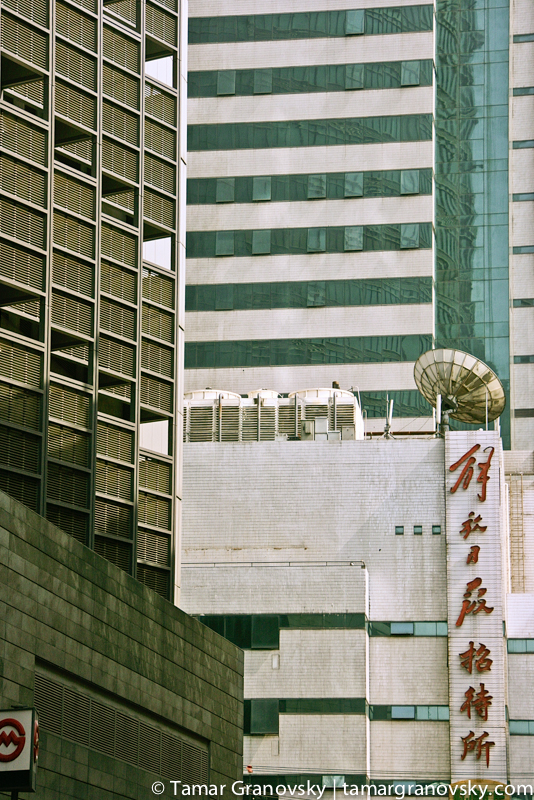
I arrived in Shanghai after a five hour bullet train ride from Beijing at 310 km/hr. The ride was so smooth and unlike the American Amtrak Acela train – it puts the U.S. rail to shame!. Shanghai is SO different from Beijing. Beijing is steeped in the past and Shanghai is about the present and future. Unlike the Beijing apartment complexes that are identical and look like they were just plopped down, Shanghai consists of apartment complexes of varying styles and skyscrapers of every size, shape, and material. This city has a very different feel from the nation’s capital.

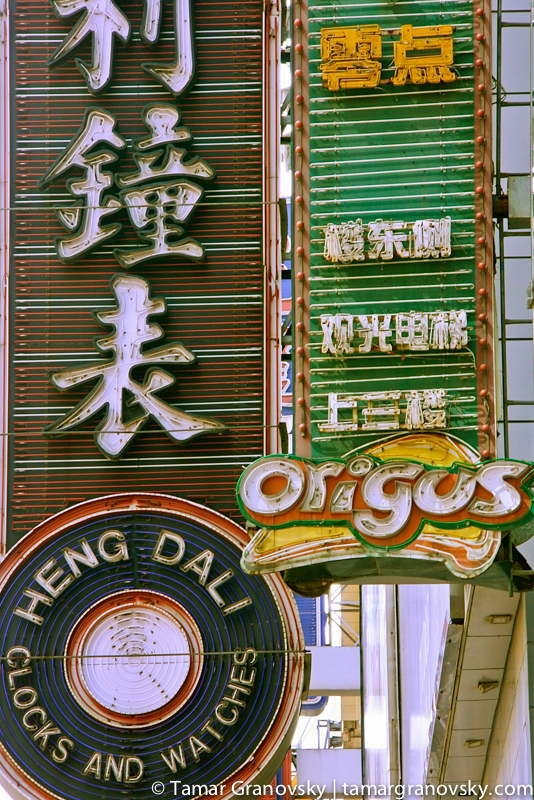
The first day I walked the Bund which is made up of buildings from colonial times. It was originally a towpath for barges – and barges galore still populate the Huangpu River. It was transformed into the banking area and the Bund is where the majority of art deco and neoclassical buildings were built in the early 20th century. Today, it is filled with fancy shmancy hotels and retail stores like Cartier. Across the river is the Pudong area where they have built, in the last 20 years or so, the futuristic part of Shanghai. This includes the site of the famous Oriental Pearl Tower. I also walked along Nanjing East Road which is a pedestrian mall with simple stores, primarily, but some fancier stores too, and Chinese delicacies and tourist shops. Nanjing East Road is where the first department stores in China were opened in the 1920s. There are still many neon signs from the bygone days that mingle with the contemporary shops.

Shanghai

Shanghai

I stayed with my new Italian friends, Laura and Luca, who I met in Yunnan Province and whose company I enjoyed very much. Their children, Vanni and Ada, are a pleasure and Luca has a great sense of humour. I spent time with Laura talking about the arts and exploring parts of the city when she could join me. I was so fortunate to have met such gracious and welcoming people. My whole 3.5 months in Asia, in fact, was virtually nothing but pure pleasure and wonderful people. I was very lucky.

One of the only sour notes was that on my first day out and about in Shanghai I was scammed. I kind of realised it was happening but I do believe that one tends to doubt oneself. And the funny thing is that I had approached these people. Had I not done so I would not have lost $320USD. I read in the guidebook, after the fact: Beware of English-speaking students asking you if you want to walk around and spend some time together and then wanting to take you to a tea house… Two days later I knew better when I was approached…

On a happier note, I took the time in Shanghai to go to a few museums: The Shanghai Museum and the Shanghai Jewish Refugee Museum. I tried to go to the Museum of Contemporary Art but they were closed and in between installations; that was a disappointment. I went to M50 where, unlike at the very vibrant Art Zone 798 in Beijing, I saw a lot of mediocre to bad art. There was though, one truly wonderful exhibition, “Across the Waibaidu“, at Island6 Gallery. I also spent time wandering The People’s Square and Park as well as the Yuyuan Gardens.

Shanghai

Shanghai

Shangai

Shanghai

I had the opportunity to dine with the brother of a friend and his girlfriend. In typical Chinese fashion they treated me to quite a feast and it was nice to get to know them a bit.

Shanghai

Shanghai

On my final day in Shanghai Laura and I went to the French Concession. As the Lonely Planet says: “Once home to the bulk of Shanghai’s adventures, revolutionaries, gangsters, prostitutes, and writers, the French Concession is the most graceful part of the city. Today a residential, retail and restaurant district with atmosphere tree-lined streets… The cream of Shanghai’s old residential buildings and art deco apartment blocks, hotels and edifices are preserved here… The district naturally tends toward gentrification, but it’s also a trendy and happening enclave, excellent for random exploration…..” The neighbourhood was excellent for walking and exploring and I was tempted into splurging a bit.

Shanghai, so different from Beijing. How I love Shanghai!